

7.4 Near-Threshold Behavior of Wave Functions
349
-0.4 -0.3 -0.2 -0.1
0
0.1 0.2 0.3
1
1.02
1.04
1.06
1.08
1.1
1.12
1.14
E (MeV)
S[0p
1/2 s
1/2 ]
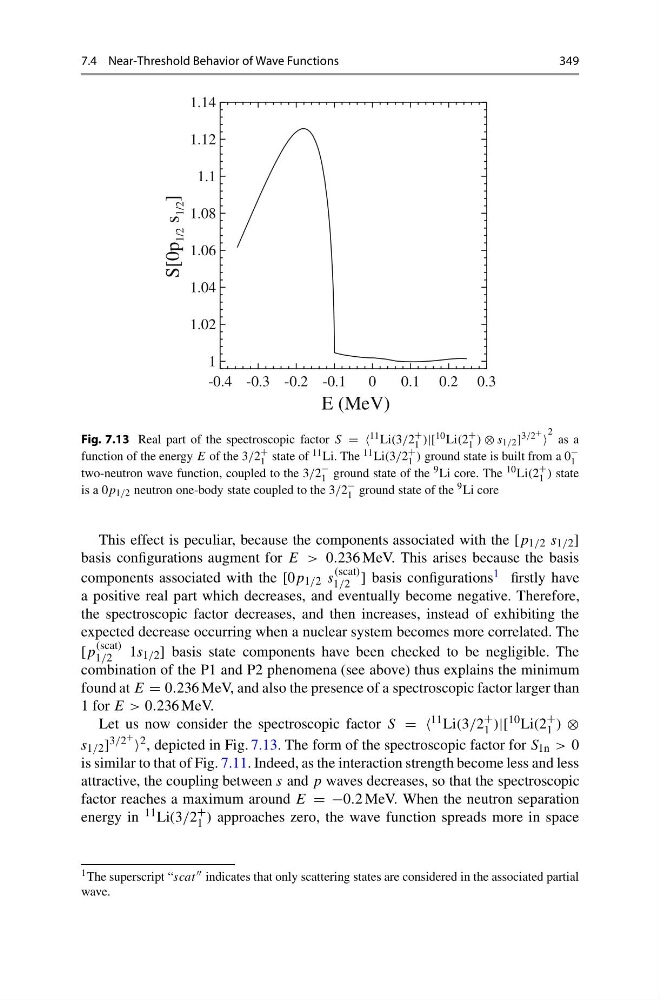
Fig. 7.13 Real part of the spectroscopic factor S = = 11 Li(3/2
+
1 )|[ 10 Li(2
+
1 ) ⊗ s 1/2 ] 3/2 +
2 as a
function of the energy E of the 3/2
+
1 state of 11 Li. The 11 Li(3/2
+
1 ) ground state is built from a 0
−
1
two-neutron wave function, coupled to the 3/2
−
1 ground state of the 9 Li core. The 10 Li(2
+
1 ) state
is a 0p 1/2 neutron one-body state coupled to the 3/2
−
1 ground state of the 9 Li core
This effect is peculiar, because the components associated with the [p 1/2 s 1/2 ]
basis configurations augment for E > 0.236 MeV. This arises because the basis
components associated with the [0p 1/2 s
(scat)
1/2 ] basis configurations 1 firstly have
a positive real part which decreases, and eventually become negative. Therefore,
the spectroscopic factor decreases, and then increases, instead of exhibiting the
expected decrease occurring when a nuclear system becomes more correlated. The
[p
(scat)
1/2
1s 1/2 ] basis state components have been checked to be negligible. The
combination of the P1 and P2 phenomena (see above) thus explains the minimum
found at E = 0.236 MeV, and also the presence of a spectroscopic factor larger than
1 for E > 0.236 MeV.
Let us now consider the spectroscopic factor S = = 11 Li(3/2
+
1 )|[ 10 Li(2
+
1 ) ⊗
s 1/2 ] 3/2 + 2 , depicted in Fig. 7.13. The form of the spectroscopic factor for S 1n > 0
is similar to that of Fig. 7.11. Indeed, as the interaction strength become less and less
attractive, the coupling between s and p waves decreases, so that the spectroscopic
factor reaches a maximum around E = −0.2 MeV. When the neutron separation
energy in 11 Li(3/2
+
1 ) approaches zero, the wave function spreads more in space
1 The superscript “scat indicates that only scattering states are considered in the associated partial
wave.
349
-0.4 -0.3 -0.2 -0.1
0
0.1 0.2 0.3
1
1.02
1.04
1.06
1.08
1.1
1.12
1.14
E (MeV)
S[0p
1/2 s
1/2 ]
Fig. 7.13 Real part of the spectroscopic factor S = = 11 Li(3/2
+
1 )|[ 10 Li(2
+
1 ) ⊗ s 1/2 ] 3/2 +
2 as a
function of the energy E of the 3/2
+
1 state of 11 Li. The 11 Li(3/2
+
1 ) ground state is built from a 0
−
1
two-neutron wave function, coupled to the 3/2
−
1 ground state of the 9 Li core. The 10 Li(2
+
1 ) state
is a 0p 1/2 neutron one-body state coupled to the 3/2
−
1 ground state of the 9 Li core
This effect is peculiar, because the components associated with the [p 1/2 s 1/2 ]
basis configurations augment for E > 0.236 MeV. This arises because the basis
components associated with the [0p 1/2 s
(scat)
1/2 ] basis configurations 1 firstly have
a positive real part which decreases, and eventually become negative. Therefore,
the spectroscopic factor decreases, and then increases, instead of exhibiting the
expected decrease occurring when a nuclear system becomes more correlated. The
[p
(scat)
1/2
1s 1/2 ] basis state components have been checked to be negligible. The
combination of the P1 and P2 phenomena (see above) thus explains the minimum
found at E = 0.236 MeV, and also the presence of a spectroscopic factor larger than
1 for E > 0.236 MeV.
Let us now consider the spectroscopic factor S = = 11 Li(3/2
+
1 )|[ 10 Li(2
+
1 ) ⊗
s 1/2 ] 3/2 + 2 , depicted in Fig. 7.13. The form of the spectroscopic factor for S 1n > 0
is similar to that of Fig. 7.11. Indeed, as the interaction strength become less and less
attractive, the coupling between s and p waves decreases, so that the spectroscopic
factor reaches a maximum around E = −0.2 MeV. When the neutron separation
energy in 11 Li(3/2
+
1 ) approaches zero, the wave function spreads more in space
1 The superscript “scat indicates that only scattering states are considered in the associated partial
wave.