

348
7 Wave Functions in the Vicinity of Particle-Emission Threshold
-0.4 -0.3 -0.2 -0.1
0
0.1 0.2 0.3
0.8
0.85
0.9
0.95
1
1.05
1.1
E (MeV)
S[1s
1/2 p
1/2 ]
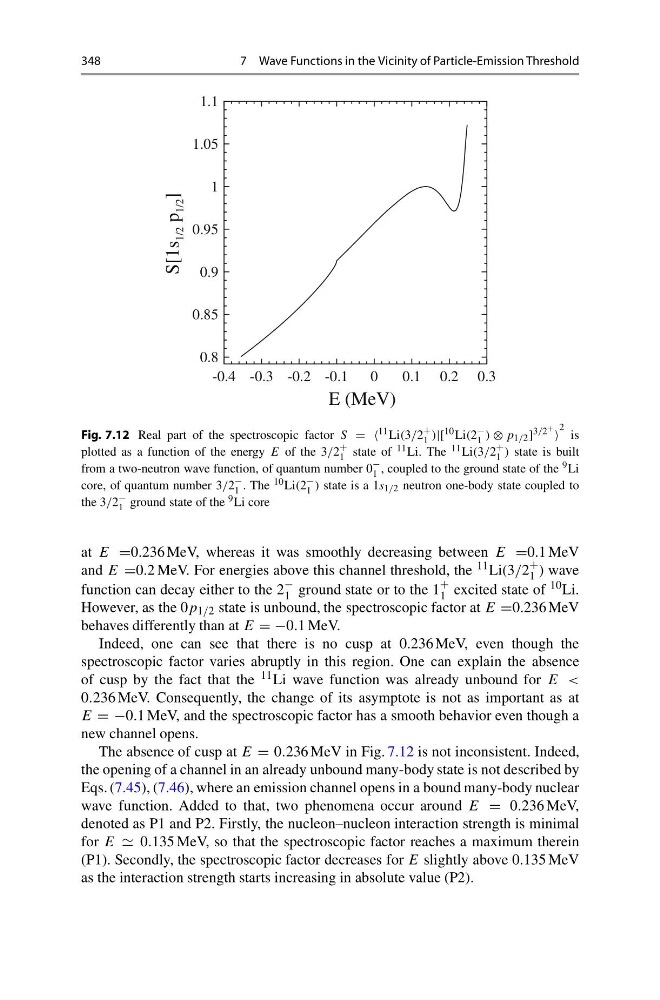
Fig. 7.12 Real part of the spectroscopic factor S = = 11 Li(3/2
+
1 )|[ 10 Li(2
−
1 ) ⊗ p 1/2 ] 3/2 +
2 is
plotted as a function of the energy E of the 3/2
+
1 state of 11 Li. The 11 Li(3/2
+
1 ) state is built
from a two-neutron wave function, of quantum number 0
−
1 , coupled to the ground state of the 9 Li
core, of quantum number 3/2
−
1 . The 10 Li(2
−
1 ) state is a 1s 1/2 neutron one-body state coupled to
the 3/2
−
1 ground state of the 9 Li core
at E =0.236 MeV, whereas it was smoothly decreasing between E =0.1 MeV
and E =0.2 MeV. For energies above this channel threshold, the 11 Li(3/2
+
1 ) wave
function can decay either to the 2
−
1 ground state or to the 1
+
1 excited state of 10 Li.
However, as the 0p 1/2 state is unbound, the spectroscopic factor at E =0.236 MeV
behaves differently than at E = −0.1 MeV.
Indeed, one can see that there is no cusp at 0.236 MeV, even though the
spectroscopic factor varies abruptly in this region. One can explain the absence
of cusp by the fact that the 11 Li wave function was already unbound for E <
0.236 MeV. Consequently, the change of its asymptote is not as important as at
E = −0.1 MeV, and the spectroscopic factor has a smooth behavior even though a
new channel opens.
The absence of cusp at E = 0.236 MeV in Fig. 7.12 is not inconsistent. Indeed,
the opening of a channel in an already unbound many-body state is not described by
Eqs. (7.45), (7.46), where an emission channel opens in a bound many-body nuclear
wave function. Added to that, two phenomena occur around E = 0.236 MeV,
denoted as P1 and P2. Firstly, the nucleon–nucleon interaction strength is minimal
for E 0.135 MeV, so that the spectroscopic factor reaches a maximum therein
(P1). Secondly, the spectroscopic factor decreases for E slightly above 0.135 MeV
as the interaction strength starts increasing in absolute value (P2).
7 Wave Functions in the Vicinity of Particle-Emission Threshold
-0.4 -0.3 -0.2 -0.1
0
0.1 0.2 0.3
0.8
0.85
0.9
0.95
1
1.05
1.1
E (MeV)
S[1s
1/2 p
1/2 ]
Fig. 7.12 Real part of the spectroscopic factor S = = 11 Li(3/2
+
1 )|[ 10 Li(2
−
1 ) ⊗ p 1/2 ] 3/2 +
2 is
plotted as a function of the energy E of the 3/2
+
1 state of 11 Li. The 11 Li(3/2
+
1 ) state is built
from a two-neutron wave function, of quantum number 0
−
1 , coupled to the ground state of the 9 Li
core, of quantum number 3/2
−
1 . The 10 Li(2
−
1 ) state is a 1s 1/2 neutron one-body state coupled to
the 3/2
−
1 ground state of the 9 Li core
at E =0.236 MeV, whereas it was smoothly decreasing between E =0.1 MeV
and E =0.2 MeV. For energies above this channel threshold, the 11 Li(3/2
+
1 ) wave
function can decay either to the 2
−
1 ground state or to the 1
+
1 excited state of 10 Li.
However, as the 0p 1/2 state is unbound, the spectroscopic factor at E =0.236 MeV
behaves differently than at E = −0.1 MeV.
Indeed, one can see that there is no cusp at 0.236 MeV, even though the
spectroscopic factor varies abruptly in this region. One can explain the absence
of cusp by the fact that the 11 Li wave function was already unbound for E <
0.236 MeV. Consequently, the change of its asymptote is not as important as at
E = −0.1 MeV, and the spectroscopic factor has a smooth behavior even though a
new channel opens.
The absence of cusp at E = 0.236 MeV in Fig. 7.12 is not inconsistent. Indeed,
the opening of a channel in an already unbound many-body state is not described by
Eqs. (7.45), (7.46), where an emission channel opens in a bound many-body nuclear
wave function. Added to that, two phenomena occur around E = 0.236 MeV,
denoted as P1 and P2. Firstly, the nucleon–nucleon interaction strength is minimal
for E 0.135 MeV, so that the spectroscopic factor reaches a maximum therein
(P1). Secondly, the spectroscopic factor decreases for E slightly above 0.135 MeV
as the interaction strength starts increasing in absolute value (P2).