

7.2 Halo Nuclei
327
structures. The nature of halo states is more complicated in the deformed case than
in the spherical case. This can be seen by expanding a one-body deformed state
using a partial wave decomposition. Indeed, only partial waves of orbital momentum
equal to = 0, 1 can generate halos (see Sect. 7.2.1.1). Thus, a one-body deformed
halo state is typically a mixture of partial wave components of halo and localized
structure. It can also happen that the core and weakly bound nucleons are decoupled
so that the deformation of the core and of the nucleons forming the halo can be
different [57].
In order to illustrate the basic features of halos in deformed nuclei, we will
consider in this section the main features of axially deformed neutron halo states
(see also Ref. [57] for more detailed studies and numerical applications). As one
has already considered the near-threshold properties of a nucleon in a spherical
potential, it is convenient to expand deformed one-body states in a partial wave:
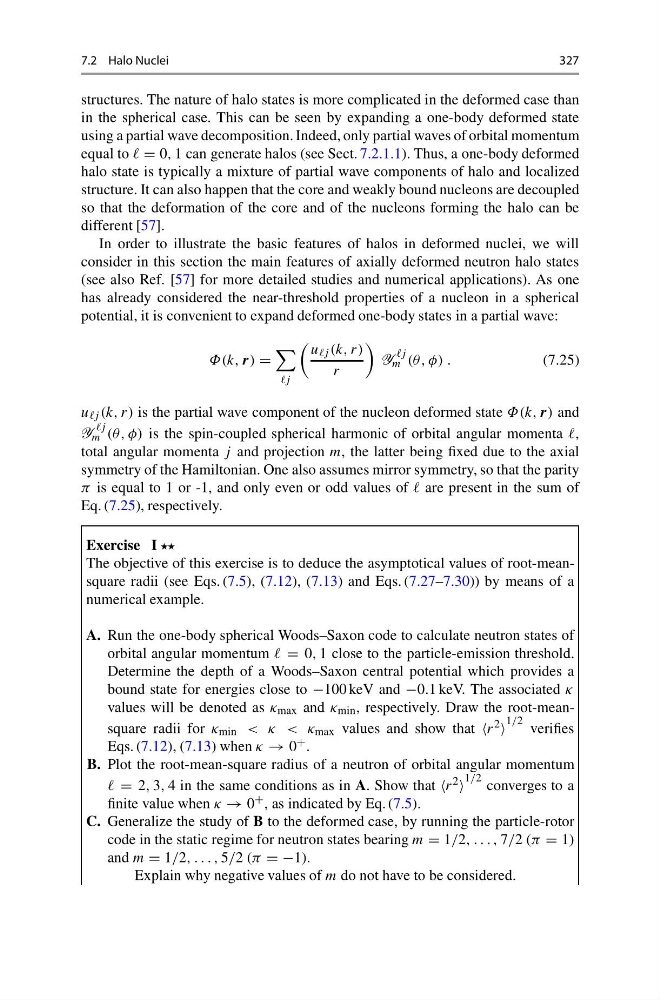
Φ(k, r) =
u j (k, r)
r
Y
m (θ, φ) .
(7.25)
u j (k, r) is the partial wave component of the nucleon deformed state Φ(k, r) and
Y
m (θ, φ) is the spin-coupled spherical harmonic of orbital angular momenta
total angular momenta j and projection m, the latter being fixed due to the axial
symmetry of the Hamiltonian. One also assumes mirror symmetry, so that the parity
π is equal to 1 or -1, and only even or odd values of are present in the sum of
Eq. (7.25), respectively.
Exercise I
The objective of this exercise is to deduce the asymptotical values of root-meansquare radii (see Eqs. (7.5), (7.12), (7.13) and Eqs. (7.27–7.30)) by means of a
numerical example.
A. Run the one-body spherical Woods–Saxon code to calculate neutron states of
orbital angular momentum = 0, 1 close to the particle-emission threshold.
Determine the depth of a Woods–Saxon central potential which provides a
bound state for energies close to −100 keV and −0.1 keV. The associated κ
values will be denoted as κ max and κ min , respectively. Draw the root-meansquare radii for κ min < κ < κ max values and show that 2
1/2 verifies
Eqs. (7.12), (7.13) when κ → 0 + .
B. Plot the root-mean-square radius of a neutron of orbital angular momentum
= 2, 3, 4 in the same conditions as in A. Show that 2
1/2 converges to a
finite value when κ → 0 + , as indicated by Eq. (7.5).
C. Generalize the study of B to the deformed case, by running the particle-rotor
code in the static regime for neutron states bearing m = 1/2, . . . , 7/2 (π = 1)
and m = 1/2, . . . , 5/2 (π = −1).
Explain why negative values of m do not have to be considered.
327
structures. The nature of halo states is more complicated in the deformed case than
in the spherical case. This can be seen by expanding a one-body deformed state
using a partial wave decomposition. Indeed, only partial waves of orbital momentum
equal to = 0, 1 can generate halos (see Sect. 7.2.1.1). Thus, a one-body deformed
halo state is typically a mixture of partial wave components of halo and localized
structure. It can also happen that the core and weakly bound nucleons are decoupled
so that the deformation of the core and of the nucleons forming the halo can be
different [57].
In order to illustrate the basic features of halos in deformed nuclei, we will
consider in this section the main features of axially deformed neutron halo states
(see also Ref. [57] for more detailed studies and numerical applications). As one
has already considered the near-threshold properties of a nucleon in a spherical
potential, it is convenient to expand deformed one-body states in a partial wave:
Φ(k, r) =
u j (k, r)
r
Y
m (θ, φ) .
(7.25)
u j (k, r) is the partial wave component of the nucleon deformed state Φ(k, r) and
Y
m (θ, φ) is the spin-coupled spherical harmonic of orbital angular momenta
total angular momenta j and projection m, the latter being fixed due to the axial
symmetry of the Hamiltonian. One also assumes mirror symmetry, so that the parity
π is equal to 1 or -1, and only even or odd values of are present in the sum of
Eq. (7.25), respectively.
Exercise I
The objective of this exercise is to deduce the asymptotical values of root-meansquare radii (see Eqs. (7.5), (7.12), (7.13) and Eqs. (7.27–7.30)) by means of a
numerical example.
A. Run the one-body spherical Woods–Saxon code to calculate neutron states of
orbital angular momentum = 0, 1 close to the particle-emission threshold.
Determine the depth of a Woods–Saxon central potential which provides a
bound state for energies close to −100 keV and −0.1 keV. The associated κ
values will be denoted as κ max and κ min , respectively. Draw the root-meansquare radii for κ min < κ < κ max values and show that 2
1/2 verifies
Eqs. (7.12), (7.13) when κ → 0 + .
B. Plot the root-mean-square radius of a neutron of orbital angular momentum
= 2, 3, 4 in the same conditions as in A. Show that 2
1/2 converges to a
finite value when κ → 0 + , as indicated by Eq. (7.5).
C. Generalize the study of B to the deformed case, by running the particle-rotor
code in the static regime for neutron states bearing m = 1/2, . . . , 7/2 (π = 1)
and m = 1/2, . . . , 5/2 (π = −1).
Explain why negative values of m do not have to be considered.