

326
7 Wave Functions in the Vicinity of Particle-Emission Threshold
2Tz
0
0.5
1.0
1.5
0
10
20
3
4
5
6
7
8
9
Z a
2Tz
-3
-2
-1
0
1
2
3
4
p-shell
=1
0.3
1
5
0.0
1
10
100
8
10 12 14 16 18 20
Z a
-3 -2 -1 1 3 7 8
sd-shell
=2
1j
(fm -1/2
)
η
β
crit
η
crit
η
crit
β
crit
β
1j
(fm -1/2
)
η
β
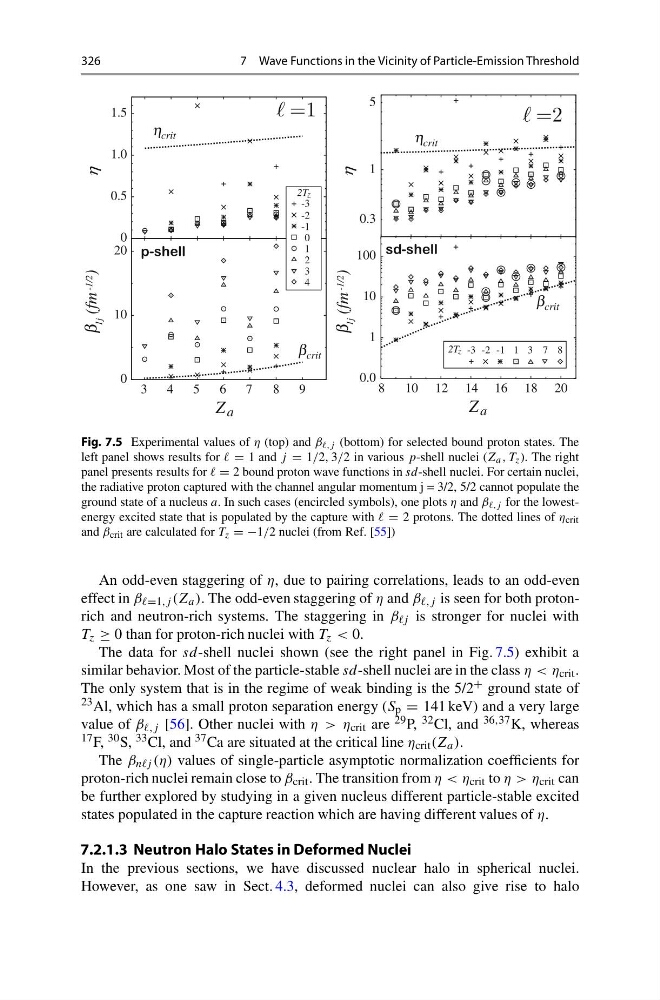
Fig. 7.5 Experimental values of η (top) and β ,j (bottom) for selected bound proton states. The
left panel shows results for = 1 and j = 1/2, 3/2 in various p-shell nuclei (Z a , T z ). The right
panel presents results for = 2 bound proton wave functions in sd-shell nuclei. For certain nuclei,
the radiative proton captured with the channel angular momentum j = 3/2, 5/2 cannot populate the
ground state of a nucleus a. In such cases (encircled symbols), one plots η and β ,j for the lowestenergy excited state that is populated by the capture with = 2 protons. The dotted lines of η crit
and β crit are calculated for T z = −1/2 nuclei (from Ref. [55])
An odd-even staggering of η, due to pairing correlations, leads to an odd-even
effect in β (Z a ). The odd-even staggering of η and β ,j is seen for both protonrich and neutron-rich systems. The staggering in β j is stronger for nuclei with
T z ≥ 0 than for proton-rich nuclei with T z < 0.
The data for sd-shell nuclei shown (see the right panel in Fig. 7.5) exhibit a
similar behavior. Most of the particle-stable sd-shell nuclei are in the class η < η crit .
The only system that is in the regime of weak binding is the 5/2 + ground state of
23 Al, which has a small proton separation energy (S p = 141 keV) and a very large
value of β [56]. Other nuclei with η > η crit are 29 P, 32 Cl, and 36,37 K, whereas
17 F, 30 S, 33 Cl, and 37 Ca are situated at the critical line η crit (Z a ).
The β nnj (η) values of single-particle asymptotic normalization coefficients for
proton-rich nuclei remain close to β crit . The transition from η < η crit to η > η crit can
be further explored by studying in a given nucleus different particle-stable excited
states populated in the capture reaction which are having different values of η.
7.2.1.3 Neutron Halo States in Deformed Nuclei
In the previous sections, we have discussed nuclear halo in spherical nuclei.
However, as one saw in Sect. 4.3, deformed nuclei can also give rise to halo
7 Wave Functions in the Vicinity of Particle-Emission Threshold
2Tz
0
0.5
1.0
1.5
0
10
20
3
4
5
6
7
8
9
Z a
2Tz
-3
-2
-1
0
1
2
3
4
p-shell
=1
0.3
1
5
0.0
1
10
100
8
10 12 14 16 18 20
Z a
-3 -2 -1 1 3 7 8
sd-shell
=2
1j
(fm -1/2
)
η
β
crit
η
crit
η
crit
β
crit
β
1j
(fm -1/2
)
η
β
Fig. 7.5 Experimental values of η (top) and β ,j (bottom) for selected bound proton states. The
left panel shows results for = 1 and j = 1/2, 3/2 in various p-shell nuclei (Z a , T z ). The right
panel presents results for = 2 bound proton wave functions in sd-shell nuclei. For certain nuclei,
the radiative proton captured with the channel angular momentum j = 3/2, 5/2 cannot populate the
ground state of a nucleus a. In such cases (encircled symbols), one plots η and β ,j for the lowestenergy excited state that is populated by the capture with = 2 protons. The dotted lines of η crit
and β crit are calculated for T z = −1/2 nuclei (from Ref. [55])
An odd-even staggering of η, due to pairing correlations, leads to an odd-even
effect in β (Z a ). The odd-even staggering of η and β ,j is seen for both protonrich and neutron-rich systems. The staggering in β j is stronger for nuclei with
T z ≥ 0 than for proton-rich nuclei with T z < 0.
The data for sd-shell nuclei shown (see the right panel in Fig. 7.5) exhibit a
similar behavior. Most of the particle-stable sd-shell nuclei are in the class η < η crit .
The only system that is in the regime of weak binding is the 5/2 + ground state of
23 Al, which has a small proton separation energy (S p = 141 keV) and a very large
value of β [56]. Other nuclei with η > η crit are 29 P, 32 Cl, and 36,37 K, whereas
17 F, 30 S, 33 Cl, and 37 Ca are situated at the critical line η crit (Z a ).
The β nnj (η) values of single-particle asymptotic normalization coefficients for
proton-rich nuclei remain close to β crit . The transition from η < η crit to η > η crit can
be further explored by studying in a given nucleus different particle-stable excited
states populated in the capture reaction which are having different values of η.
7.2.1.3 Neutron Halo States in Deformed Nuclei
In the previous sections, we have discussed nuclear halo in spherical nuclei.
However, as one saw in Sect. 4.3, deformed nuclei can also give rise to halo