

320
7 Wave Functions in the Vicinity of Particle-Emission Threshold
where A is a normalization constant. The root-mean-square radius of u(k = 0, r)
is finite, as r 2 u(k = 0, r) 2 = O(r −2 ) for r → +∞, so that r 2 u(k = 0, r) 2 is
integrable.
A useful inequality verified by the root-mean-square radius when ≥ 2 can
be obtained if one assumes that the Woods–Saxon potential mimicking the core
potential vanishes after R 0 + 2d, with R 0 the radius of the Woods–Saxon potential
and d its diffuseness. Indeed, the Woods–Saxon potential is smaller than 12% of its
maximal value for r > R 0 + 2d, which is sufficient to devise a qualitative estimate.
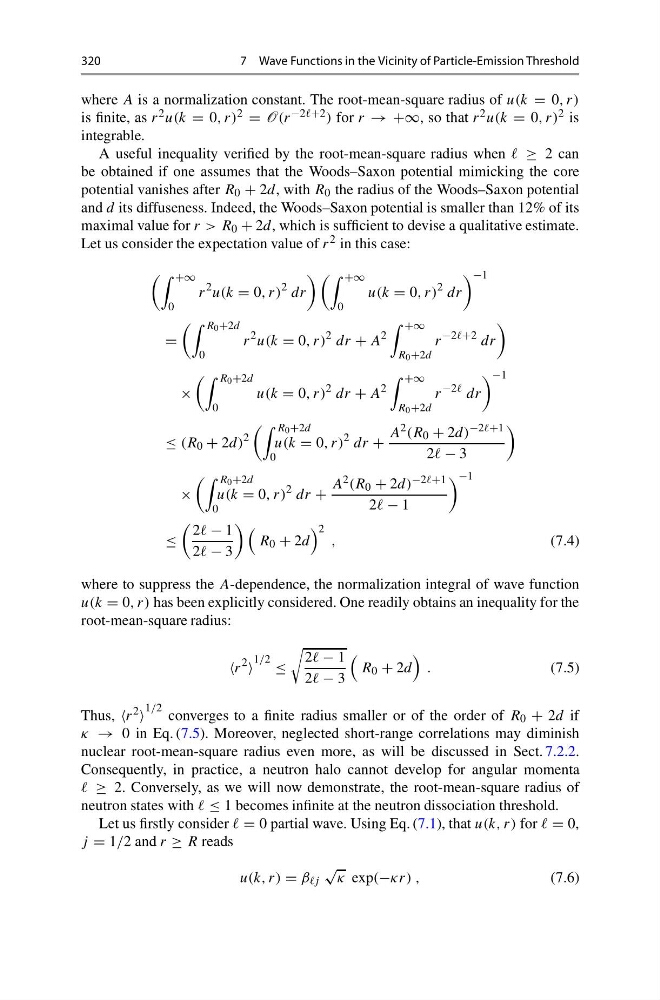
Let us consider the expectation value of r 2 in this case:
+∞
0
r
2 u(k = 0, r)
2 dr
+∞
0
u(k = 0, r)
2 dr
−1
=
R 0 +2d
0
r
2 u(k = 0, r)
2 dr + A
2
+∞
R 0 +2d
r
−2 dr
×
R 0 +2d
0
u(k = 0, r)
2 dr + A
2
+∞
R 0 +2d
r
−2 dr
−1
≤ (R 0 + 2d)
2
R 0 +2d
0
u(k = 0, r)
2 dr +
A 2 (R 0 + 2d) −2
2 − 3
×
R 0 +2d
0
u(k = 0, r)
2 dr +
A 2 (R 0 + 2d) −2
2 − 1
−1
≤
2 − 1
2 − 3
R 0 + 2d
2
,
(7.4)
where to suppress the A-dependence, the normalization integral of wave function
u(k = 0, r) has been explicitly considered. One readily obtains an inequality for the
root-mean-square radius:
2
1/2 ≤
2 − 1
2 − 3
R 0 + 2d
.
(7.5)
Thus, 2
1/2 converges to a finite radius smaller or of the order of R 0 + 2d if
κ → 0 in Eq. (7.5). Moreover, neglected short-range correlations may diminish
nuclear root-mean-square radius even more, as will be discussed in Sect. 7.2.2.
Consequently, in practice, a neutron halo cannot develop for angular momenta
≥ 2. Conversely, as we will now demonstrate, the root-mean-square radius of
neutron states with ≤ 1 becomes infinite at the neutron dissociation threshold.
Let us firstly consider = 0 partial wave. Using Eq. (7.1), that u(k, r) for = 0,
j = 1/2 and r ≥ R reads
u(k, r) = β
√
κ exp(−κr) ,
(7.6)
7 Wave Functions in the Vicinity of Particle-Emission Threshold
where A is a normalization constant. The root-mean-square radius of u(k = 0, r)
is finite, as r 2 u(k = 0, r) 2 = O(r −2 ) for r → +∞, so that r 2 u(k = 0, r) 2 is
integrable.
A useful inequality verified by the root-mean-square radius when ≥ 2 can
be obtained if one assumes that the Woods–Saxon potential mimicking the core
potential vanishes after R 0 + 2d, with R 0 the radius of the Woods–Saxon potential
and d its diffuseness. Indeed, the Woods–Saxon potential is smaller than 12% of its
maximal value for r > R 0 + 2d, which is sufficient to devise a qualitative estimate.
Let us consider the expectation value of r 2 in this case:
+∞
0
r
2 u(k = 0, r)
2 dr
+∞
0
u(k = 0, r)
2 dr
−1
=
R 0 +2d
0
r
2 u(k = 0, r)
2 dr + A
2
+∞
R 0 +2d
r
−2 dr
×
R 0 +2d
0
u(k = 0, r)
2 dr + A
2
+∞
R 0 +2d
r
−2 dr
−1
≤ (R 0 + 2d)
2
R 0 +2d
0
u(k = 0, r)
2 dr +
A 2 (R 0 + 2d) −2
2 − 3
×
R 0 +2d
0
u(k = 0, r)
2 dr +
A 2 (R 0 + 2d) −2
2 − 1
−1
≤
2 − 1
2 − 3
R 0 + 2d
2
,
(7.4)
where to suppress the A-dependence, the normalization integral of wave function
u(k = 0, r) has been explicitly considered. One readily obtains an inequality for the
root-mean-square radius:
2
1/2 ≤
2 − 1
2 − 3
R 0 + 2d
.
(7.5)
Thus, 2
1/2 converges to a finite radius smaller or of the order of R 0 + 2d if
κ → 0 in Eq. (7.5). Moreover, neglected short-range correlations may diminish
nuclear root-mean-square radius even more, as will be discussed in Sect. 7.2.2.
Consequently, in practice, a neutron halo cannot develop for angular momenta
≥ 2. Conversely, as we will now demonstrate, the root-mean-square radius of
neutron states with ≤ 1 becomes infinite at the neutron dissociation threshold.
Let us firstly consider = 0 partial wave. Using Eq. (7.1), that u(k, r) for = 0,
j = 1/2 and r ≥ R reads
u(k, r) = β
√
κ exp(−κr) ,
(7.6)