

7.2 Halo Nuclei
319
square radius, of 50 Å [50], while that of the 4 He 2 − 3 He trimer is relatively smaller,
of 13 Å [50]. Spin-polarized triton is also suspected to form halos [53]. We have seen
in Sect. 4.3 that electron halos can be found in multipolar anions, where extended
electronic wave functions develop close to the detachment threshold.
7.2.1 Halo States in a Single-Particle Potential
The simplest model which can be used to describe halo configuration is that of
a spherical potential, mimicking a well-bound core, with which a loosely bound
proton or neutron interact. This model discards nucleon - nucleon correlations, but
is useful to identify the partial waves which can give rise to the halo structure. Due
to the confinement induced by the centrifugal barrier, a neutron halo can develop if
the partial waves of lowest angular momentum are mainly occupied. Proton halos
are also expected to occur in light nuclei. Indeed, the Coulomb barrier has to be
sufficiently small not to confine protons inside the nuclear zone. Moreover, like in
the case of neutron halo, low angular momentum partial waves should be mainly
involved in proton halo.
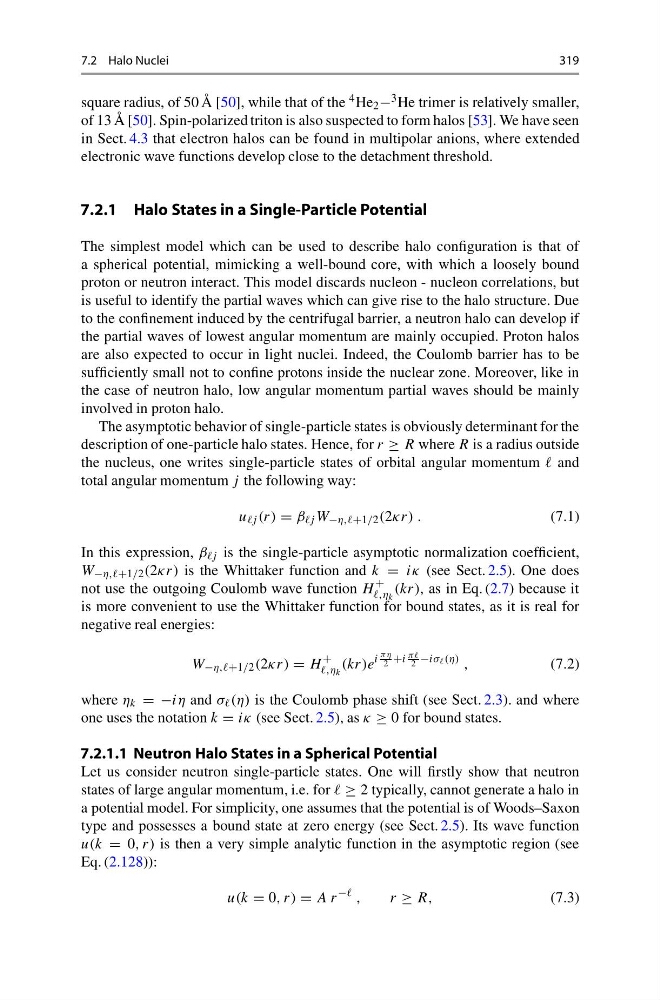
The asymptotic behavior of single-particle states is obviously determinant for the
description of one-particle halo states. Hence, for r ≥ R where R is a radius outside
the nucleus, one writes single-particle states of orbital angular momentum and
total angular momentum j the following way:
u j (r) = β W −η,,+1/2 (2κr) .
(7.1)
In this expression, β j is the single-particle asymptotic normalization coefficient,
W −η,,+1/2 (2κr) is the Whittaker function and k = iκ (see Sect. 2.5). One does
not use the outgoing Coulomb wave function H
+
,η k
(kr), as in Eq. (2.7) because it
is more convenient to use the Whittaker function for bound states, as it is real for
negative real energies:
W −η,,+1/2 (2κr) = H
+
k
(kr)e
i
πη
2 +i
ππ
2 −iσ (η) ,
(7.2)
where η k = −iη and σ (η) is the Coulomb phase shift (see Sect. 2.3). and where
one uses the notation k = iκ (see Sect. 2.5), as κ ≥ 0 for bound states.
7.2.1.1 Neutron Halo States in a Spherical Potential
Let us consider neutron single-particle states. One will firstly show that neutron
states of large angular momentum, i.e. for ≥ 2 typically, cannot generate a halo in
a potential model. For simplicity, one assumes that the potential is of Woods–Saxon
type and possesses a bound state at zero energy (see Sect. 2.5). Its wave function
u(k = 0, r) is then a very simple analytic function in the asymptotic region (see
Eq. (2.128)):
u(k = 0, r) = A r
− ,
r ≥ R,
(7.3)
319
square radius, of 50 Å [50], while that of the 4 He 2 − 3 He trimer is relatively smaller,
of 13 Å [50]. Spin-polarized triton is also suspected to form halos [53]. We have seen
in Sect. 4.3 that electron halos can be found in multipolar anions, where extended
electronic wave functions develop close to the detachment threshold.
7.2.1 Halo States in a Single-Particle Potential
The simplest model which can be used to describe halo configuration is that of
a spherical potential, mimicking a well-bound core, with which a loosely bound
proton or neutron interact. This model discards nucleon - nucleon correlations, but
is useful to identify the partial waves which can give rise to the halo structure. Due
to the confinement induced by the centrifugal barrier, a neutron halo can develop if
the partial waves of lowest angular momentum are mainly occupied. Proton halos
are also expected to occur in light nuclei. Indeed, the Coulomb barrier has to be
sufficiently small not to confine protons inside the nuclear zone. Moreover, like in
the case of neutron halo, low angular momentum partial waves should be mainly
involved in proton halo.
The asymptotic behavior of single-particle states is obviously determinant for the
description of one-particle halo states. Hence, for r ≥ R where R is a radius outside
the nucleus, one writes single-particle states of orbital angular momentum and
total angular momentum j the following way:
u j (r) = β W −η,,+1/2 (2κr) .
(7.1)
In this expression, β j is the single-particle asymptotic normalization coefficient,
W −η,,+1/2 (2κr) is the Whittaker function and k = iκ (see Sect. 2.5). One does
not use the outgoing Coulomb wave function H
+
,η k
(kr), as in Eq. (2.7) because it
is more convenient to use the Whittaker function for bound states, as it is real for
negative real energies:
W −η,,+1/2 (2κr) = H
+
k
(kr)e
i
πη
2 +i
ππ
2 −iσ (η) ,
(7.2)
where η k = −iη and σ (η) is the Coulomb phase shift (see Sect. 2.3). and where
one uses the notation k = iκ (see Sect. 2.5), as κ ≥ 0 for bound states.
7.2.1.1 Neutron Halo States in a Spherical Potential
Let us consider neutron single-particle states. One will firstly show that neutron
states of large angular momentum, i.e. for ≥ 2 typically, cannot generate a halo in
a potential model. For simplicity, one assumes that the potential is of Woods–Saxon
type and possesses a bound state at zero energy (see Sect. 2.5). Its wave function
u(k = 0, r) is then a very simple analytic function in the asymptotic region (see
Eq. (2.128)):
u(k = 0, r) = A r
− ,
r ≥ R,
(7.3)