

316
7 Wave Functions in the Vicinity of Particle-Emission Threshold
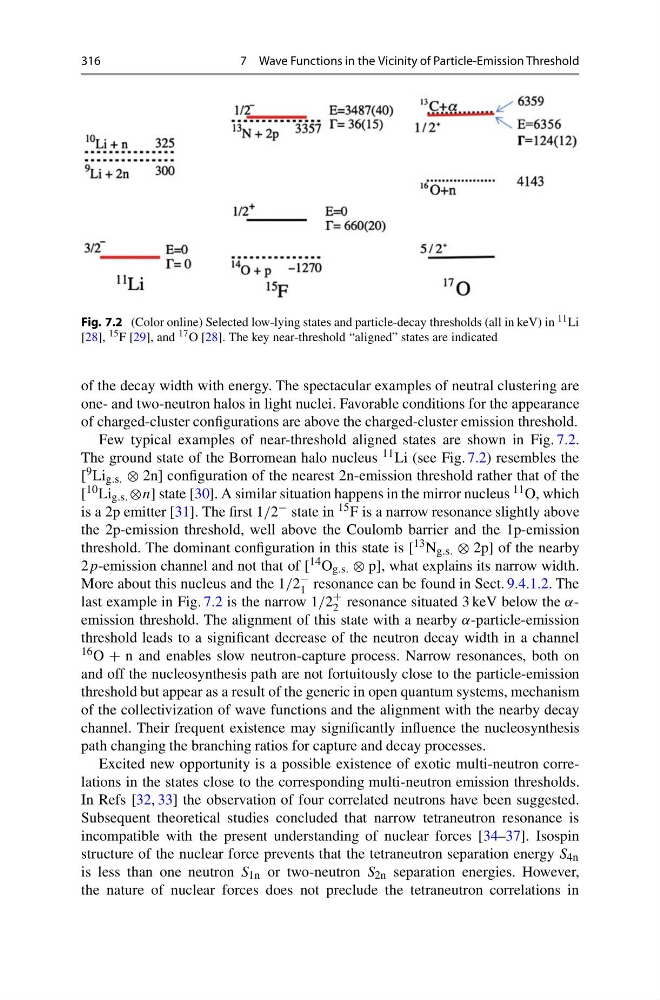
Fig. 7.2 (Color online) Selected low-lying states and particle-decay thresholds (all in keV) in 11 Li
[28], 15 F [29], and 17 O [28]. The key near-threshold “aligned” states are indicated
of the decay width with energy. The spectacular examples of neutral clustering are
one- and two-neutron halos in light nuclei. Favorable conditions for the appearance
of charged-cluster configurations are above the charged-cluster emission threshold.
Few typical examples of near-threshold aligned states are shown in Fig. 7.2.
The ground state of the Borromean halo nucleus 11 Li (see Fig. 7.2) resembles the
[ 9 Li g.s. ⊗ 2n] configuration of the nearest 2n-emission threshold rather that of the
[ 10 Li g.s. ⊗n] state [30]. A similar situation happens in the mirror nucleus 11 O, which
is a 2p emitter [31]. The first 1/2 − state in 15 F is a narrow resonance slightly above
the 2p-emission threshold, well above the Coulomb barrier and the 1p-emission
threshold. The dominant configuration in this state is [ 13 N g.s. ⊗ 2p] of the nearby
2p-emission channel and not that of [ 14 O g.s. ⊗ p], what explains its narrow width.
More about this nucleus and the 1/2
−
1 resonance can be found in Sect. 9.4.1.2. The
last example in Fig. 7.2 is the narrow 1/2
+
2 resonance situated 3 keV below the αemission threshold. The alignment of this state with a nearby α-particle-emission
threshold leads to a significant decrease of the neutron decay width in a channel
16 O + n and enables slow neutron-capture process. Narrow resonances, both on
and off the nucleosynthesis path are not fortuitously close to the particle-emission
threshold but appear as a result of the generic in open quantum systems, mechanism
of the collectivization of wave functions and the alignment with the nearby decay
channel. Their frequent existence may significantly influence the nucleosynthesis
path changing the branching ratios for capture and decay processes.
Excited new opportunity is a possible existence of exotic multi-neutron correlations in the states close to the corresponding multi-neutron emission thresholds.
In Refs [32, 33] the observation of four correlated neutrons have been suggested.
Subsequent theoretical studies concluded that narrow tetraneutron resonance is
incompatible with the present understanding of nuclear forces [34–37]. Isospin
structure of the nuclear force prevents that the tetraneutron separation energy S 4n
is less than one neutron S 1n or two-neutron S 2n separation energies. However,
the nature of nuclear forces does not preclude the tetraneutron correlations in
7 Wave Functions in the Vicinity of Particle-Emission Threshold
Fig. 7.2 (Color online) Selected low-lying states and particle-decay thresholds (all in keV) in 11 Li
[28], 15 F [29], and 17 O [28]. The key near-threshold “aligned” states are indicated
of the decay width with energy. The spectacular examples of neutral clustering are
one- and two-neutron halos in light nuclei. Favorable conditions for the appearance
of charged-cluster configurations are above the charged-cluster emission threshold.
Few typical examples of near-threshold aligned states are shown in Fig. 7.2.
The ground state of the Borromean halo nucleus 11 Li (see Fig. 7.2) resembles the
[ 9 Li g.s. ⊗ 2n] configuration of the nearest 2n-emission threshold rather that of the
[ 10 Li g.s. ⊗n] state [30]. A similar situation happens in the mirror nucleus 11 O, which
is a 2p emitter [31]. The first 1/2 − state in 15 F is a narrow resonance slightly above
the 2p-emission threshold, well above the Coulomb barrier and the 1p-emission
threshold. The dominant configuration in this state is [ 13 N g.s. ⊗ 2p] of the nearby
2p-emission channel and not that of [ 14 O g.s. ⊗ p], what explains its narrow width.
More about this nucleus and the 1/2
−
1 resonance can be found in Sect. 9.4.1.2. The
last example in Fig. 7.2 is the narrow 1/2
+
2 resonance situated 3 keV below the αemission threshold. The alignment of this state with a nearby α-particle-emission
threshold leads to a significant decrease of the neutron decay width in a channel
16 O + n and enables slow neutron-capture process. Narrow resonances, both on
and off the nucleosynthesis path are not fortuitously close to the particle-emission
threshold but appear as a result of the generic in open quantum systems, mechanism
of the collectivization of wave functions and the alignment with the nearby decay
channel. Their frequent existence may significantly influence the nucleosynthesis
path changing the branching ratios for capture and decay processes.
Excited new opportunity is a possible existence of exotic multi-neutron correlations in the states close to the corresponding multi-neutron emission thresholds.
In Refs [32, 33] the observation of four correlated neutrons have been suggested.
Subsequent theoretical studies concluded that narrow tetraneutron resonance is
incompatible with the present understanding of nuclear forces [34–37]. Isospin
structure of the nuclear force prevents that the tetraneutron separation energy S 4n
is less than one neutron S 1n or two-neutron S 2n separation energies. However,
the nature of nuclear forces does not preclude the tetraneutron correlations in