

7.1 Configuration Mixing in the Vicinity of the Dissociation Threshold
315
12 C
0
+
0
+
8
Be + α
11
B + p
11
C + n
7367
15957
18721
12 C ( 11 C + n)
12 C ( 11 B + p)
12 C (3α)
18721
15957
7366
Complexity
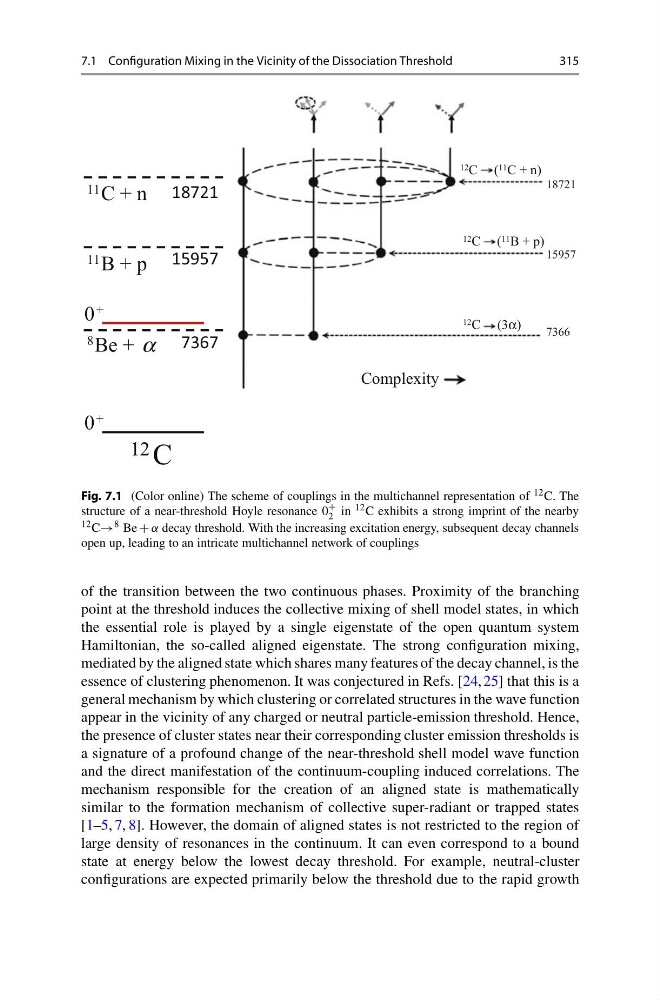
Fig. 7.1 (Color online) The scheme of couplings in the multichannel representation of 12 C. The
structure of a near-threshold Hoyle resonance 0
+
2 in 12 C exhibits a strong imprint of the nearby
12 C→ 8 Be + α decay threshold. With the increasing excitation energy, subsequent decay channels
open up, leading to an intricate multichannel network of couplings
of the transition between the two continuous phases. Proximity of the branching
point at the threshold induces the collective mixing of shell model states, in which
the essential role is played by a single eigenstate of the open quantum system
Hamiltonian, the so-called aligned eigenstate. The strong configuration mixing,
mediated by the aligned state which shares many features of the decay channel, is the
essence of clustering phenomenon. It was conjectured in Refs. [24, 25] that this is a
general mechanism by which clustering or correlated structures in the wave function
appear in the vicinity of any charged or neutral particle-emission threshold. Hence,
the presence of cluster states near their corresponding cluster emission thresholds is
a signature of a profound change of the near-threshold shell model wave function
and the direct manifestation of the continuum-coupling induced correlations. The
mechanism responsible for the creation of an aligned state is mathematically
similar to the formation mechanism of collective super-radiant or trapped states
[1–5, 7, 8]. However, the domain of aligned states is not restricted to the region of
large density of resonances in the continuum. It can even correspond to a bound
state at energy below the lowest decay threshold. For example, neutral-cluster
configurations are expected primarily below the threshold due to the rapid growth
315
12 C
0
+
0
+
8
Be + α
11
B + p
11
C + n
7367
15957
18721
12 C ( 11 C + n)
12 C ( 11 B + p)
12 C (3α)
18721
15957
7366
Complexity
Fig. 7.1 (Color online) The scheme of couplings in the multichannel representation of 12 C. The
structure of a near-threshold Hoyle resonance 0
+
2 in 12 C exhibits a strong imprint of the nearby
12 C→ 8 Be + α decay threshold. With the increasing excitation energy, subsequent decay channels
open up, leading to an intricate multichannel network of couplings
of the transition between the two continuous phases. Proximity of the branching
point at the threshold induces the collective mixing of shell model states, in which
the essential role is played by a single eigenstate of the open quantum system
Hamiltonian, the so-called aligned eigenstate. The strong configuration mixing,
mediated by the aligned state which shares many features of the decay channel, is the
essence of clustering phenomenon. It was conjectured in Refs. [24, 25] that this is a
general mechanism by which clustering or correlated structures in the wave function
appear in the vicinity of any charged or neutral particle-emission threshold. Hence,
the presence of cluster states near their corresponding cluster emission thresholds is
a signature of a profound change of the near-threshold shell model wave function
and the direct manifestation of the continuum-coupling induced correlations. The
mechanism responsible for the creation of an aligned state is mathematically
similar to the formation mechanism of collective super-radiant or trapped states
[1–5, 7, 8]. However, the domain of aligned states is not restricted to the region of
large density of resonances in the continuum. It can even correspond to a bound
state at energy below the lowest decay threshold. For example, neutral-cluster
configurations are expected primarily below the threshold due to the rapid growth