

304
6 Physical Applications of the Gamow Shell Model
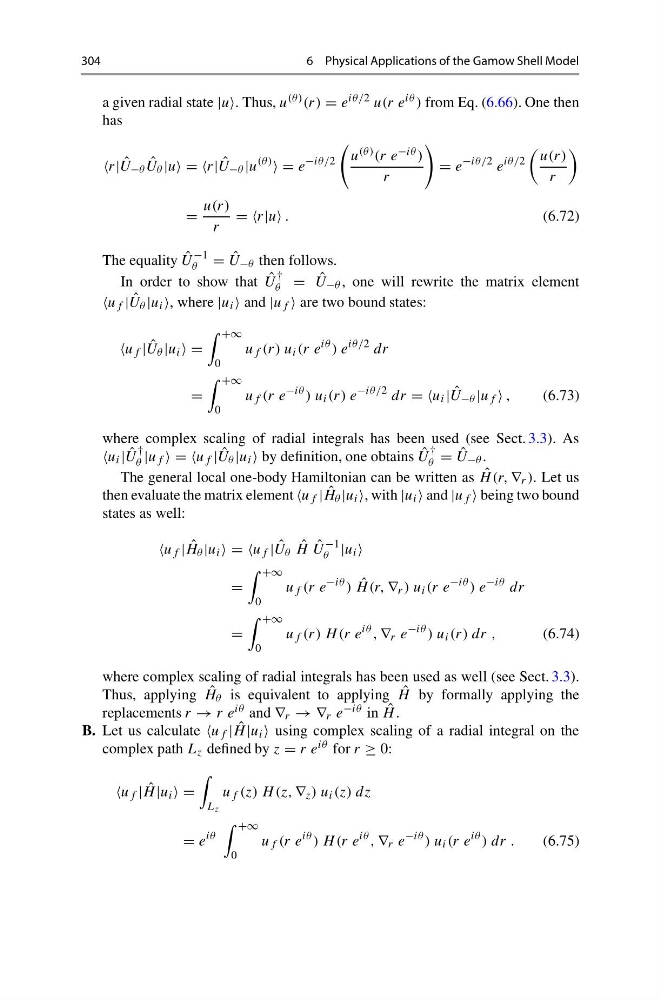
a given radial state |u. Thus, u (θ) (r) = e iθ/2 u(r e iθ ) from Eq. (6.66). One then
has
ˆ
U −θ ˆ
U θ |u = =r| ˆ
U −θ |u
(θ)
= e
−iθ/2
u (θ) (r e −iθ )
r
= e
−iθ/2 e
iθ/2
u(r)
r
=
u(r)
r
= =r|u .
(6.72)
The equality ˆ
U
−1
θ = ˆ
U −θ then follows.
In order to show that ˆ
U
†
θ = ˆ
U −θ , one will rewrite the matrix element
f | ˆ
U θ |u i , where |u i and |u f are two bound states:
f | ˆ
U θ |u i =
+∞
0
u f (r) u i (r e
iθ ) e
iθ/2 dr
=
+∞
0
u f (r e
−iθ ) u i (r) e
−iθ/2 dr = =u i | ˆ
U −θ |u f ,
(6.73)
where complex scaling of radial integrals has been used (see Sect. 3.3). As
i | ˆ
U
†
θ |u f = u f | ˆ
U θ |u i by definition, one obtains ˆ
U
†
θ = ˆ
U −θ .
The general local one-body Hamiltonian can be written as ˆ
H (r, ∇ r ). Let us
then evaluate the matrix element f | ˆ
H θ |u i , with |u i and |u f being two bound
states as well:
f | ˆ
H θ |u i = =u f | ˆ
U θ ˆ
H ˆ
U
−1
θ |u i
=
+∞
0
u f (r e
−iθ ) ˆ
H (r, ∇ r ) u i (r e
−iθ ) e
−iθ dr
=
+∞
0
u f (r) H (r e
iθ , ∇ r e
−iθ ) u i (r) dr ,
(6.74)
where complex scaling of radial integrals has been used as well (see Sect. 3.3).
Thus, applying ˆ
H θ is equivalent to applying ˆ
H by formally applying the
replacements r → r e iθ and ∇ r → ∇ r e −iθ in ˆ
H .
B. Let us calculate f | ˆ
H |u i using complex scaling of a radial integral on the
complex path L z defined by z = r e iθ for r ≥ 0:
f | ˆ
H |u i =
L z
u f (z) H (z, ∇ z ) u i (z) dz
= e
iθ
+∞
0
u f (r e
iθ ) H (r e
iθ , ∇ r e
−iθ ) u i (r e
iθ ) dr .
(6.75)
6 Physical Applications of the Gamow Shell Model
a given radial state |u. Thus, u (θ) (r) = e iθ/2 u(r e iθ ) from Eq. (6.66). One then
has
ˆ
U −θ ˆ
U θ |u = =r| ˆ
U −θ |u
(θ)
= e
−iθ/2
u (θ) (r e −iθ )
r
= e
−iθ/2 e
iθ/2
u(r)
r
=
u(r)
r
= =r|u .
(6.72)
The equality ˆ
U
−1
θ = ˆ
U −θ then follows.
In order to show that ˆ
U
†
θ = ˆ
U −θ , one will rewrite the matrix element
f | ˆ
U θ |u i , where |u i and |u f are two bound states:
f | ˆ
U θ |u i =
+∞
0
u f (r) u i (r e
iθ ) e
iθ/2 dr
=
+∞
0
u f (r e
−iθ ) u i (r) e
−iθ/2 dr = =u i | ˆ
U −θ |u f ,
(6.73)
where complex scaling of radial integrals has been used (see Sect. 3.3). As
i | ˆ
U
†
θ |u f = u f | ˆ
U θ |u i by definition, one obtains ˆ
U
†
θ = ˆ
U −θ .
The general local one-body Hamiltonian can be written as ˆ
H (r, ∇ r ). Let us
then evaluate the matrix element f | ˆ
H θ |u i , with |u i and |u f being two bound
states as well:
f | ˆ
H θ |u i = =u f | ˆ
U θ ˆ
H ˆ
U
−1
θ |u i
=
+∞
0
u f (r e
−iθ ) ˆ
H (r, ∇ r ) u i (r e
−iθ ) e
−iθ dr
=
+∞
0
u f (r) H (r e
iθ , ∇ r e
−iθ ) u i (r) dr ,
(6.74)
where complex scaling of radial integrals has been used as well (see Sect. 3.3).
Thus, applying ˆ
H θ is equivalent to applying ˆ
H by formally applying the
replacements r → r e iθ and ∇ r → ∇ r e −iθ in ˆ
H .
B. Let us calculate f | ˆ
H |u i using complex scaling of a radial integral on the
complex path L z defined by z = r e iθ for r ≥ 0:
f | ˆ
H |u i =
L z
u f (z) H (z, ∇ z ) u i (z) dz
= e
iθ
+∞
0
u f (r e
iθ ) H (r e
iθ , ∇ r e
−iθ ) u i (r e
iθ ) dr .
(6.75)