

Solutions to Exercises
303
non-interacting system cannot be used as a starting point. Moreover, one
knows from the two-pair case that the solutions of Eq. (6.63) are complex in
general. Consequently, it is necessary to devise a complex-valued starting
point. Indeed, the Newton-Raphson method applied to Eq. (6.63) cannot
converge to a complex solution if its starting point is real.
(ii) One will then consider instead a system formed by two interacting pairs and
by one non-interacting pair. Consequently, one can use a combination of the
solutions (6.64) and (6.65), i.e. one pair is initiated with Eq. (6.64) while
the two others are initiated with Eq. (6.65). This starting point is clearly
complex.
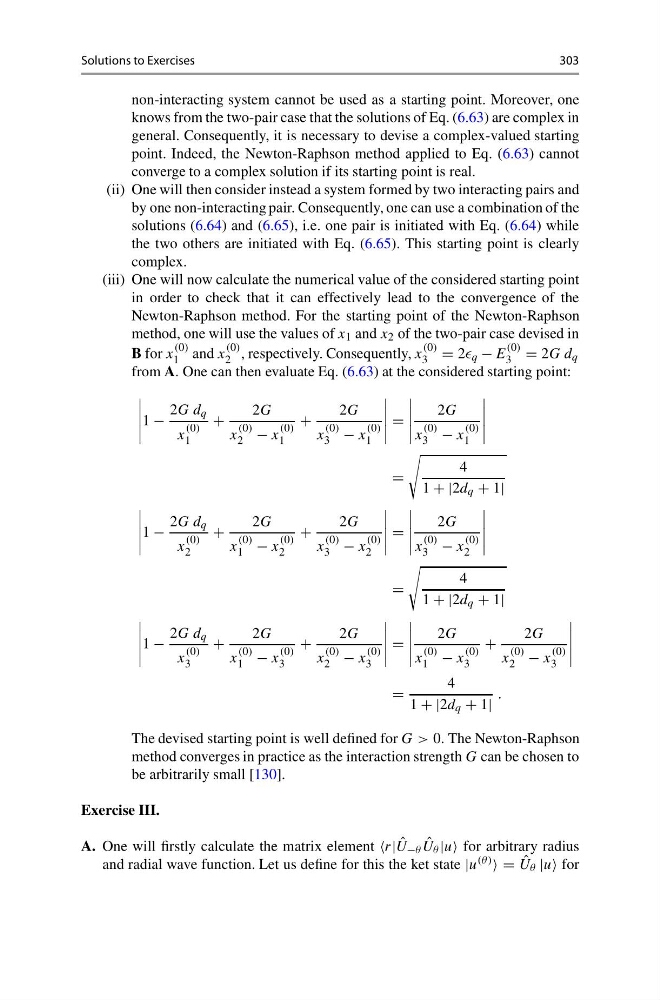
(iii) One will now calculate the numerical value of the considered starting point
in order to check that it can effectively lead to the convergence of the
Newton-Raphson method. For the starting point of the Newton-Raphson
method, one will use the values of x 1 and x 2 of the two-pair case devised in
B for x
(0)
1 and x
(0)
2 , respectively. Consequently, x
(0)
3 = 2 q − E
(0)
3 = 2G d q
from A. One can then evaluate Eq. (6.63) at the considered starting point:
1 −
2G d q
x
(0)
1
+
2G
x
(0)
2 − x
(0)
1
+
2G
x
(0)
3 − x
(0)
1
=
2G
x
(0)
3 − x
(0)
1
=
4
1 + |2d q + 1|
1 −
2G d q
x
(0)
2
+
2G
x
(0)
1 − x
(0)
2
+
2G
x
(0)
3 − x
(0)
2
=
2G
x
(0)
3 − x
(0)
2
=
4
1 + |2d q + 1|
1 −
2G d q
x
(0)
3
+
2G
x
(0)
1 − x
(0)
3
+
2G
x
(0)
2 − x
(0)
3
=
2G
x
(0)
1 − x
(0)
3
+
2G
x
(0)
2 − x
(0)
3
=
4
1 + |2d q + 1|
.
The devised starting point is well defined for G > 0. The Newton-Raphson
method converges in practice as the interaction strength G can be chosen to
be arbitrarily small [130].
Exercise III.
A. One will firstly calculate the matrix element ˆ
U −θ ˆ
U θ |u for arbitrary radius
and radial wave function. Let us define for this the ket state |u (θ) = ˆ
U θ |u for
303
non-interacting system cannot be used as a starting point. Moreover, one
knows from the two-pair case that the solutions of Eq. (6.63) are complex in
general. Consequently, it is necessary to devise a complex-valued starting
point. Indeed, the Newton-Raphson method applied to Eq. (6.63) cannot
converge to a complex solution if its starting point is real.
(ii) One will then consider instead a system formed by two interacting pairs and
by one non-interacting pair. Consequently, one can use a combination of the
solutions (6.64) and (6.65), i.e. one pair is initiated with Eq. (6.64) while
the two others are initiated with Eq. (6.65). This starting point is clearly
complex.
(iii) One will now calculate the numerical value of the considered starting point
in order to check that it can effectively lead to the convergence of the
Newton-Raphson method. For the starting point of the Newton-Raphson
method, one will use the values of x 1 and x 2 of the two-pair case devised in
B for x
(0)
1 and x
(0)
2 , respectively. Consequently, x
(0)
3 = 2 q − E
(0)
3 = 2G d q
from A. One can then evaluate Eq. (6.63) at the considered starting point:
1 −
2G d q
x
(0)
1
+
2G
x
(0)
2 − x
(0)
1
+
2G
x
(0)
3 − x
(0)
1
=
2G
x
(0)
3 − x
(0)
1
=
4
1 + |2d q + 1|
1 −
2G d q
x
(0)
2
+
2G
x
(0)
1 − x
(0)
2
+
2G
x
(0)
3 − x
(0)
2
=
2G
x
(0)
3 − x
(0)
2
=
4
1 + |2d q + 1|
1 −
2G d q
x
(0)
3
+
2G
x
(0)
1 − x
(0)
3
+
2G
x
(0)
2 − x
(0)
3
=
2G
x
(0)
1 − x
(0)
3
+
2G
x
(0)
2 − x
(0)
3
=
4
1 + |2d q + 1|
.
The devised starting point is well defined for G > 0. The Newton-Raphson
method converges in practice as the interaction strength G can be chosen to
be arbitrarily small [130].
Exercise III.
A. One will firstly calculate the matrix element ˆ
U −θ ˆ
U θ |u for arbitrary radius
and radial wave function. Let us define for this the ket state |u (θ) = ˆ
U θ |u for