

6.4 Three-Body Model in Berggren Basis
275
0
30
60
90
120
150
180
0.0
0.1
0.2
0.3
0.4
0.5
0.6
0.7
0.8
0.9
GSM 2
GSM 10
GCC 2
GCC 10
0
+
6 He g.s.
θ (degrees)
ρ (θ)
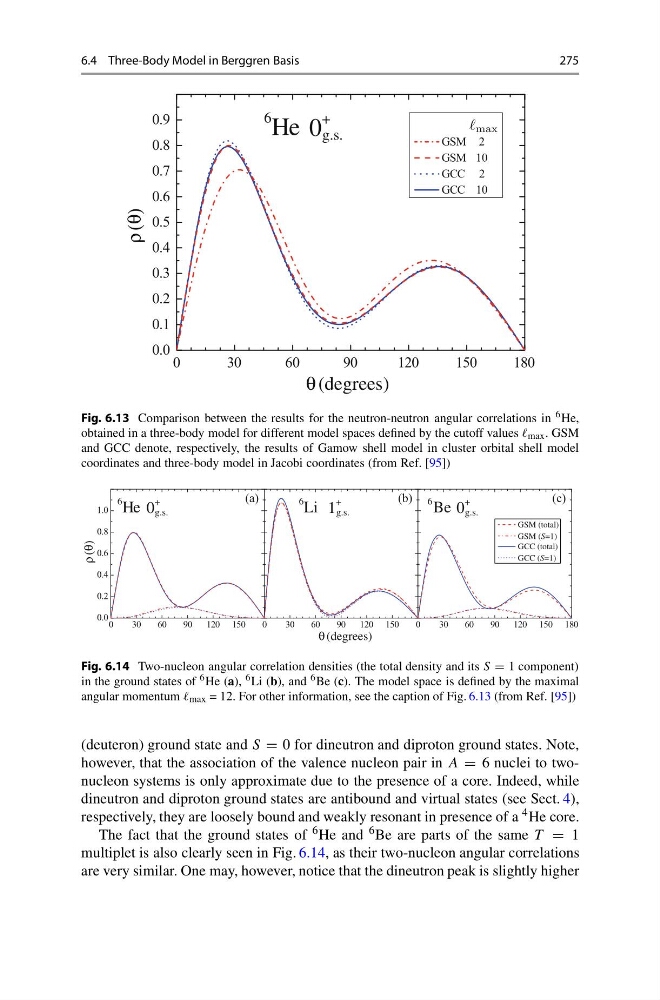
Fig. 6.13 Comparison between the results for the neutron-neutron angular correlations in 6 He,
obtained in a three-body model for different model spaces defined by the cutoff values max . GSM
and GCC denote, respectively, the results of Gamow shell model in cluster orbital shell model
coordinates and three-body model in Jacobi coordinates (from Ref. [95])
0
30
60
90 120 150
0
30
60
90 120 150
0
30
60
90 120 150
0.0
0.2
0.4
0.6
0.8
1.0
180
0
+
6 He g.s.
1
+
6 Li g.s.
(a)
(b)
(c)
0
+
6 Be g.s.
GSM (total)
GSM (S=1)
GCC (total)
GCC (S=1)
θ (degrees)
ρ (θ)
Fig. 6.14 Two-nucleon angular correlation densities (the total density and its S = 1 component)
in the ground states of 6 He (a), 6 Li (b), and 6 Be (c). The model space is defined by the maximal
angular momentum max = 12. For other information, see the caption of Fig. 6.13 (from Ref. [95])
(deuteron) ground state and S = 0 for dineutron and diproton ground states. Note,
however, that the association of the valence nucleon pair in A = 6 nuclei to twonucleon systems is only approximate due to the presence of a core. Indeed, while
dineutron and diproton ground states are antibound and virtual states (see Sect. 4),
respectively, they are loosely bound and weakly resonant in presence of a 4 He core.
The fact that the ground states of 6 He and 6 Be are parts of the same T = 1
multiplet is also clearly seen in Fig. 6.14, as their two-nucleon angular correlations
are very similar. One may, however, notice that the dineutron peak is slightly higher
275
0
30
60
90
120
150
180
0.0
0.1
0.2
0.3
0.4
0.5
0.6
0.7
0.8
0.9
GSM 2
GSM 10
GCC 2
GCC 10
0
+
6 He g.s.
θ (degrees)
ρ (θ)
Fig. 6.13 Comparison between the results for the neutron-neutron angular correlations in 6 He,
obtained in a three-body model for different model spaces defined by the cutoff values max . GSM
and GCC denote, respectively, the results of Gamow shell model in cluster orbital shell model
coordinates and three-body model in Jacobi coordinates (from Ref. [95])
0
30
60
90 120 150
0
30
60
90 120 150
0
30
60
90 120 150
0.0
0.2
0.4
0.6
0.8
1.0
180
0
+
6 He g.s.
1
+
6 Li g.s.
(a)
(b)
(c)
0
+
6 Be g.s.
GSM (total)
GSM (S=1)
GCC (total)
GCC (S=1)
θ (degrees)
ρ (θ)
Fig. 6.14 Two-nucleon angular correlation densities (the total density and its S = 1 component)
in the ground states of 6 He (a), 6 Li (b), and 6 Be (c). The model space is defined by the maximal
angular momentum max = 12. For other information, see the caption of Fig. 6.13 (from Ref. [95])
(deuteron) ground state and S = 0 for dineutron and diproton ground states. Note,
however, that the association of the valence nucleon pair in A = 6 nuclei to twonucleon systems is only approximate due to the presence of a core. Indeed, while
dineutron and diproton ground states are antibound and virtual states (see Sect. 4),
respectively, they are loosely bound and weakly resonant in presence of a 4 He core.
The fact that the ground states of 6 He and 6 Be are parts of the same T = 1
multiplet is also clearly seen in Fig. 6.14, as their two-nucleon angular correlations
are very similar. One may, however, notice that the dineutron peak is slightly higher