

274
6 Physical Applications of the Gamow Shell Model
While it is straightforward to calculate ρ(θ) with cluster orbital shell model
coordinates, the two-nucleon correlation cannot be calculated directly in T-type
coordinates, which are used to diagonalize the Hamiltonian of a three-body model
in Jacobi coordinates. As a consequence, one can either calculate the density
distribution ρ T (x, y, ϕ) in T-type variables and then using geometric relations (see
the left panel of Fig. 6.11) transform it to the density ρ(r 1 , r 2 , θ) in cluster orbital
shell model variables, or apply the coordinate transformation from T-type to V-type
and then calculate the two-nucleon correlation directly using cluster orbital shell
model coordinates. This transformation coefficient, which has been discussed in
Ref. [104], provides with an analytical relation between hyperspherical harmonics
in cluster orbital shell model coordinates Y J M
γ K (r
1 , r
2 ) and the T-type Jacobi
coordinates Y
J M
γ K (x , y ), where r
1 , r
2 , x , and y are r 1 , r 2 , x, and y multiplied
by a mass-related constant:
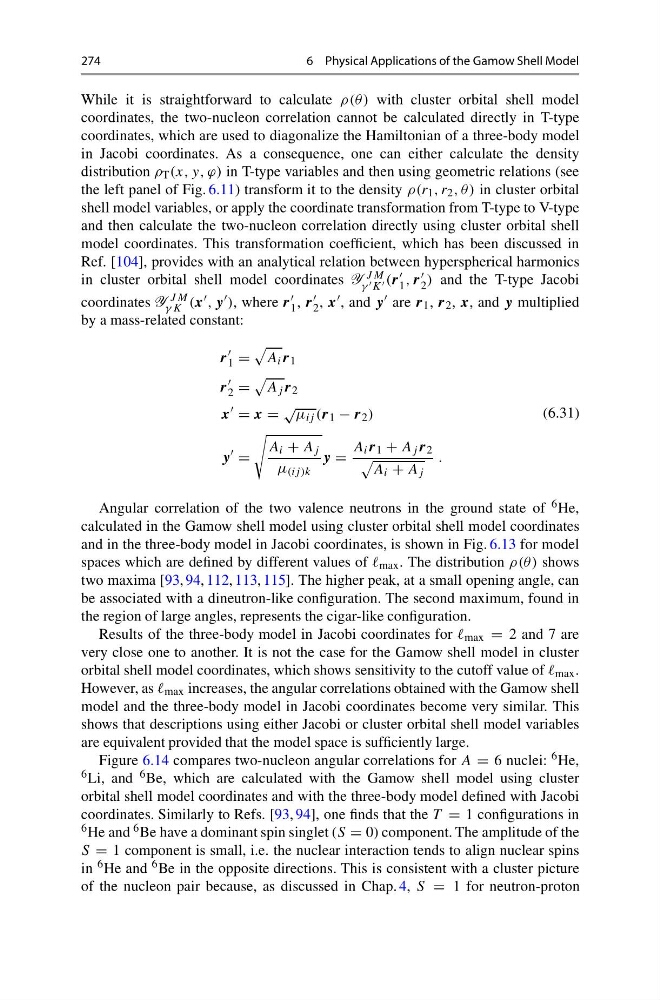
r
1 =
A i r 1
r
2 =
A j r 2
x
= x =
√
μ ij (r 1 − r 2 )
y
=
A i + A j
μ (ij )k
y =
A i r 1 + A j r 2
A i + A j
.
(6.31)
Angular correlation of the two valence neutrons in the ground state of 6 He,
calculated in the Gamow shell model using cluster orbital shell model coordinates
and in the three-body model in Jacobi coordinates, is shown in Fig. 6.13 for model
spaces which are defined by different values of max . The distribution ρ(θ) shows
two maxima [93, 94, 112, 113, 115]. The higher peak, at a small opening angle, can
be associated with a dineutron-like configuration. The second maximum, found in
the region of large angles, represents the cigar-like configuration.
Results of the three-body model in Jacobi coordinates for max = 2 and 7 are
very close one to another. It is not the case for the Gamow shell model in cluster
orbital shell model coordinates, which shows sensitivity to the cutoff value of max .
However, as max increases, the angular correlations obtained with the Gamow shell
model and the three-body model in Jacobi coordinates become very similar. This
shows that descriptions using either Jacobi or cluster orbital shell model variables
are equivalent provided that the model space is sufficiently large.
Figure 6.14 compares two-nucleon angular correlations for A = 6 nuclei: 6 He,
6 Li, and 6 Be, which are calculated with the Gamow shell model using cluster
orbital shell model coordinates and with the three-body model defined with Jacobi
coordinates. Similarly to Refs. [93, 94], one finds that the T = 1 configurations in
6 He and 6 Be have a dominant spin singlet (S = 0) component. The amplitude of the
S = 1 component is small, i.e. the nuclear interaction tends to align nuclear spins
in 6 He and 6 Be in the opposite directions. This is consistent with a cluster picture
of the nucleon pair because, as discussed in Chap. 4, S = 1 for neutron-proton
6 Physical Applications of the Gamow Shell Model
While it is straightforward to calculate ρ(θ) with cluster orbital shell model
coordinates, the two-nucleon correlation cannot be calculated directly in T-type
coordinates, which are used to diagonalize the Hamiltonian of a three-body model
in Jacobi coordinates. As a consequence, one can either calculate the density
distribution ρ T (x, y, ϕ) in T-type variables and then using geometric relations (see
the left panel of Fig. 6.11) transform it to the density ρ(r 1 , r 2 , θ) in cluster orbital
shell model variables, or apply the coordinate transformation from T-type to V-type
and then calculate the two-nucleon correlation directly using cluster orbital shell
model coordinates. This transformation coefficient, which has been discussed in
Ref. [104], provides with an analytical relation between hyperspherical harmonics
in cluster orbital shell model coordinates Y J M
γ K (r
1 , r
2 ) and the T-type Jacobi
coordinates Y
J M
γ K (x , y ), where r
1 , r
2 , x , and y are r 1 , r 2 , x, and y multiplied
by a mass-related constant:
r
1 =
A i r 1
r
2 =
A j r 2
x
= x =
√
μ ij (r 1 − r 2 )
y
=
A i + A j
μ (ij )k
y =
A i r 1 + A j r 2
A i + A j
.
(6.31)
Angular correlation of the two valence neutrons in the ground state of 6 He,
calculated in the Gamow shell model using cluster orbital shell model coordinates
and in the three-body model in Jacobi coordinates, is shown in Fig. 6.13 for model
spaces which are defined by different values of max . The distribution ρ(θ) shows
two maxima [93, 94, 112, 113, 115]. The higher peak, at a small opening angle, can
be associated with a dineutron-like configuration. The second maximum, found in
the region of large angles, represents the cigar-like configuration.
Results of the three-body model in Jacobi coordinates for max = 2 and 7 are
very close one to another. It is not the case for the Gamow shell model in cluster
orbital shell model coordinates, which shows sensitivity to the cutoff value of max .
However, as max increases, the angular correlations obtained with the Gamow shell
model and the three-body model in Jacobi coordinates become very similar. This
shows that descriptions using either Jacobi or cluster orbital shell model variables
are equivalent provided that the model space is sufficiently large.
Figure 6.14 compares two-nucleon angular correlations for A = 6 nuclei: 6 He,
6 Li, and 6 Be, which are calculated with the Gamow shell model using cluster
orbital shell model coordinates and with the three-body model defined with Jacobi
coordinates. Similarly to Refs. [93, 94], one finds that the T = 1 configurations in
6 He and 6 Be have a dominant spin singlet (S = 0) component. The amplitude of the
S = 1 component is small, i.e. the nuclear interaction tends to align nuclear spins
in 6 He and 6 Be in the opposite directions. This is consistent with a cluster picture
of the nucleon pair because, as discussed in Chap. 4, S = 1 for neutron-proton