

262
6 Physical Applications of the Gamow Shell Model
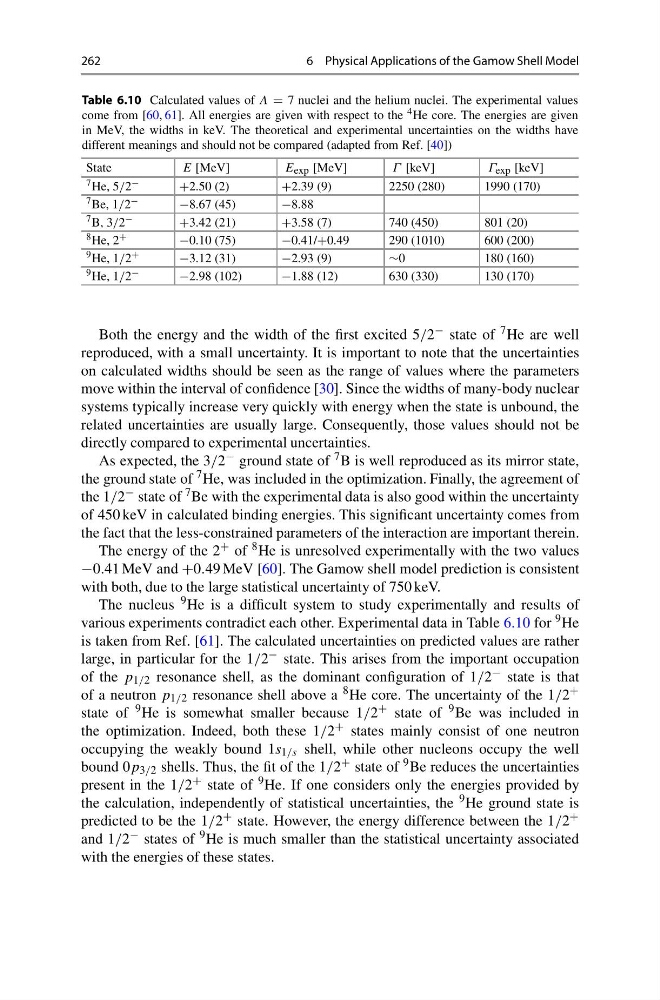
Table 6.10 Calculated values of A = 7 nuclei and the helium nuclei. The experimental values
come from [60, 61]. All energies are given with respect to the 4 He core. The energies are given
in MeV, the widths in keV. The theoretical and experimental uncertainties on the widths have
different meanings and should not be compared (adapted from Ref. [40])
State
E [MeV]
E exp [MeV]
Γ [keV]
Γ exp [keV]
7 He, 5/2 −
+2.50 (2)
+2.39 (9)
2250 (280)
1990 (170)
7 Be, 1/2 −
−8.67 (45)
−8.88
7 B, 3/2 −
+3.42 (21)
+3.58 (7)
740 (450)
801 (20)
8 He, 2 +
−0.10 (75)
−0.41/+0.49
290 (1010)
600 (200)
9 He, 1/2 +
−3.12 (31)
−2.93 (9)
∼0
180 (160)
9 He, 1/2 −
−2.98 (102)
−1.88 (12)
630 (330)
130 (170)
Both the energy and the width of the first excited 5/2 − state of 7 He are well
reproduced, with a small uncertainty. It is important to note that the uncertainties
on calculated widths should be seen as the range of values where the parameters
move within the interval of confidence [30]. Since the widths of many-body nuclear
systems typically increase very quickly with energy when the state is unbound, the
related uncertainties are usually large. Consequently, those values should not be
directly compared to experimental uncertainties.
As expected, the 3/2 − ground state of 7 B is well reproduced as its mirror state,
the ground state of 7 He, was included in the optimization. Finally, the agreement of
the 1/2 − state of 7 Be with the experimental data is also good within the uncertainty
of 450 keV in calculated binding energies. This significant uncertainty comes from
the fact that the less-constrained parameters of the interaction are important therein.
The energy of the 2 + of 8 He is unresolved experimentally with the two values
−0.41 MeV and +0.49 MeV [60]. The Gamow shell model prediction is consistent
with both, due to the large statistical uncertainty of 750 keV.
The nucleus 9 He is a difficult system to study experimentally and results of
various experiments contradict each other. Experimental data in Table 6.10 for 9 He
is taken from Ref. [61]. The calculated uncertainties on predicted values are rather
large, in particular for the 1/2 − state. This arises from the important occupation
of the p 1/2 resonance shell, as the dominant configuration of 1/2 − state is that
of a neutron p 1/2 resonance shell above a 8 He core. The uncertainty of the 1/2 +
state of 9 He is somewhat smaller because 1/2 + state of 9 Be was included in
the optimization. Indeed, both these 1/2 + states mainly consist of one neutron
occupying the weakly bound 1s 1/s shell, while other nucleons occupy the well
bound 0p 3/2 shells. Thus, the fit of the 1/2 + state of 9 Be reduces the uncertainties
present in the 1/2 + state of 9 He. If one considers only the energies provided by
the calculation, independently of statistical uncertainties, the 9 He ground state is
predicted to be the 1/2 + state. However, the energy difference between the 1/2 +
and 1/2 − states of 9 He is much smaller than the statistical uncertainty associated
with the energies of these states.
6 Physical Applications of the Gamow Shell Model
Table 6.10 Calculated values of A = 7 nuclei and the helium nuclei. The experimental values
come from [60, 61]. All energies are given with respect to the 4 He core. The energies are given
in MeV, the widths in keV. The theoretical and experimental uncertainties on the widths have
different meanings and should not be compared (adapted from Ref. [40])
State
E [MeV]
E exp [MeV]
Γ [keV]
Γ exp [keV]
7 He, 5/2 −
+2.50 (2)
+2.39 (9)
2250 (280)
1990 (170)
7 Be, 1/2 −
−8.67 (45)
−8.88
7 B, 3/2 −
+3.42 (21)
+3.58 (7)
740 (450)
801 (20)
8 He, 2 +
−0.10 (75)
−0.41/+0.49
290 (1010)
600 (200)
9 He, 1/2 +
−3.12 (31)
−2.93 (9)
∼0
180 (160)
9 He, 1/2 −
−2.98 (102)
−1.88 (12)
630 (330)
130 (170)
Both the energy and the width of the first excited 5/2 − state of 7 He are well
reproduced, with a small uncertainty. It is important to note that the uncertainties
on calculated widths should be seen as the range of values where the parameters
move within the interval of confidence [30]. Since the widths of many-body nuclear
systems typically increase very quickly with energy when the state is unbound, the
related uncertainties are usually large. Consequently, those values should not be
directly compared to experimental uncertainties.
As expected, the 3/2 − ground state of 7 B is well reproduced as its mirror state,
the ground state of 7 He, was included in the optimization. Finally, the agreement of
the 1/2 − state of 7 Be with the experimental data is also good within the uncertainty
of 450 keV in calculated binding energies. This significant uncertainty comes from
the fact that the less-constrained parameters of the interaction are important therein.
The energy of the 2 + of 8 He is unresolved experimentally with the two values
−0.41 MeV and +0.49 MeV [60]. The Gamow shell model prediction is consistent
with both, due to the large statistical uncertainty of 750 keV.
The nucleus 9 He is a difficult system to study experimentally and results of
various experiments contradict each other. Experimental data in Table 6.10 for 9 He
is taken from Ref. [61]. The calculated uncertainties on predicted values are rather
large, in particular for the 1/2 − state. This arises from the important occupation
of the p 1/2 resonance shell, as the dominant configuration of 1/2 − state is that
of a neutron p 1/2 resonance shell above a 8 He core. The uncertainty of the 1/2 +
state of 9 He is somewhat smaller because 1/2 + state of 9 Be was included in
the optimization. Indeed, both these 1/2 + states mainly consist of one neutron
occupying the weakly bound 1s 1/s shell, while other nucleons occupy the well
bound 0p 3/2 shells. Thus, the fit of the 1/2 + state of 9 Be reduces the uncertainties
present in the 1/2 + state of 9 He. If one considers only the energies provided by
the calculation, independently of statistical uncertainties, the 9 He ground state is
predicted to be the 1/2 + state. However, the energy difference between the 1/2 +
and 1/2 − states of 9 He is much smaller than the statistical uncertainty associated
with the energies of these states.