

6.3 Effective Nucleon–Nucleon Interactions for Gamow Shell Model. . .
261
Table 6.9 Correlation coefficients between the two-body interaction parameters. Parameters
depend on the spin S = 0, 1 and isospin T = 0, 1 of the two nucleons, as indicated in their
superscript (adapted from Ref. [40])
V 11
C
V 10
C
V 00
C
V 01
C
V 11
LS
V 11
T
V 10
T
V 11
C
1
0.24
0.26
−0.44
0.63
−0.45
−0.25
V 10
C
0.24
1
−0.22
−0.92
0.01
−0.89
−0.99
V 00
C
0.26
−0.22
1
0.30
−0.21
0.38
0.21
V
01
C
−0.44
−0.92
0.30
1
−0.17
0.96
0.89
V 11
LS
0.63
0.01
−0.21
−0.17
1
−0.28
−0.04
V 11
T
−0.45
−0.89
0.38
0.96
−0.28
1
0.88
V
10
T
−0.25
−0.99
0.21
0.89
−0.04
0.88
1
Energy (MeV)
7 Be
7 He
4 He
7 B
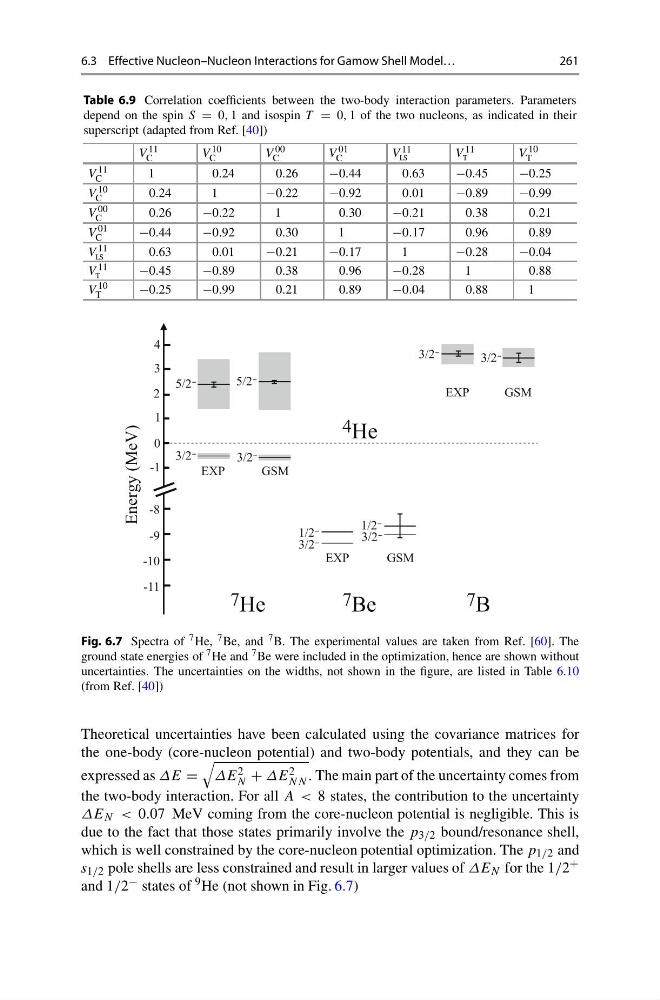
Fig. 6.7 Spectra of 7 He, 7 Be, and 7 B. The experimental values are taken from Ref. [60]. The
ground state energies of 7 He and 7 Be were included in the optimization, hence are shown without
uncertainties. The uncertainties on the widths, not shown in the figure, are listed in Table 6.10
(from Ref. [40])
Theoretical uncertainties have been calculated using the covariance matrices for
the one-body (core-nucleon potential) and two-body potentials, and they can be
expressed as ΔE =
ΔE 2
N + ΔE 2
NN . The main part of the uncertainty comes from
the two-body interaction. For all A < 8 states, the contribution to the uncertainty
ΔE N < 0.07 MeV coming from the core-nucleon potential is negligible. This is
due to the fact that those states primarily involve the p 3/2 bound/resonance shell,
which is well constrained by the core-nucleon potential optimization. The p 1/2 and
s 1/2 pole shells are less constrained and result in larger values of ΔE N for the 1/2 +
and 1/2 − states of 9 He (not shown in Fig. 6.7)
261
Table 6.9 Correlation coefficients between the two-body interaction parameters. Parameters
depend on the spin S = 0, 1 and isospin T = 0, 1 of the two nucleons, as indicated in their
superscript (adapted from Ref. [40])
V 11
C
V 10
C
V 00
C
V 01
C
V 11
LS
V 11
T
V 10
T
V 11
C
1
0.24
0.26
−0.44
0.63
−0.45
−0.25
V 10
C
0.24
1
−0.22
−0.92
0.01
−0.89
−0.99
V 00
C
0.26
−0.22
1
0.30
−0.21
0.38
0.21
V
01
C
−0.44
−0.92
0.30
1
−0.17
0.96
0.89
V 11
LS
0.63
0.01
−0.21
−0.17
1
−0.28
−0.04
V 11
T
−0.45
−0.89
0.38
0.96
−0.28
1
0.88
V
10
T
−0.25
−0.99
0.21
0.89
−0.04
0.88
1
Energy (MeV)
7 Be
7 He
4 He
7 B
Fig. 6.7 Spectra of 7 He, 7 Be, and 7 B. The experimental values are taken from Ref. [60]. The
ground state energies of 7 He and 7 Be were included in the optimization, hence are shown without
uncertainties. The uncertainties on the widths, not shown in the figure, are listed in Table 6.10
(from Ref. [40])
Theoretical uncertainties have been calculated using the covariance matrices for
the one-body (core-nucleon potential) and two-body potentials, and they can be
expressed as ΔE =
ΔE 2
N + ΔE 2
NN . The main part of the uncertainty comes from
the two-body interaction. For all A < 8 states, the contribution to the uncertainty
ΔE N < 0.07 MeV coming from the core-nucleon potential is negligible. This is
due to the fact that those states primarily involve the p 3/2 bound/resonance shell,
which is well constrained by the core-nucleon potential optimization. The p 1/2 and
s 1/2 pole shells are less constrained and result in larger values of ΔE N for the 1/2 +
and 1/2 − states of 9 He (not shown in Fig. 6.7)