

244
6 Physical Applications of the Gamow Shell Model
0.6
0.8
1
1.2
1.4
1.6
Energy (MeV)
5
He
7 H e (H O -S M )
7 H
e
( G
S M
1
)
7 H
e ( G
S M
2
)
5
7
9
1 1
E 1/2 - E 3/2 - splitting
V SO (MeV)
-
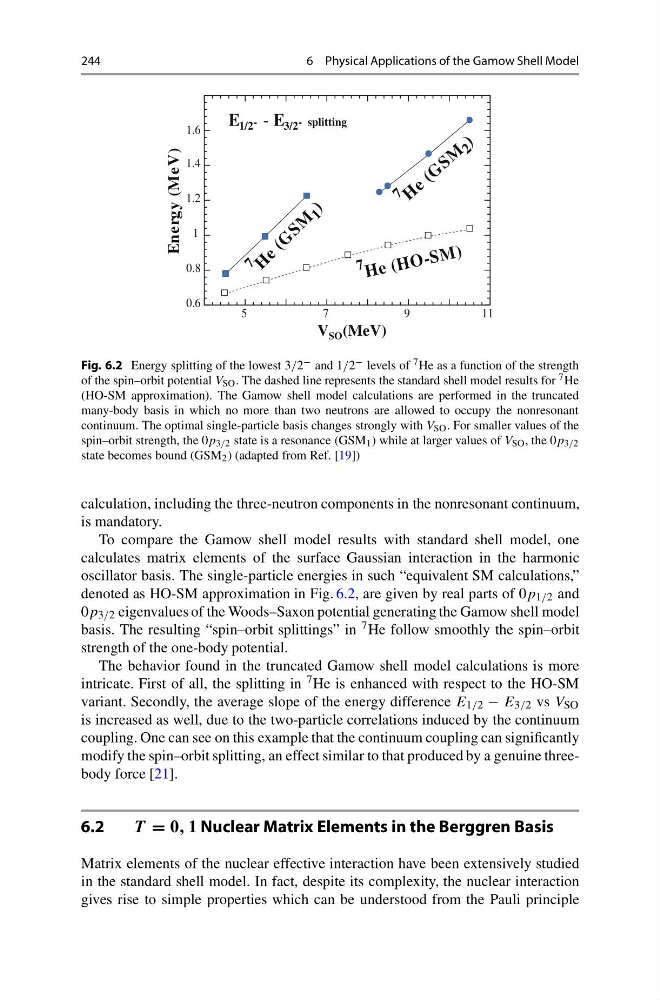
Fig. 6.2 Energy splitting of the lowest 3/2 − and 1/2 − levels of 7 He as a function of the strength
of the spin–orbit potential V SO . The dashed line represents the standard shell model results for 7 He
(HO-SM approximation). The Gamow shell model calculations are performed in the truncated
many-body basis in which no more than two neutrons are allowed to occupy the nonresonant
continuum. The optimal single-particle basis changes strongly with V SO . For smaller values of the
spin–orbit strength, the 0p 3/2 state is a resonance (GSM 1 ) while at larger values of V SO , the 0p 3/2
state becomes bound (GSM 2 ) (adapted from Ref. [19])
calculation, including the three-neutron components in the nonresonant continuum,
is mandatory.
To compare the Gamow shell model results with standard shell model, one
calculates matrix elements of the surface Gaussian interaction in the harmonic
oscillator basis. The single-particle energies in such “equivalent SM calculations,”
denoted as HO-SM approximation in Fig. 6.2, are given by real parts of 0p 1/2 and
0p 3/2 eigenvalues of the Woods–Saxon potential generating the Gamow shell model
basis. The resulting “spin–orbit splittings” in 7 He follow smoothly the spin–orbit
strength of the one-body potential.
The behavior found in the truncated Gamow shell model calculations is more
intricate. First of all, the splitting in 7 He is enhanced with respect to the HO-SM
variant. Secondly, the average slope of the energy difference E 1/2 − E 3/2 vs V SO
is increased as well, due to the two-particle correlations induced by the continuum
coupling. One can see on this example that the continuum coupling can significantly
modify the spin–orbit splitting, an effect similar to that produced by a genuine threebody force [21].
6.2
T = 0, 1 Nuclear Matrix Elements in the Berggren Basis
Matrix elements of the nuclear effective interaction have been extensively studied
in the standard shell model. In fact, despite its complexity, the nuclear interaction
gives rise to simple properties which can be understood from the Pauli principle
6 Physical Applications of the Gamow Shell Model
0.6
0.8
1
1.2
1.4
1.6
Energy (MeV)
5
He
7 H e (H O -S M )
7 H
e
( G
S M
1
)
7 H
e ( G
S M
2
)
5
7
9
1 1
E 1/2 - E 3/2 - splitting
V SO (MeV)
-
Fig. 6.2 Energy splitting of the lowest 3/2 − and 1/2 − levels of 7 He as a function of the strength
of the spin–orbit potential V SO . The dashed line represents the standard shell model results for 7 He
(HO-SM approximation). The Gamow shell model calculations are performed in the truncated
many-body basis in which no more than two neutrons are allowed to occupy the nonresonant
continuum. The optimal single-particle basis changes strongly with V SO . For smaller values of the
spin–orbit strength, the 0p 3/2 state is a resonance (GSM 1 ) while at larger values of V SO , the 0p 3/2
state becomes bound (GSM 2 ) (adapted from Ref. [19])
calculation, including the three-neutron components in the nonresonant continuum,
is mandatory.
To compare the Gamow shell model results with standard shell model, one
calculates matrix elements of the surface Gaussian interaction in the harmonic
oscillator basis. The single-particle energies in such “equivalent SM calculations,”
denoted as HO-SM approximation in Fig. 6.2, are given by real parts of 0p 1/2 and
0p 3/2 eigenvalues of the Woods–Saxon potential generating the Gamow shell model
basis. The resulting “spin–orbit splittings” in 7 He follow smoothly the spin–orbit
strength of the one-body potential.
The behavior found in the truncated Gamow shell model calculations is more
intricate. First of all, the splitting in 7 He is enhanced with respect to the HO-SM
variant. Secondly, the average slope of the energy difference E 1/2 − E 3/2 vs V SO
is increased as well, due to the two-particle correlations induced by the continuum
coupling. One can see on this example that the continuum coupling can significantly
modify the spin–orbit splitting, an effect similar to that produced by a genuine threebody force [21].
6.2
T = 0, 1 Nuclear Matrix Elements in the Berggren Basis
Matrix elements of the nuclear effective interaction have been extensively studied
in the standard shell model. In fact, despite its complexity, the nuclear interaction
gives rise to simple properties which can be understood from the Pauli principle