

6.1 Effective Interaction in the Vicinity of the Particle-Emission Threshold
243
–0.15
–3.8
–3.6
–3.4
–3.2
–3.0
–0.10
–S n [ 5 He](MeV)
ΔE(MeV)
–0.05
0.00
0.05
0.10
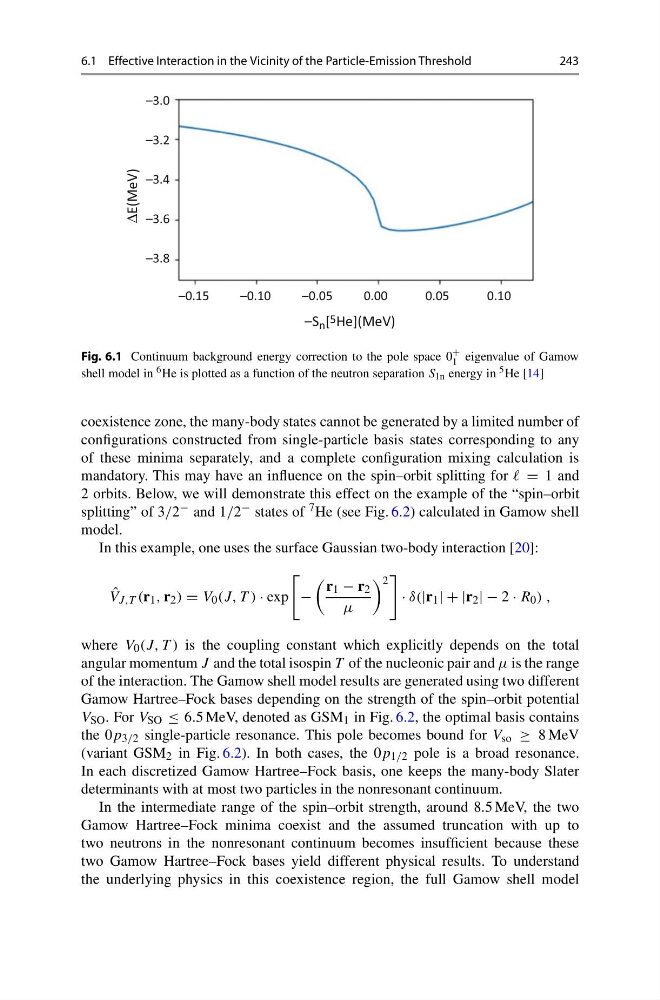
Fig. 6.1 Continuum background energy correction to the pole space 0
+
1 eigenvalue of Gamow
shell model in 6 He is plotted as a function of the neutron separation S 1n energy in 5 He [14]
coexistence zone, the many-body states cannot be generated by a limited number of
configurations constructed from single-particle basis states corresponding to any
of these minima separately, and a complete configuration mixing calculation is
mandatory. This may have an influence on the spin–orbit splitting for = 1 and
2 orbits. Below, we will demonstrate this effect on the example of the “spin–orbit
splitting” of 3/2 − and 1/2 − states of 7 He (see Fig. 6.2) calculated in Gamow shell
model.
In this example, one uses the surface Gaussian two-body interaction [20]:
ˆ
V J,T (r 1 , r 2 ) = V 0 (J, T ) · exp
−
r 1 − r 2
μ
2
· δ(|r 1 | + |r 2 | − 2 · R 0 ) ,
where V 0 (J, T ) is the coupling constant which explicitly depends on the total
angular momentum J and the total isospin T of the nucleonic pair and μ is the range
of the interaction. The Gamow shell model results are generated using two different
Gamow Hartree–Fock bases depending on the strength of the spin–orbit potential
V SO . For V SO ≤ 6.5 MeV, denoted as GSM 1 in Fig. 6.2, the optimal basis contains
the 0p 3/2 single-particle resonance. This pole becomes bound for V so ≥ 8 MeV
(variant GSM 2 in Fig. 6.2). In both cases, the 0p 1/2 pole is a broad resonance.
In each discretized Gamow Hartree–Fock basis, one keeps the many-body Slater
determinants with at most two particles in the nonresonant continuum.
In the intermediate range of the spin–orbit strength, around 8.5 MeV, the two
Gamow Hartree–Fock minima coexist and the assumed truncation with up to
two neutrons in the nonresonant continuum becomes insufficient because these
two Gamow Hartree–Fock bases yield different physical results. To understand
the underlying physics in this coexistence region, the full Gamow shell model
243
–0.15
–3.8
–3.6
–3.4
–3.2
–3.0
–0.10
–S n [ 5 He](MeV)
ΔE(MeV)
–0.05
0.00
0.05
0.10
Fig. 6.1 Continuum background energy correction to the pole space 0
+
1 eigenvalue of Gamow
shell model in 6 He is plotted as a function of the neutron separation S 1n energy in 5 He [14]
coexistence zone, the many-body states cannot be generated by a limited number of
configurations constructed from single-particle basis states corresponding to any
of these minima separately, and a complete configuration mixing calculation is
mandatory. This may have an influence on the spin–orbit splitting for = 1 and
2 orbits. Below, we will demonstrate this effect on the example of the “spin–orbit
splitting” of 3/2 − and 1/2 − states of 7 He (see Fig. 6.2) calculated in Gamow shell
model.
In this example, one uses the surface Gaussian two-body interaction [20]:
ˆ
V J,T (r 1 , r 2 ) = V 0 (J, T ) · exp
−
r 1 − r 2
μ
2
· δ(|r 1 | + |r 2 | − 2 · R 0 ) ,
where V 0 (J, T ) is the coupling constant which explicitly depends on the total
angular momentum J and the total isospin T of the nucleonic pair and μ is the range
of the interaction. The Gamow shell model results are generated using two different
Gamow Hartree–Fock bases depending on the strength of the spin–orbit potential
V SO . For V SO ≤ 6.5 MeV, denoted as GSM 1 in Fig. 6.2, the optimal basis contains
the 0p 3/2 single-particle resonance. This pole becomes bound for V so ≥ 8 MeV
(variant GSM 2 in Fig. 6.2). In both cases, the 0p 1/2 pole is a broad resonance.
In each discretized Gamow Hartree–Fock basis, one keeps the many-body Slater
determinants with at most two particles in the nonresonant continuum.
In the intermediate range of the spin–orbit strength, around 8.5 MeV, the two
Gamow Hartree–Fock minima coexist and the assumed truncation with up to
two neutrons in the nonresonant continuum becomes insufficient because these
two Gamow Hartree–Fock bases yield different physical results. To understand
the underlying physics in this coexistence region, the full Gamow shell model