

212
5 Formulation and Implementation of the Gamow Shell Model
5.6
Calculation of Two-Body Matrix Elements in the Gamow
Shell Model
Realistic interactions are defined with the relative coordinate of the two nucleons.
The shell model approaches, on the other side, demand the use of laboratory or
cluster orbital shell model coordinates. The change from relative to laboratory
coordinates is straightforward using a basis of harmonic oscillator states by the way
of Talmi-Brody-Moshinsky coefficients [23]. Consequently, the calculation of the
two-body matrix elements of realistic interactions poses no problem in standard
shell model.
However, the Talmi-Brody-Moshinsky transformation cannot be directly applied
in the Berggren basis. The extension of the Brody-Moshinsky transformation to
arbitrary bases can be done, in fact, with vector brackets [24–26] at the price,
however, of very time-consuming calculations. Indeed, the finite sums entering the
Talmi-Brody-Moshinsky transformation become the two-dimensional integrals with
vector brackets. Moreover, the presence in vector brackets of the Dirac delta and
Heaviside function, which are not analytical in the complex plane, makes the use of
complex-energy states difficult.
The solution to these theoretical and practical problems comes from the fact
that the effect of nuclear interaction for bound and resonance states is localized
in the vicinity of a nucleus. Consequently, one can assume that in Gamow shell
model calculations a decomposition of the nuclear interaction in a basis of harmonic
oscillator states will converge rapidly (see Sect. 2.2).
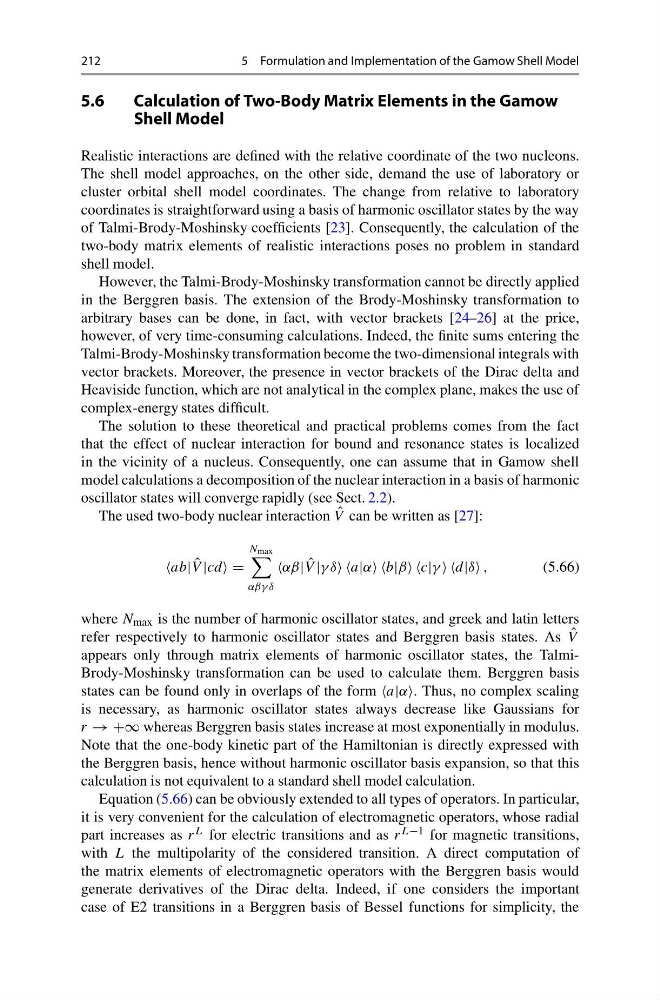
The used two-body nuclear interaction ˆ
V can be written as [27]:
ab| ˆ
V |cd =
N max
αβγ δ
αβ| ˆ
V |γ δ ,
(5.66)
where N max is the number of harmonic oscillator states, and greek and latin letters
refer respectively to harmonic oscillator states and Berggren basis states. As ˆ
V
appears only through matrix elements of harmonic oscillator states, the TalmiBrody-Moshinsky transformation can be used to calculate them. Berggren basis
states can be found only in overlaps of the form Thus, no complex scaling
is necessary, as harmonic oscillator states always decrease like Gaussians for
r → +∞ whereas Berggren basis states increase at most exponentially in modulus.
Note that the one-body kinetic part of the Hamiltonian is directly expressed with
the Berggren basis, hence without harmonic oscillator basis expansion, so that this
calculation is not equivalent to a standard shell model calculation.
Equation (5.66) can be obviously extended to all types of operators. In particular,
it is very convenient for the calculation of electromagnetic operators, whose radial
part increases as r L for electric transitions and as r L−1 for magnetic transitions,
with L the multipolarity of the considered transition. A direct computation of
the matrix elements of electromagnetic operators with the Berggren basis would
generate derivatives of the Dirac delta. Indeed, if one considers the important
case of E2 transitions in a Berggren basis of Bessel functions for simplicity, the
5 Formulation and Implementation of the Gamow Shell Model
5.6
Calculation of Two-Body Matrix Elements in the Gamow
Shell Model
Realistic interactions are defined with the relative coordinate of the two nucleons.
The shell model approaches, on the other side, demand the use of laboratory or
cluster orbital shell model coordinates. The change from relative to laboratory
coordinates is straightforward using a basis of harmonic oscillator states by the way
of Talmi-Brody-Moshinsky coefficients [23]. Consequently, the calculation of the
two-body matrix elements of realistic interactions poses no problem in standard
shell model.
However, the Talmi-Brody-Moshinsky transformation cannot be directly applied
in the Berggren basis. The extension of the Brody-Moshinsky transformation to
arbitrary bases can be done, in fact, with vector brackets [24–26] at the price,
however, of very time-consuming calculations. Indeed, the finite sums entering the
Talmi-Brody-Moshinsky transformation become the two-dimensional integrals with
vector brackets. Moreover, the presence in vector brackets of the Dirac delta and
Heaviside function, which are not analytical in the complex plane, makes the use of
complex-energy states difficult.
The solution to these theoretical and practical problems comes from the fact
that the effect of nuclear interaction for bound and resonance states is localized
in the vicinity of a nucleus. Consequently, one can assume that in Gamow shell
model calculations a decomposition of the nuclear interaction in a basis of harmonic
oscillator states will converge rapidly (see Sect. 2.2).
The used two-body nuclear interaction ˆ
V can be written as [27]:
ab| ˆ
V |cd =
N max
αβγ δ
αβ| ˆ
V |γ δ ,
(5.66)
where N max is the number of harmonic oscillator states, and greek and latin letters
refer respectively to harmonic oscillator states and Berggren basis states. As ˆ
V
appears only through matrix elements of harmonic oscillator states, the TalmiBrody-Moshinsky transformation can be used to calculate them. Berggren basis
states can be found only in overlaps of the form Thus, no complex scaling
is necessary, as harmonic oscillator states always decrease like Gaussians for
r → +∞ whereas Berggren basis states increase at most exponentially in modulus.
Note that the one-body kinetic part of the Hamiltonian is directly expressed with
the Berggren basis, hence without harmonic oscillator basis expansion, so that this
calculation is not equivalent to a standard shell model calculation.
Equation (5.66) can be obviously extended to all types of operators. In particular,
it is very convenient for the calculation of electromagnetic operators, whose radial
part increases as r L for electric transitions and as r L−1 for magnetic transitions,
with L the multipolarity of the considered transition. A direct computation of
the matrix elements of electromagnetic operators with the Berggren basis would
generate derivatives of the Dirac delta. Indeed, if one considers the important
case of E2 transitions in a Berggren basis of Bessel functions for simplicity, the