

5.2 Translationally Invariant Shell Model Scheme: The Cluster Orbital Shell. . .
201
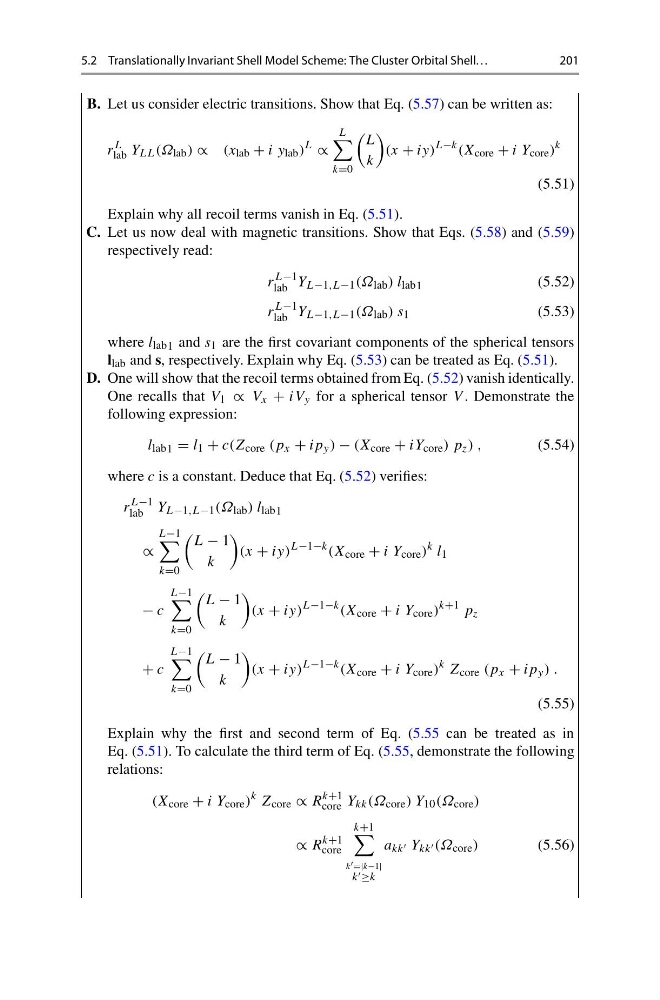
B. Let us consider electric transitions. Show that Eq. (5.57) can be written as:
r
L
lab Y LL (Ω lab ) ∝ (x lab + i y lab )
L
∝
L
k=0
L
k
(x + iy)
L−k (X core + i Y core )
k
(5.51)
Explain why all recoil terms vanish in Eq. (5.51).
C. Let us now deal with magnetic transitions. Show that Eqs. (5.58) and (5.59)
respectively read:
r
L−1
lab Y L−1,L−1 (Ω lab ) l lab1
(5.52)
r
L−1
lab Y L−1,L−1 (Ω lab ) s 1
(5.53)
where l lab1 and s 1 are the first covariant components of the spherical tensors
l lab and s, respectively. Explain why Eq. (5.53) can be treated as Eq. (5.51).
D. One will show that the recoil terms obtained from Eq. (5.52) vanish identically.
One recalls that V 1 ∝ V x + iV y for a spherical tensor V . Demonstrate the
following expression:
l lab1 = l 1 + c(Z core (p x + ip y ) − (X core + iY core ) p z ) ,
(5.54)
where c is a constant. Deduce that Eq. (5.52) verifies:
r
L−1
lab Y L−1,L−1 (Ω lab ) l lab1
∝
L−1
k=0
L − 1
k
(x + iy)
L−1−k (X core + i Y core )
k l 1
− c
L−1
k=0
L − 1
k
(x + iy)
L−1−k (X core + i Y core )
k+1 p z
+ c
L−1
k=0
L − 1
k
(x + iy)
L−1−k (X core + i Y core )
k Z core (p x + ip y ) .
(5.55)
Explain why the first and second term of Eq. (5.55 can be treated as in
Eq. (5.51). To calculate the third term of Eq. (5.55, demonstrate the following
relations:
(X core + i Y core )
k Z core ∝ R
k+1
core Y kk (Ω core ) Y 10 (Ω core )
∝ R
k+1
core
k+1
k =|k−1|
k ≥k
a kk Y kk (Ω core )
(5.56)
201
B. Let us consider electric transitions. Show that Eq. (5.57) can be written as:
r
L
lab Y LL (Ω lab ) ∝ (x lab + i y lab )
L
∝
L
k=0
L
k
(x + iy)
L−k (X core + i Y core )
k
(5.51)
Explain why all recoil terms vanish in Eq. (5.51).
C. Let us now deal with magnetic transitions. Show that Eqs. (5.58) and (5.59)
respectively read:
r
L−1
lab Y L−1,L−1 (Ω lab ) l lab1
(5.52)
r
L−1
lab Y L−1,L−1 (Ω lab ) s 1
(5.53)
where l lab1 and s 1 are the first covariant components of the spherical tensors
l lab and s, respectively. Explain why Eq. (5.53) can be treated as Eq. (5.51).
D. One will show that the recoil terms obtained from Eq. (5.52) vanish identically.
One recalls that V 1 ∝ V x + iV y for a spherical tensor V . Demonstrate the
following expression:
l lab1 = l 1 + c(Z core (p x + ip y ) − (X core + iY core ) p z ) ,
(5.54)
where c is a constant. Deduce that Eq. (5.52) verifies:
r
L−1
lab Y L−1,L−1 (Ω lab ) l lab1
∝
L−1
k=0
L − 1
k
(x + iy)
L−1−k (X core + i Y core )
k l 1
− c
L−1
k=0
L − 1
k
(x + iy)
L−1−k (X core + i Y core )
k+1 p z
+ c
L−1
k=0
L − 1
k
(x + iy)
L−1−k (X core + i Y core )
k Z core (p x + ip y ) .
(5.55)
Explain why the first and second term of Eq. (5.55 can be treated as in
Eq. (5.51). To calculate the third term of Eq. (5.55, demonstrate the following
relations:
(X core + i Y core )
k Z core ∝ R
k+1
core Y kk (Ω core ) Y 10 (Ω core )
∝ R
k+1
core
k+1
k =|k−1|
k ≥k
a kk Y kk (Ω core )
(5.56)