

200
5 Formulation and Implementation of the Gamow Shell Model
where ν is proton or neutron, N ν is the number of protons (Z) or neutrons (N), ν
runs over all protons or neutrons, and:
R CM =
m p
M
p
r p,lab +
m n
M
n
r n,lab .
(5.47)
is the center-of-mass of the nucleus. R CM also bears a concise expression using
cluster orbital shell model coordinates:
R CM = R CM,core +
m p
M
p∈val
r p +
m n
M
n∈val
r n ,
(5.48)
where one has used Eqs. (5.24–5.26). The total root-mean-square radius is a simple
function of the proton and neutron root-mean-square radii:
R rms =
Z
A
R
2
p;rms +
N
A
R
2
n;rms
1/2
.
(5.49)
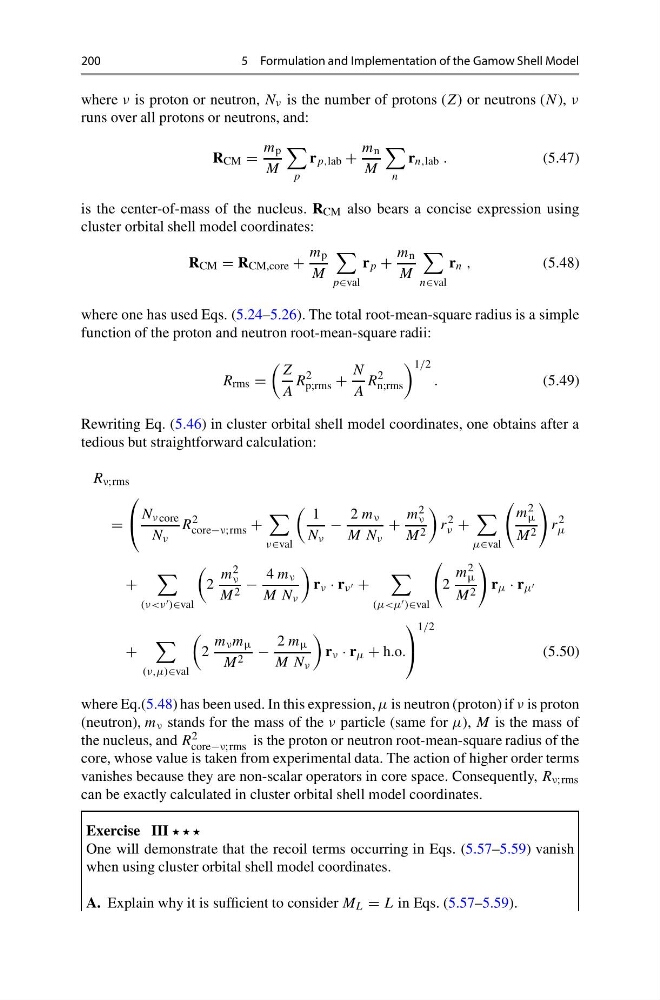
Rewriting Eq. (5.46) in cluster orbital shell model coordinates, one obtains after a
tedious but straightforward calculation:
R ν;rms
=
⎛
⎝ N ν core
N ν
R
2
core−ν;rms +
ν∈val
1
N ν
−
2 m ν
M N ν
+
m 2
ν
M 2
r
2
ν +
μ∈val
m 2
μ
M 2
r
2
μ
+
(ν<ν )∈val
2
m 2
ν
M 2 −
4 m ν
M N ν
r ν · r ν +
(μ<μ )∈val
2
m 2
μ
M 2
r μ · r μ
+
(ν,μ)∈val
2
m ν m μ
M 2 −
2 m μ
M N ν
r ν · r μ + h.o.
⎞
⎠
1/2
(5.50)
where Eq.(5.48) has been used. In this expression, μ is neutron (proton) if ν is proton
(neutron), m ν stands for the mass of the ν particle (same for μ), M is the mass of
the nucleus, and R 2
core−ν;rms is the proton or neutron root-mean-square radius of the
core, whose value is taken from experimental data. The action of higher order terms
vanishes because they are non-scalar operators in core space. Consequently, R ν;rms
can be exactly calculated in cluster orbital shell model coordinates.
Exercise III
One will demonstrate that the recoil terms occurring in Eqs. (5.57–5.59) vanish
when using cluster orbital shell model coordinates.
A. Explain why it is sufficient to consider M L = L in Eqs. (5.57–5.59).
5 Formulation and Implementation of the Gamow Shell Model
where ν is proton or neutron, N ν is the number of protons (Z) or neutrons (N), ν
runs over all protons or neutrons, and:
R CM =
m p
M
p
r p,lab +
m n
M
n
r n,lab .
(5.47)
is the center-of-mass of the nucleus. R CM also bears a concise expression using
cluster orbital shell model coordinates:
R CM = R CM,core +
m p
M
p∈val
r p +
m n
M
n∈val
r n ,
(5.48)
where one has used Eqs. (5.24–5.26). The total root-mean-square radius is a simple
function of the proton and neutron root-mean-square radii:
R rms =
Z
A
R
2
p;rms +
N
A
R
2
n;rms
1/2
.
(5.49)
Rewriting Eq. (5.46) in cluster orbital shell model coordinates, one obtains after a
tedious but straightforward calculation:
R ν;rms
=
⎛
⎝ N ν core
N ν
R
2
core−ν;rms +
ν∈val
1
N ν
−
2 m ν
M N ν
+
m 2
ν
M 2
r
2
ν +
μ∈val
m 2
μ
M 2
r
2
μ
+
(ν<ν )∈val
2
m 2
ν
M 2 −
4 m ν
M N ν
r ν · r ν +
(μ<μ )∈val
2
m 2
μ
M 2
r μ · r μ
+
(ν,μ)∈val
2
m ν m μ
M 2 −
2 m μ
M N ν
r ν · r μ + h.o.
⎞
⎠
1/2
(5.50)
where Eq.(5.48) has been used. In this expression, μ is neutron (proton) if ν is proton
(neutron), m ν stands for the mass of the ν particle (same for μ), M is the mass of
the nucleus, and R 2
core−ν;rms is the proton or neutron root-mean-square radius of the
core, whose value is taken from experimental data. The action of higher order terms
vanishes because they are non-scalar operators in core space. Consequently, R ν;rms
can be exactly calculated in cluster orbital shell model coordinates.
Exercise III
One will demonstrate that the recoil terms occurring in Eqs. (5.57–5.59) vanish
when using cluster orbital shell model coordinates.
A. Explain why it is sufficient to consider M L = L in Eqs. (5.57–5.59).