

198
5 Formulation and Implementation of the Gamow Shell Model
In fact, the two-body interaction in laboratory coordinates becomes the A-body
interaction in cluster orbital shell model coordinates.
A solution to this problem can be found by demanding all couplings between core
and valence spaces to vanish. In practice, in order to impose these conditions, it is
necessary to define effective interactions directly with cluster orbital shell model
coordinates. As realistic interactions are defined in a no-core picture, where all
nucleons interact, the use of realistic interactions in the cluster orbital shell model
seems to be impossible.
One can solve this problem by firstly defining an effective interaction derived
from a realistic interaction, with core and valence parts calculated in the laboratory
frame, so that couplings between core and valence spaces vanish. To illustrate this
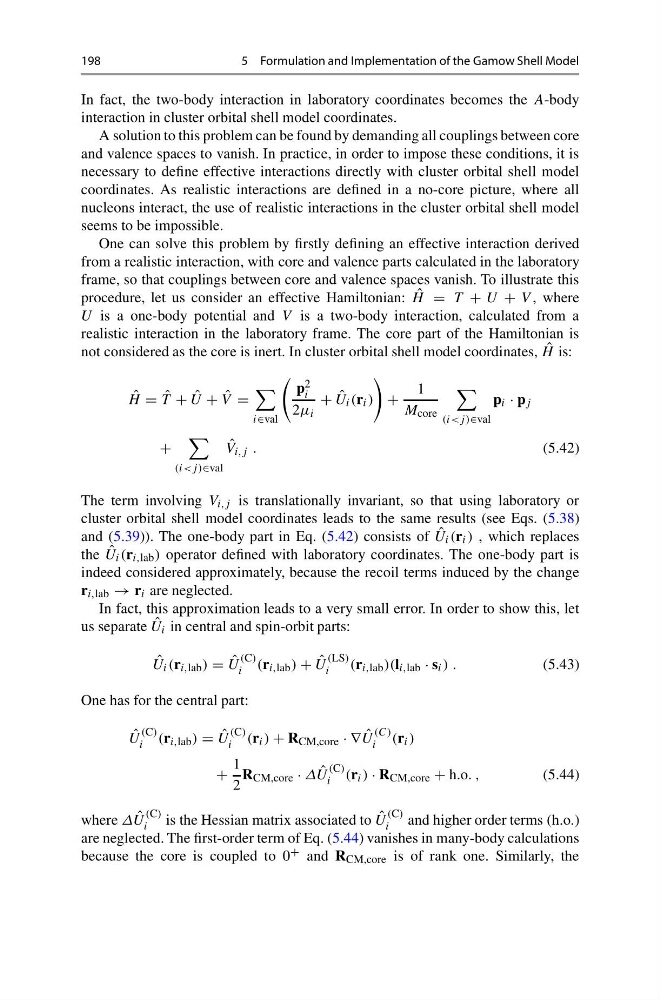
procedure, let us consider an effective Hamiltonian: ˆ
H = T + U + V , where
U is a one-body potential and V is a two-body interaction, calculated from a
realistic interaction in the laboratory frame. The core part of the Hamiltonian is
not considered as the core is inert. In cluster orbital shell model coordinates, ˆ
H is:
ˆ
H = ˆ
T + ˆ
U + ˆ
V =
i∈val
p 2
i
2μ i
+ ˆ
U i (r i )
+
1
M core
(i
+
(i
V i,j .
(5.42)
The term involving V i,j is translationally invariant, so that using laboratory or
cluster orbital shell model coordinates leads to the same results (see Eqs. (5.38)
and (5.39)). The one-body part in Eq. (5.42) consists of ˆ
U i (r i ) , which replaces
the ˆ
U i (r i,lab ) operator defined with laboratory coordinates. The one-body part is
indeed considered approximately, because the recoil terms induced by the change
r i,lab → r i are neglected.
In fact, this approximation leads to a very small error. In order to show this, let
us separate ˆ
U i in central and spin-orbit parts:
ˆ
U i (r i,lab ) = ˆ
U
(C)
i (r i,lab ) + ˆ
U
(LS)
i
(r i,lab )(l i,lab · s i ) .
(5.43)
One has for the central part:
ˆ
U
(C)
i (r i,lab ) = ˆ
U
(C)
i (r i ) + R CM,core · ∇ ˆ
U
(C)
i (r i )
+
1
2
R CM,core · Δ ˆ
U
(C)
i (r i ) · R CM,core + h.o. ,
(5.44)
where Δ ˆ
U
(C)
i
is the Hessian matrix associated to ˆ
U
(C)
i
and higher order terms (h.o.)
are neglected. The first-order term of Eq. (5.44) vanishes in many-body calculations
because the core is coupled to 0 + and R CM,core is of rank one. Similarly, the
5 Formulation and Implementation of the Gamow Shell Model
In fact, the two-body interaction in laboratory coordinates becomes the A-body
interaction in cluster orbital shell model coordinates.
A solution to this problem can be found by demanding all couplings between core
and valence spaces to vanish. In practice, in order to impose these conditions, it is
necessary to define effective interactions directly with cluster orbital shell model
coordinates. As realistic interactions are defined in a no-core picture, where all
nucleons interact, the use of realistic interactions in the cluster orbital shell model
seems to be impossible.
One can solve this problem by firstly defining an effective interaction derived
from a realistic interaction, with core and valence parts calculated in the laboratory
frame, so that couplings between core and valence spaces vanish. To illustrate this
procedure, let us consider an effective Hamiltonian: ˆ
H = T + U + V , where
U is a one-body potential and V is a two-body interaction, calculated from a
realistic interaction in the laboratory frame. The core part of the Hamiltonian is
not considered as the core is inert. In cluster orbital shell model coordinates, ˆ
H is:
ˆ
H = ˆ
T + ˆ
U + ˆ
V =
i∈val
p 2
i
2μ i
+ ˆ
U i (r i )
+
1
M core
(i
+
(i
V i,j .
(5.42)
The term involving V i,j is translationally invariant, so that using laboratory or
cluster orbital shell model coordinates leads to the same results (see Eqs. (5.38)
and (5.39)). The one-body part in Eq. (5.42) consists of ˆ
U i (r i ) , which replaces
the ˆ
U i (r i,lab ) operator defined with laboratory coordinates. The one-body part is
indeed considered approximately, because the recoil terms induced by the change
r i,lab → r i are neglected.
In fact, this approximation leads to a very small error. In order to show this, let
us separate ˆ
U i in central and spin-orbit parts:
ˆ
U i (r i,lab ) = ˆ
U
(C)
i (r i,lab ) + ˆ
U
(LS)
i
(r i,lab )(l i,lab · s i ) .
(5.43)
One has for the central part:
ˆ
U
(C)
i (r i,lab ) = ˆ
U
(C)
i (r i ) + R CM,core · ∇ ˆ
U
(C)
i (r i )
+
1
2
R CM,core · Δ ˆ
U
(C)
i (r i ) · R CM,core + h.o. ,
(5.44)
where Δ ˆ
U
(C)
i
is the Hessian matrix associated to ˆ
U
(C)
i
and higher order terms (h.o.)
are neglected. The first-order term of Eq. (5.44) vanishes in many-body calculations
because the core is coupled to 0 + and R CM,core is of rank one. Similarly, the