

5.2 Translationally Invariant Shell Model Scheme: The Cluster Orbital Shell. . .
197
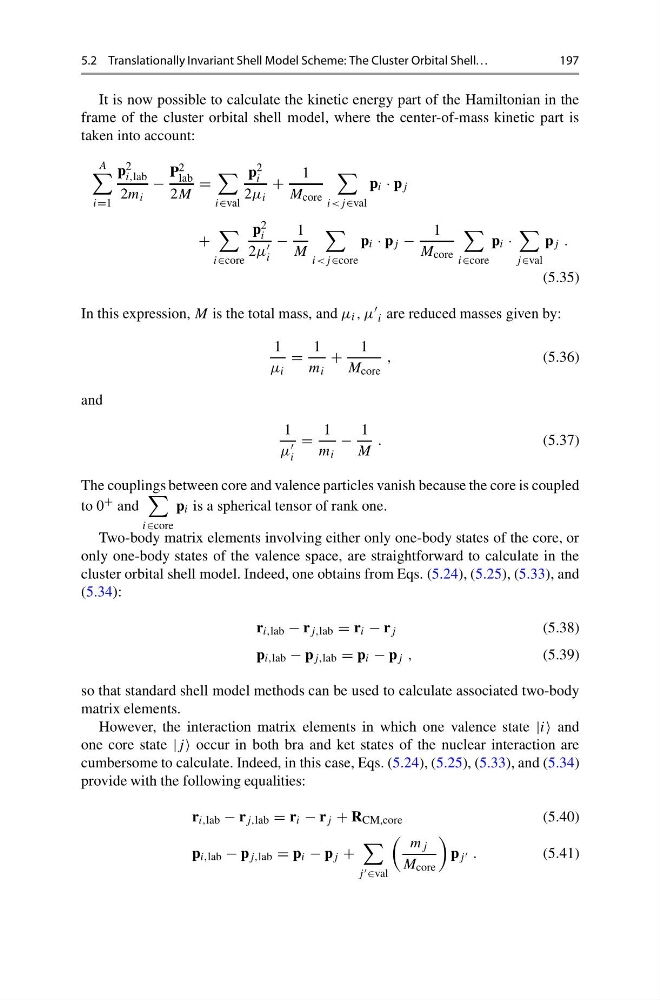
It is now possible to calculate the kinetic energy part of the Hamiltonian in the
frame of the cluster orbital shell model, where the center-of-mass kinetic part is
taken into account:
A
i=1
p 2
i,lab
2m i
−
P 2
lab
2M
=
i∈val
p 2
i
2μ i
+
1
M core
i
+
i∈core
p 2
i
2μ
i
−
1
M
i
1
M core
i∈core
p i ·
j ∈val
p j .
(5.35)
In this expression, M is the total mass, and μ i , μ
i are reduced masses given by:
1
μ i
=
1
m i
+
1
M core
,
(5.36)
and
1
μ
i
=
1
m i
−
1
M
.
(5.37)
The couplings between core and valence particles vanish because the core is coupled
to 0 + and
i∈core
p i is a spherical tensor of rank one.
Two-body matrix elements involving either only one-body states of the core, or
only one-body states of the valence space, are straightforward to calculate in the
cluster orbital shell model. Indeed, one obtains from Eqs. (5.24), (5.25), (5.33), and
(5.34):
r i,lab − r j,lab = r i − r j
(5.38)
p i,lab − p j,lab = p i − p j ,
(5.39)
so that standard shell model methods can be used to calculate associated two-body
matrix elements.
However, the interaction matrix elements in which one valence state |i and
one core state |j occur in both bra and ket states of the nuclear interaction are
cumbersome to calculate. Indeed, in this case, Eqs. (5.24), (5.25), (5.33), and (5.34)
provide with the following equalities:
r i,lab − r j,lab = r i − r j + R CM,core
(5.40)
p i,lab − p j,lab = p i − p j +
j ∈val
m j
M core
p j .
(5.41)
197
It is now possible to calculate the kinetic energy part of the Hamiltonian in the
frame of the cluster orbital shell model, where the center-of-mass kinetic part is
taken into account:
A
i=1
p 2
i,lab
2m i
−
P 2
lab
2M
=
i∈val
p 2
i
2μ i
+
1
M core
i
+
i∈core
p 2
i
2μ
i
−
1
M
i
1
M core
i∈core
p i ·
j ∈val
p j .
(5.35)
In this expression, M is the total mass, and μ i , μ
i are reduced masses given by:
1
μ i
=
1
m i
+
1
M core
,
(5.36)
and
1
μ
i
=
1
m i
−
1
M
.
(5.37)
The couplings between core and valence particles vanish because the core is coupled
to 0 + and
i∈core
p i is a spherical tensor of rank one.
Two-body matrix elements involving either only one-body states of the core, or
only one-body states of the valence space, are straightforward to calculate in the
cluster orbital shell model. Indeed, one obtains from Eqs. (5.24), (5.25), (5.33), and
(5.34):
r i,lab − r j,lab = r i − r j
(5.38)
p i,lab − p j,lab = p i − p j ,
(5.39)
so that standard shell model methods can be used to calculate associated two-body
matrix elements.
However, the interaction matrix elements in which one valence state |i and
one core state |j occur in both bra and ket states of the nuclear interaction are
cumbersome to calculate. Indeed, in this case, Eqs. (5.24), (5.25), (5.33), and (5.34)
provide with the following equalities:
r i,lab − r j,lab = r i − r j + R CM,core
(5.40)
p i,lab − p j,lab = p i − p j +
j ∈val
m j
M core
p j .
(5.41)