

178
4 Two-Particle Systems in the Berggren Basis
0.0
0.2
0.4
0.6
0.8
1.0
Re(n
j
)
(a)
s 1/2
d 5/2
g 9/2
1 /2 5 /2 9 /2 13 /2 17 /2
0.0
0.4
0.8
1.2
Γ
j
(MeV)
(b)
11 Be
d 5/2
(c)
s 1/2
d 5/2
3 /2
(d)
s 1/2 d 5/2
J
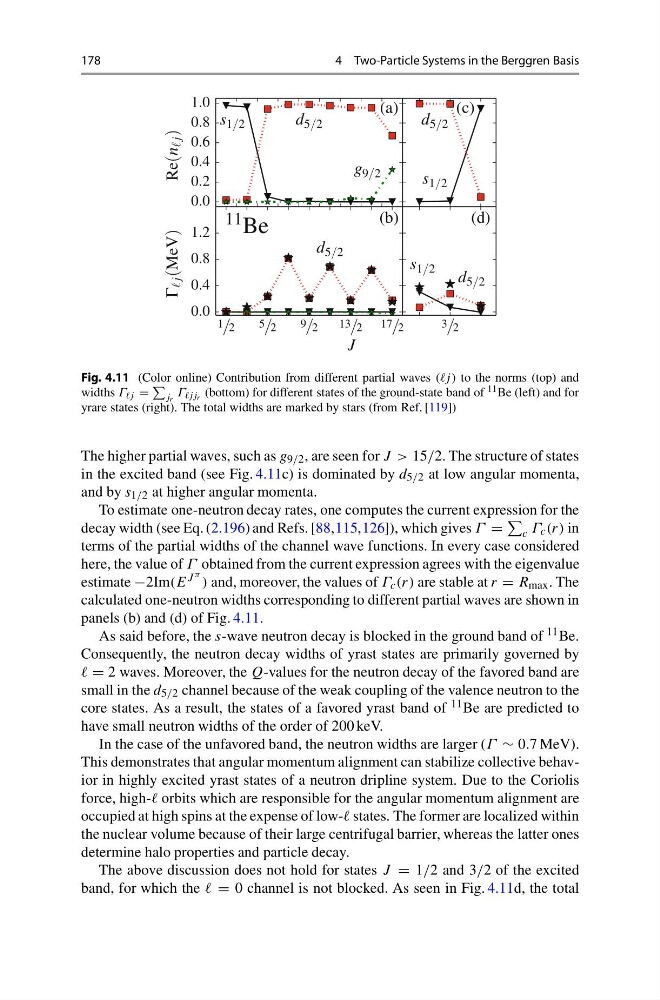
Fig. 4.11 (Color online) Contribution from different partial waves ((j ) to the norms (top) and
widths Γ =
jr Γ jjr (bottom) for different states of the ground-state band of 11 Be (left) and for
yrare states (right). The total widths are marked by stars (from Ref. [119])
The higher partial waves, such as g 9/2 , are seen for J > 15/2. The structure of states
in the excited band (see Fig. 4.11c) is dominated by d 5/2 at low angular momenta,
and by s 1/2 at higher angular momenta.
To estimate one-neutron decay rates, one computes the current expression for the
decay width (see Eq. (2.196) and Refs. [88,115,126]), which gives Γ =
c Γ c (r) in
terms of the partial widths of the channel wave functions. In every case considered
here, the value of Γ obtained from the current expression agrees with the eigenvalue
estimate −2Im(E J π ) and, moreover, the values of Γ c (r) are stable at r = R max . The
calculated one-neutron widths corresponding to different partial waves are shown in
panels (b) and (d) of Fig. 4.11.
As said before, the s-wave neutron decay is blocked in the ground band of 11 Be.
Consequently, the neutron decay widths of yrast states are primarily governed by
= 2 waves. Moreover, the Q-values for the neutron decay of the favored band are
small in the d 5/2 channel because of the weak coupling of the valence neutron to the
core states. As a result, the states of a favored yrast band of 11 Be are predicted to
have small neutron widths of the order of 200 keV.
In the case of the unfavored band, the neutron widths are larger (Γ ∼ 0.7 MeV).
This demonstrates that angular momentum alignment can stabilize collective behavior in highly excited yrast states of a neutron dripline system. Due to the Coriolis
force, high- orbits which are responsible for the angular momentum alignment are
occupied at high spins at the expense of low- states. The former are localized within
the nuclear volume because of their large centrifugal barrier, whereas the latter ones
determine halo properties and particle decay.
The above discussion does not hold for states J = 1/2 and 3/2 of the excited
band, for which the = 0 channel is not blocked. As seen in Fig. 4.11d, the total
4 Two-Particle Systems in the Berggren Basis
0.0
0.2
0.4
0.6
0.8
1.0
Re(n
j
)
(a)
s 1/2
d 5/2
g 9/2
1 /2 5 /2 9 /2 13 /2 17 /2
0.0
0.4
0.8
1.2
Γ
j
(MeV)
(b)
11 Be
d 5/2
(c)
s 1/2
d 5/2
3 /2
(d)
s 1/2 d 5/2
J
Fig. 4.11 (Color online) Contribution from different partial waves ((j ) to the norms (top) and
widths Γ =
jr Γ jjr (bottom) for different states of the ground-state band of 11 Be (left) and for
yrare states (right). The total widths are marked by stars (from Ref. [119])
The higher partial waves, such as g 9/2 , are seen for J > 15/2. The structure of states
in the excited band (see Fig. 4.11c) is dominated by d 5/2 at low angular momenta,
and by s 1/2 at higher angular momenta.
To estimate one-neutron decay rates, one computes the current expression for the
decay width (see Eq. (2.196) and Refs. [88,115,126]), which gives Γ =
c Γ c (r) in
terms of the partial widths of the channel wave functions. In every case considered
here, the value of Γ obtained from the current expression agrees with the eigenvalue
estimate −2Im(E J π ) and, moreover, the values of Γ c (r) are stable at r = R max . The
calculated one-neutron widths corresponding to different partial waves are shown in
panels (b) and (d) of Fig. 4.11.
As said before, the s-wave neutron decay is blocked in the ground band of 11 Be.
Consequently, the neutron decay widths of yrast states are primarily governed by
= 2 waves. Moreover, the Q-values for the neutron decay of the favored band are
small in the d 5/2 channel because of the weak coupling of the valence neutron to the
core states. As a result, the states of a favored yrast band of 11 Be are predicted to
have small neutron widths of the order of 200 keV.
In the case of the unfavored band, the neutron widths are larger (Γ ∼ 0.7 MeV).
This demonstrates that angular momentum alignment can stabilize collective behavior in highly excited yrast states of a neutron dripline system. Due to the Coriolis
force, high- orbits which are responsible for the angular momentum alignment are
occupied at high spins at the expense of low- states. The former are localized within
the nuclear volume because of their large centrifugal barrier, whereas the latter ones
determine halo properties and particle decay.
The above discussion does not hold for states J = 1/2 and 3/2 of the excited
band, for which the = 0 channel is not blocked. As seen in Fig. 4.11d, the total