

4.3 The Particle-Rotor Model in the Berggren Basis
177
1 /2 3 /2 5 /2 7 /2 9 /2 11 /2 13 /2
J
0
5
10
Energy (MeV)
11 Be
r = +i
r = -i
E 4 +
d
E 2 +
d
E 0 +
d
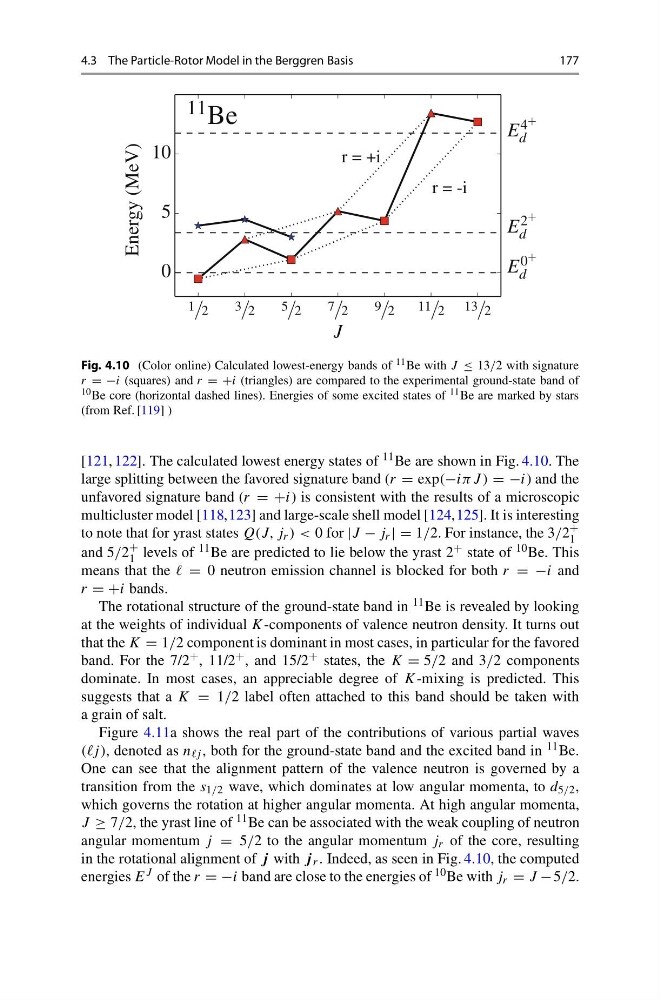
Fig. 4.10 (Color online) Calculated lowest-energy bands of 11 Be with J ≤ 13/2 with signature
r = −i (squares) and r = +i (triangles) are compared to the experimental ground-state band of
10 Be core (horizontal dashed lines). Energies of some excited states of 11 Be are marked by stars
(from Ref. [119] )
[121, 122]. The calculated lowest energy states of 11 Be are shown in Fig. 4.10. The
large splitting between the favored signature band (r = exp(−iπJ ) = −i) and the
unfavored signature band (r = +i) is consistent with the results of a microscopic
multicluster model [118,123] and large-scale shell model [124,125]. It is interesting
to note that for yrast states Q(J, j r ) < 0 for |J − j r | = 1/2. For instance, the 3/2
+
1
and 5/2
+
1 levels of 11 Be are predicted to lie below the yrast 2 + state of 10 Be. This
means that the = 0 neutron emission channel is blocked for both r = −i and
r = +i bands.
The rotational structure of the ground-state band in 11 Be is revealed by looking
at the weights of individual K-components of valence neutron density. It turns out
that the K = 1/2 component is dominant in most cases, in particular for the favored
band. For the 7/2 + , 11/2 + , and 15/2 + states, the K = 5/2 and 3/2 components
dominate. In most cases, an appreciable degree of K-mixing is predicted. This
suggests that a K = 1/2 label often attached to this band should be taken with
a grain of salt.
Figure 4.11a shows the real part of the contributions of various partial waves
((j ), denoted as n j , both for the ground-state band and the excited band in 11 Be.
One can see that the alignment pattern of the valence neutron is governed by a
transition from the s 1/2 wave, which dominates at low angular momenta, to d 5/2 ,
which governs the rotation at higher angular momenta. At high angular momenta,
J ≥ 7/2, the yrast line of 11 Be can be associated with the weak coupling of neutron
angular momentum j = 5/2 to the angular momentum j r of the core, resulting
in the rotational alignment of j with j r . Indeed, as seen in Fig. 4.10, the computed
energies E J of the r = −i band are close to the energies of 10 Be with j r = J − 5/2.
177
1 /2 3 /2 5 /2 7 /2 9 /2 11 /2 13 /2
J
0
5
10
Energy (MeV)
11 Be
r = +i
r = -i
E 4 +
d
E 2 +
d
E 0 +
d
Fig. 4.10 (Color online) Calculated lowest-energy bands of 11 Be with J ≤ 13/2 with signature
r = −i (squares) and r = +i (triangles) are compared to the experimental ground-state band of
10 Be core (horizontal dashed lines). Energies of some excited states of 11 Be are marked by stars
(from Ref. [119] )
[121, 122]. The calculated lowest energy states of 11 Be are shown in Fig. 4.10. The
large splitting between the favored signature band (r = exp(−iπJ ) = −i) and the
unfavored signature band (r = +i) is consistent with the results of a microscopic
multicluster model [118,123] and large-scale shell model [124,125]. It is interesting
to note that for yrast states Q(J, j r ) < 0 for |J − j r | = 1/2. For instance, the 3/2
+
1
and 5/2
+
1 levels of 11 Be are predicted to lie below the yrast 2 + state of 10 Be. This
means that the = 0 neutron emission channel is blocked for both r = −i and
r = +i bands.
The rotational structure of the ground-state band in 11 Be is revealed by looking
at the weights of individual K-components of valence neutron density. It turns out
that the K = 1/2 component is dominant in most cases, in particular for the favored
band. For the 7/2 + , 11/2 + , and 15/2 + states, the K = 5/2 and 3/2 components
dominate. In most cases, an appreciable degree of K-mixing is predicted. This
suggests that a K = 1/2 label often attached to this band should be taken with
a grain of salt.
Figure 4.11a shows the real part of the contributions of various partial waves
((j ), denoted as n j , both for the ground-state band and the excited band in 11 Be.
One can see that the alignment pattern of the valence neutron is governed by a
transition from the s 1/2 wave, which dominates at low angular momenta, to d 5/2 ,
which governs the rotation at higher angular momenta. At high angular momenta,
J ≥ 7/2, the yrast line of 11 Be can be associated with the weak coupling of neutron
angular momentum j = 5/2 to the angular momentum j r of the core, resulting
in the rotational alignment of j with j r . Indeed, as seen in Fig. 4.10, the computed
energies E J of the r = −i band are close to the energies of 10 Be with j r = J − 5/2.