

168
4 Two-Particle Systems in the Berggren Basis
6
7
8
9 10 11 12 13 14
max
6.35
6.40
6.45
6.50
6.55
Critical moment Q +
zz,c (ea 2
0 )
J π = 0 + , I → ∞ , s = 1.6 a 0
Analytical result
k max = 6 a
−1
0
k max = 8 a
−1
0
k max = 10 a
−1
0
k max = 12 a
−1
0
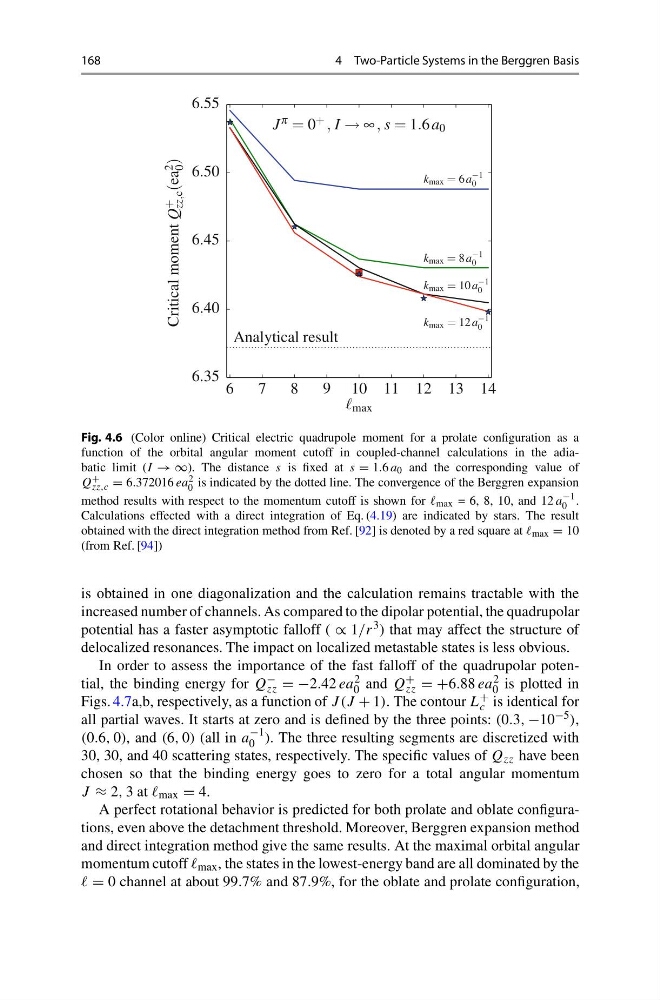
Fig. 4.6 (Color online) Critical electric quadrupole moment for a prolate configuration as a
function of the orbital angular moment cutoff in coupled-channel calculations in the adiabatic limit (I → ∞). The distance s is fixed at s = 1.6 a 0 and the corresponding value of
Q +
zz,c = 6.372016 ea 2
0 is indicated by the dotted line. The convergence of the Berggren expansion
method results with respect to the momentum cutoff is shown for max = 6, 8, 10, and 12 a
−1
0 .
Calculations effected with a direct integration of Eq. (4.19) are indicated by stars. The result
obtained with the direct integration method from Ref. [92] is denoted by a red square at max = 10
(from Ref. [94])
is obtained in one diagonalization and the calculation remains tractable with the
increased number of channels. As compared to the dipolar potential, the quadrupolar
potential has a faster asymptotic falloff ( ∝ 1/r 3 ) that may affect the structure of
delocalized resonances. The impact on localized metastable states is less obvious.
In order to assess the importance of the fast falloff of the quadrupolar potential, the binding energy for Q −
zz = −2.42 ea 2
0 and Q +
zz = +6.88 ea 2
0 is plotted in
Figs. 4.7a,b, respectively, as a function of J (J + 1). The contour L +
c is identical for
all partial waves. It starts at zero and is defined by the three points: (0.3, −10 −5 ),
(0.6, 0), and (6, 0) (all in a
−1
0 ). The three resulting segments are discretized with
30, 30, and 40 scattering states, respectively. The specific values of Q zz have been
chosen so that the binding energy goes to zero for a total angular momentum
J ≈ 2, 3 at max = 4.
A perfect rotational behavior is predicted for both prolate and oblate configurations, even above the detachment threshold. Moreover, Berggren expansion method
and direct integration method give the same results. At the maximal orbital angular
momentum cutoff max , the states in the lowest-energy band are all dominated by the
= 0 channel at about 99.7% and 87.9%, for the oblate and prolate configuration,
4 Two-Particle Systems in the Berggren Basis
6
7
8
9 10 11 12 13 14
max
6.35
6.40
6.45
6.50
6.55
Critical moment Q +
zz,c (ea 2
0 )
J π = 0 + , I → ∞ , s = 1.6 a 0
Analytical result
k max = 6 a
−1
0
k max = 8 a
−1
0
k max = 10 a
−1
0
k max = 12 a
−1
0
Fig. 4.6 (Color online) Critical electric quadrupole moment for a prolate configuration as a
function of the orbital angular moment cutoff in coupled-channel calculations in the adiabatic limit (I → ∞). The distance s is fixed at s = 1.6 a 0 and the corresponding value of
Q +
zz,c = 6.372016 ea 2
0 is indicated by the dotted line. The convergence of the Berggren expansion
method results with respect to the momentum cutoff is shown for max = 6, 8, 10, and 12 a
−1
0 .
Calculations effected with a direct integration of Eq. (4.19) are indicated by stars. The result
obtained with the direct integration method from Ref. [92] is denoted by a red square at max = 10
(from Ref. [94])
is obtained in one diagonalization and the calculation remains tractable with the
increased number of channels. As compared to the dipolar potential, the quadrupolar
potential has a faster asymptotic falloff ( ∝ 1/r 3 ) that may affect the structure of
delocalized resonances. The impact on localized metastable states is less obvious.
In order to assess the importance of the fast falloff of the quadrupolar potential, the binding energy for Q −
zz = −2.42 ea 2
0 and Q +
zz = +6.88 ea 2
0 is plotted in
Figs. 4.7a,b, respectively, as a function of J (J + 1). The contour L +
c is identical for
all partial waves. It starts at zero and is defined by the three points: (0.3, −10 −5 ),
(0.6, 0), and (6, 0) (all in a
−1
0 ). The three resulting segments are discretized with
30, 30, and 40 scattering states, respectively. The specific values of Q zz have been
chosen so that the binding energy goes to zero for a total angular momentum
J ≈ 2, 3 at max = 4.
A perfect rotational behavior is predicted for both prolate and oblate configurations, even above the detachment threshold. Moreover, Berggren expansion method
and direct integration method give the same results. At the maximal orbital angular
momentum cutoff max , the states in the lowest-energy band are all dominated by the
= 0 channel at about 99.7% and 87.9%, for the oblate and prolate configuration,