

166
4 Two-Particle Systems in the Berggren Basis
50 100 150
0
0
1
2
0
1
2
3
50 100 150
0
g 0
g 1
g 2
g 3
g 4
(a)
(b)
(c)
(d)
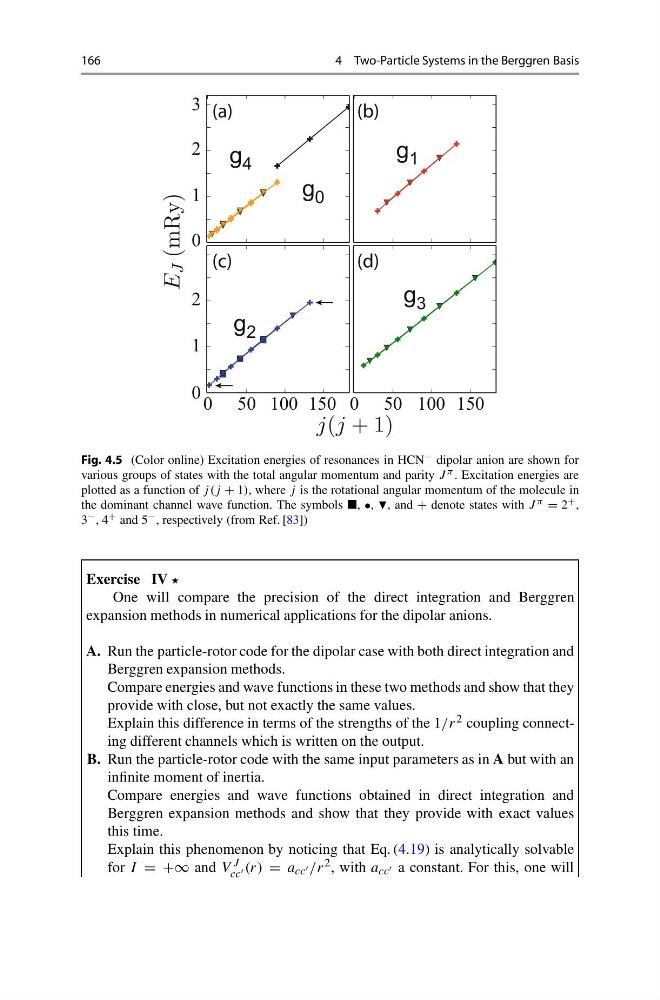
Fig. 4.5 (Color online) Excitation energies of resonances in HCN − dipolar anion are shown for
various groups of states with the total angular momentum and parity J π . Excitation energies are
plotted as a function of j (j + 1), where j is the rotational angular momentum of the molecule in
the dominant channel wave function. The symbols •, , and + denote states with J π = 2 + ,
3 − , 4 + and 5 − , respectively (from Ref. [83])
Exercise IV
One will compare the precision of the direct integration and Berggren
expansion methods in numerical applications for the dipolar anions.
A. Run the particle-rotor code for the dipolar case with both direct integration and
Berggren expansion methods.
Compare energies and wave functions in these two methods and show that they
provide with close, but not exactly the same values.
Explain this difference in terms of the strengths of the 1/r 2 coupling connecting different channels which is written on the output.
B. Run the particle-rotor code with the same input parameters as in A but with an
infinite moment of inertia.
Compare energies and wave functions obtained in direct integration and
Berggren expansion methods and show that they provide with exact values
this time.
Explain this phenomenon by noticing that Eq. (4.19) is analytically solvable
for I = +∞ and V J
cc (r) = a cc /r 2 , with a cc a constant. For this, one will
4 Two-Particle Systems in the Berggren Basis
50 100 150
0
0
1
2
0
1
2
3
50 100 150
0
g 0
g 1
g 2
g 3
g 4
(a)
(b)
(c)
(d)
Fig. 4.5 (Color online) Excitation energies of resonances in HCN − dipolar anion are shown for
various groups of states with the total angular momentum and parity J π . Excitation energies are
plotted as a function of j (j + 1), where j is the rotational angular momentum of the molecule in
the dominant channel wave function. The symbols •, , and + denote states with J π = 2 + ,
3 − , 4 + and 5 − , respectively (from Ref. [83])
Exercise IV
One will compare the precision of the direct integration and Berggren
expansion methods in numerical applications for the dipolar anions.
A. Run the particle-rotor code for the dipolar case with both direct integration and
Berggren expansion methods.
Compare energies and wave functions in these two methods and show that they
provide with close, but not exactly the same values.
Explain this difference in terms of the strengths of the 1/r 2 coupling connecting different channels which is written on the output.
B. Run the particle-rotor code with the same input parameters as in A but with an
infinite moment of inertia.
Compare energies and wave functions obtained in direct integration and
Berggren expansion methods and show that they provide with exact values
this time.
Explain this phenomenon by noticing that Eq. (4.19) is analytically solvable
for I = +∞ and V J
cc (r) = a cc /r 2 , with a cc a constant. For this, one will