

Solutions to Exercises
143
Exercise XII.
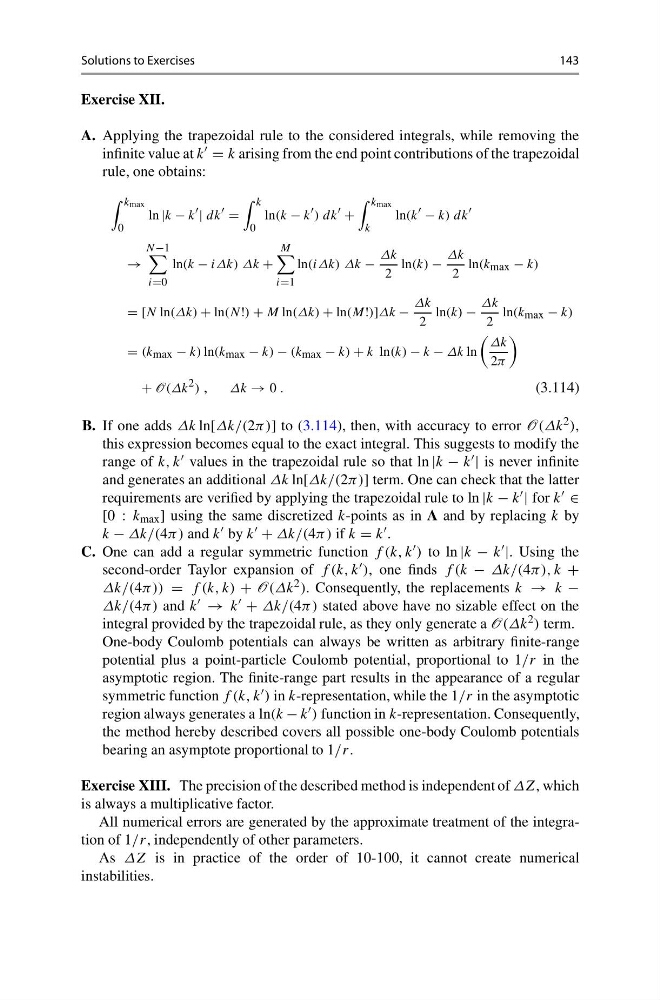
A. Applying the trapezoidal rule to the considered integrals, while removing the
infinite value at k = k arising from the end point contributions of the trapezoidal
rule, one obtains:
k max
0
ln |k − k | dk =
k
0
ln(k − k ) dk +
k max
k
ln(k − k) dk
→
N−1
i=0
ln(k − iΔk) Δk +
M
i=1
ln(iΔk) Δk −
Δk
2
ln(k) −
Δk
2
ln(k max − k)
= [N ln(Δk) + ln(N!) + M ln(Δk) + ln(M!)]Δk −
Δk
2
ln(k) −
Δk
2
ln(k max − k)
= (k max − k) ln(k max − k) − (k max − k) + k ln(k) − k − Δk ln
Δk
2π
+ O(Δk 2 ) , Δk → 0 .
(3.114)
B. If one adds Δk ln[Δk/(2π)] to (3.114), then, with accuracy to error O(Δk 2 ),
this expression becomes equal to the exact integral. This suggests to modify the
range of k, k values in the trapezoidal rule so that ln |k − k | is never infinite
and generates an additional Δk ln[Δk/(2π)] term. One can check that the latter
requirements are verified by applying the trapezoidal rule to ln |k − k | for k ∈
[0 : k max ] using the same discretized k-points as in A and by replacing k by
k − Δk/(4π) and k by k + Δk/(4π) if k = k .
C. One can add a regular symmetric function f (k, k ) to ln |k − k |. Using the
second-order Taylor expansion of f (k, k ), one finds f (k − Δk/(4π), k +
Δk/(4π)) = f (k, k) + O(Δk 2 ). Consequently, the replacements k → k −
Δk/(4π) and k → k + Δk/(4π) stated above have no sizable effect on the
integral provided by the trapezoidal rule, as they only generate a O(Δk 2 ) term.
One-body Coulomb potentials can always be written as arbitrary finite-range
potential plus a point-particle Coulomb potential, proportional to 1/r in the
asymptotic region. The finite-range part results in the appearance of a regular
symmetric function f (k, k ) in k-representation, while the 1/r in the asymptotic
region always generates a ln(k − k ) function in k-representation. Consequently,
the method hereby described covers all possible one-body Coulomb potentials
bearing an asymptote proportional to 1/r.
Exercise XIII. The precision of the described method is independent of ΔZ, which
is always a multiplicative factor.
All numerical errors are generated by the approximate treatment of the integration of 1/r, independently of other parameters.
As ΔZ is in practice of the order of 10-100, it cannot create numerical
instabilities.
143
Exercise XII.
A. Applying the trapezoidal rule to the considered integrals, while removing the
infinite value at k = k arising from the end point contributions of the trapezoidal
rule, one obtains:
k max
0
ln |k − k | dk =
k
0
ln(k − k ) dk +
k max
k
ln(k − k) dk
→
N−1
i=0
ln(k − iΔk) Δk +
M
i=1
ln(iΔk) Δk −
Δk
2
ln(k) −
Δk
2
ln(k max − k)
= [N ln(Δk) + ln(N!) + M ln(Δk) + ln(M!)]Δk −
Δk
2
ln(k) −
Δk
2
ln(k max − k)
= (k max − k) ln(k max − k) − (k max − k) + k ln(k) − k − Δk ln
Δk
2π
+ O(Δk 2 ) , Δk → 0 .
(3.114)
B. If one adds Δk ln[Δk/(2π)] to (3.114), then, with accuracy to error O(Δk 2 ),
this expression becomes equal to the exact integral. This suggests to modify the
range of k, k values in the trapezoidal rule so that ln |k − k | is never infinite
and generates an additional Δk ln[Δk/(2π)] term. One can check that the latter
requirements are verified by applying the trapezoidal rule to ln |k − k | for k ∈
[0 : k max ] using the same discretized k-points as in A and by replacing k by
k − Δk/(4π) and k by k + Δk/(4π) if k = k .
C. One can add a regular symmetric function f (k, k ) to ln |k − k |. Using the
second-order Taylor expansion of f (k, k ), one finds f (k − Δk/(4π), k +
Δk/(4π)) = f (k, k) + O(Δk 2 ). Consequently, the replacements k → k −
Δk/(4π) and k → k + Δk/(4π) stated above have no sizable effect on the
integral provided by the trapezoidal rule, as they only generate a O(Δk 2 ) term.
One-body Coulomb potentials can always be written as arbitrary finite-range
potential plus a point-particle Coulomb potential, proportional to 1/r in the
asymptotic region. The finite-range part results in the appearance of a regular
symmetric function f (k, k ) in k-representation, while the 1/r in the asymptotic
region always generates a ln(k − k ) function in k-representation. Consequently,
the method hereby described covers all possible one-body Coulomb potentials
bearing an asymptote proportional to 1/r.
Exercise XIII. The precision of the described method is independent of ΔZ, which
is always a multiplicative factor.
All numerical errors are generated by the approximate treatment of the integration of 1/r, independently of other parameters.
As ΔZ is in practice of the order of 10-100, it cannot create numerical
instabilities.