

Solutions to Exercises
135
+ O(R
−1
δ )
= C ka C k b
sin
(k b − k a )R δ − η k b ln(2k b R δ ) + η ka ln(2k a R δ ) + δ
(tot)
k b
− δ
(tot)
ka
2(k b − k a )
− C ka C k b
sin
(k a + k b )R δ − η ka ln(2k a R δ ) − η k b ln(2k b R δ ) + δ
(tot)
ka + δ
(tot)
k b
2(k a + k b )
+ O(R
−1
δ ) = C ka C k b
sin (Δ k R δ + β ab Δ k ln(R δ ) + f − (k a , k b ))
2Δ k
− C ka C k b
sin
(k a + k b )R δ − (η ka + η k b
ln(R δ ) + f + (k a , k b ))
2(k a + k b )
+ O(R
−1
δ )
= C ka C k b
sin (Δ k R δ + β ab Δ k ln(R δ ))
2Δ k
+ C ka C k b sin (Δ k R δ + β ab Δ k ln(R δ ))
cos (f − (k a , k b )) − 1
2Δ k
+ C ka C k b cos (Δ k R δ + β ab Δ k ln(R δ ))
sin (f − (k a , k b ))
2Δ k
− C ka C k b
sin
(k a + k b )R δ − (η ka + η k b ) ln(R δ ) + f + (k a , k b )
2(k a + k b )
+ O(R
−1
δ ) ,
(3.102)
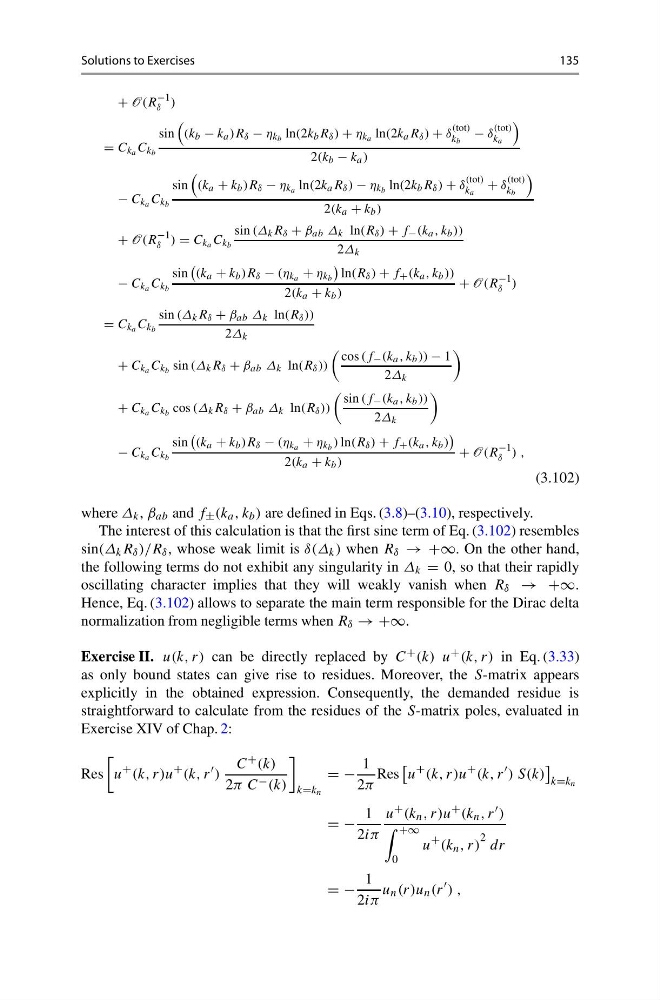
where Δ k , β ab and f ± (k a , k b ) are defined in Eqs. (3.8)–(3.10), respectively.
The interest of this calculation is that the first sine term of Eq. (3.102) resembles
sin(Δ k R δ )/R δ , whose weak limit is δ(Δ k ) when R δ → +∞. On the other hand,
the following terms do not exhibit any singularity in Δ k = 0, so that their rapidly
oscillating character implies that they will weakly vanish when R δ → +∞.
Hence, Eq. (3.102) allows to separate the main term responsible for the Dirac delta
normalization from negligible terms when R δ → +∞.
Exercise II. u(k, r) can be directly replaced by C + (k) u + (k, r) in Eq. (3.33)
as only bound states can give rise to residues. Moreover, the S-matrix appears
explicitly in the obtained expression. Consequently, the demanded residue is
straightforward to calculate from the residues of the S-matrix poles, evaluated in
Exercise XIV of Chap. 2:
Res
u
+ (k, r)u
+ (k, r
)
C + (k)
2π C − (k)
k=k n
= −
1
2π
Res
u
+ (k, r)u
+ (k, r
) S(k)
k=k n
= −
1
2iπ
u + (k n , r)u + (k n , r )
+∞
0
u
+ (k n , r)
2 dr
= −
1
2iπ
u n (r)u n (r
) ,
135
+ O(R
−1
δ )
= C ka C k b
sin
(k b − k a )R δ − η k b ln(2k b R δ ) + η ka ln(2k a R δ ) + δ
(tot)
k b
− δ
(tot)
ka
2(k b − k a )
− C ka C k b
sin
(k a + k b )R δ − η ka ln(2k a R δ ) − η k b ln(2k b R δ ) + δ
(tot)
ka + δ
(tot)
k b
2(k a + k b )
+ O(R
−1
δ ) = C ka C k b
sin (Δ k R δ + β ab Δ k ln(R δ ) + f − (k a , k b ))
2Δ k
− C ka C k b
sin
(k a + k b )R δ − (η ka + η k b
ln(R δ ) + f + (k a , k b ))
2(k a + k b )
+ O(R
−1
δ )
= C ka C k b
sin (Δ k R δ + β ab Δ k ln(R δ ))
2Δ k
+ C ka C k b sin (Δ k R δ + β ab Δ k ln(R δ ))
cos (f − (k a , k b )) − 1
2Δ k
+ C ka C k b cos (Δ k R δ + β ab Δ k ln(R δ ))
sin (f − (k a , k b ))
2Δ k
− C ka C k b
sin
(k a + k b )R δ − (η ka + η k b ) ln(R δ ) + f + (k a , k b )
2(k a + k b )
+ O(R
−1
δ ) ,
(3.102)
where Δ k , β ab and f ± (k a , k b ) are defined in Eqs. (3.8)–(3.10), respectively.
The interest of this calculation is that the first sine term of Eq. (3.102) resembles
sin(Δ k R δ )/R δ , whose weak limit is δ(Δ k ) when R δ → +∞. On the other hand,
the following terms do not exhibit any singularity in Δ k = 0, so that their rapidly
oscillating character implies that they will weakly vanish when R δ → +∞.
Hence, Eq. (3.102) allows to separate the main term responsible for the Dirac delta
normalization from negligible terms when R δ → +∞.
Exercise II. u(k, r) can be directly replaced by C + (k) u + (k, r) in Eq. (3.33)
as only bound states can give rise to residues. Moreover, the S-matrix appears
explicitly in the obtained expression. Consequently, the demanded residue is
straightforward to calculate from the residues of the S-matrix poles, evaluated in
Exercise XIV of Chap. 2:
Res
u
+ (k, r)u
+ (k, r
)
C + (k)
2π C − (k)
k=k n
= −
1
2π
Res
u
+ (k, r)u
+ (k, r
) S(k)
k=k n
= −
1
2iπ
u + (k n , r)u + (k n , r )
+∞
0
u
+ (k n , r)
2 dr
= −
1
2iπ
u n (r)u n (r
) ,