

124
3 Berggren Basis and Completeness Relations
Related to this is the influence of antibound states on the behavior of the scattering
cross section at low energies. Classic examples include the low-energy 1 S 0 neutronneutron scattering phase shift, characterized by a large and negative scattering length
[51], the scattering of slow electrons on molecules [55–57], and the eep-Coulomb
system [58].
Coming back to nuclear structure, it was argued that as a result of the inversion of
0p 1/2 and 1s 1/2 shells [59], the neutron-unbound 10 Li nucleus sustains a low-lying
1s 1/2 antibound state very close to the one-neutron (1n) emission threshold [60].
Although many theoretical calculations predict the 0p 1/2 − 1s 1/2 shell inversion,
the phenomenon still remains a matter of debate [61, 62]. Experimentally, several
groups have reported evidence of the = 0 strength at the 1n-threshold in 10 Li
[63–68]; however, no evidence of a weakly bound 1s 1/2 state has been found.
Since, experimentally, the n+ 9 Li has a large and negative scattering length, this may
indicate the presence of an antibound 1s 1/2 state in 10 Li close to the 1n-threshold,
though the presence of a low-lying 0p 1/2 state cannot be ruled out [69].
The Gamow shell model calculations that explicitly consider the antibound
1s 1/2 single-particle state were performed for the ground state of 11 Li [70, 71].
It was argued that the presence of an antibound state was important for the
formation of a neutron halo. It was also noted that the bound state wave function
of 11 Li could be expanded in terms of the real-energy, nonresonant =0 continuum,
that is, without explicit inclusion of the antibound state. Moreover, a destructive
interference between the 1s 1/2 antibound single-particle state and the associated
complex-energy, nonresonant s 1/2 background was noticed.
The question of how important is the =0 antibound state for the description
of a neutron halo in 11 Li, can be answered by analyzing results for several
complementary Berggren basis expansions. The standard Berggren completeness
relation consists of a discrete sum over bound and resonance states, and an integral
over nonresonant scattering states from the contour L
+
b (see Fig. 3.5 where a discrete
sum runs over all bound (b) and decaying resonance (d) states lying above the
complex contour L
+
b ). The continuous part takes into account the nonresonant
scattering states lying on the contour. In the particular case of =0 neutron partial
wave, there are no s 1/2 resonances due to the absence of both Coulomb and
centrifugal barriers. Consequently, a real-k contour would have been sufficient
to describe the s 1/2 neutron channel. However, to investigate the convergence of
imaginary part components of the expanded wave functions, one takes the complexk contour L
+
b close to the real-k axis.
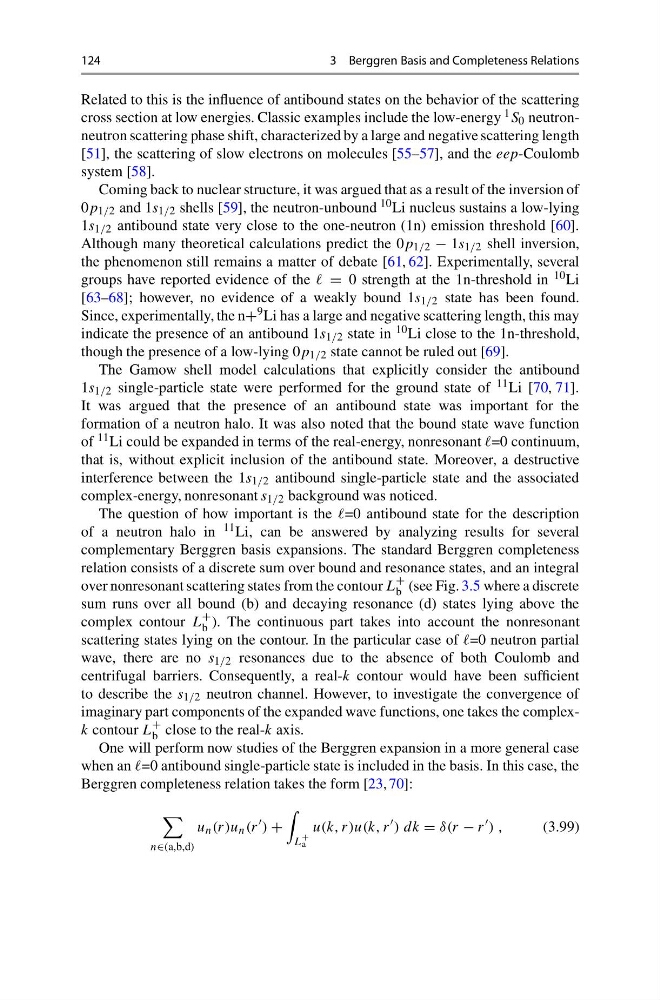
One will perform now studies of the Berggren expansion in a more general case
when an =0 antibound single-particle state is included in the basis. In this case, the
Berggren completeness relation takes the form [23, 70]:
n∈(a,b,d)
u n (r)u n (r
) +
L
+
a
u(k, r)u(k, r
) dk = δ(r − r
) ,
(3.99)
3 Berggren Basis and Completeness Relations
Related to this is the influence of antibound states on the behavior of the scattering
cross section at low energies. Classic examples include the low-energy 1 S 0 neutronneutron scattering phase shift, characterized by a large and negative scattering length
[51], the scattering of slow electrons on molecules [55–57], and the eep-Coulomb
system [58].
Coming back to nuclear structure, it was argued that as a result of the inversion of
0p 1/2 and 1s 1/2 shells [59], the neutron-unbound 10 Li nucleus sustains a low-lying
1s 1/2 antibound state very close to the one-neutron (1n) emission threshold [60].
Although many theoretical calculations predict the 0p 1/2 − 1s 1/2 shell inversion,
the phenomenon still remains a matter of debate [61, 62]. Experimentally, several
groups have reported evidence of the = 0 strength at the 1n-threshold in 10 Li
[63–68]; however, no evidence of a weakly bound 1s 1/2 state has been found.
Since, experimentally, the n+ 9 Li has a large and negative scattering length, this may
indicate the presence of an antibound 1s 1/2 state in 10 Li close to the 1n-threshold,
though the presence of a low-lying 0p 1/2 state cannot be ruled out [69].
The Gamow shell model calculations that explicitly consider the antibound
1s 1/2 single-particle state were performed for the ground state of 11 Li [70, 71].
It was argued that the presence of an antibound state was important for the
formation of a neutron halo. It was also noted that the bound state wave function
of 11 Li could be expanded in terms of the real-energy, nonresonant =0 continuum,
that is, without explicit inclusion of the antibound state. Moreover, a destructive
interference between the 1s 1/2 antibound single-particle state and the associated
complex-energy, nonresonant s 1/2 background was noticed.
The question of how important is the =0 antibound state for the description
of a neutron halo in 11 Li, can be answered by analyzing results for several
complementary Berggren basis expansions. The standard Berggren completeness
relation consists of a discrete sum over bound and resonance states, and an integral
over nonresonant scattering states from the contour L
+
b (see Fig. 3.5 where a discrete
sum runs over all bound (b) and decaying resonance (d) states lying above the
complex contour L
+
b ). The continuous part takes into account the nonresonant
scattering states lying on the contour. In the particular case of =0 neutron partial
wave, there are no s 1/2 resonances due to the absence of both Coulomb and
centrifugal barriers. Consequently, a real-k contour would have been sufficient
to describe the s 1/2 neutron channel. However, to investigate the convergence of
imaginary part components of the expanded wave functions, one takes the complexk contour L
+
b close to the real-k axis.
One will perform now studies of the Berggren expansion in a more general case
when an =0 antibound single-particle state is included in the basis. In this case, the
Berggren completeness relation takes the form [23, 70]:
n∈(a,b,d)
u n (r)u n (r
) +
L
+
a
u(k, r)u(k, r
) dk = δ(r − r
) ,
(3.99)