

112
3 Berggren Basis and Completeness Relations
One can check that the methods used in the sections following Sect. 3.2.2, with
the exception of Sect. 3.5.3, can be applied without modification to the nonlocal
case, because one always has (k) = 0 in a finite zone of the complex plane. As a
consequence, the completeness properties of the eigenstates generated by local and
nonlocal potentials are identical and both can be used to generate Berggren basis
states for Gamow shell model applications. This is particularly interesting when
using a Hartree-Fock potential to generate the Berggren basis, because this potential
recaptures a significant part of the strength provided by the nuclear interaction.
3.7
Numerical Implementation of the Berggren Completeness
Relation
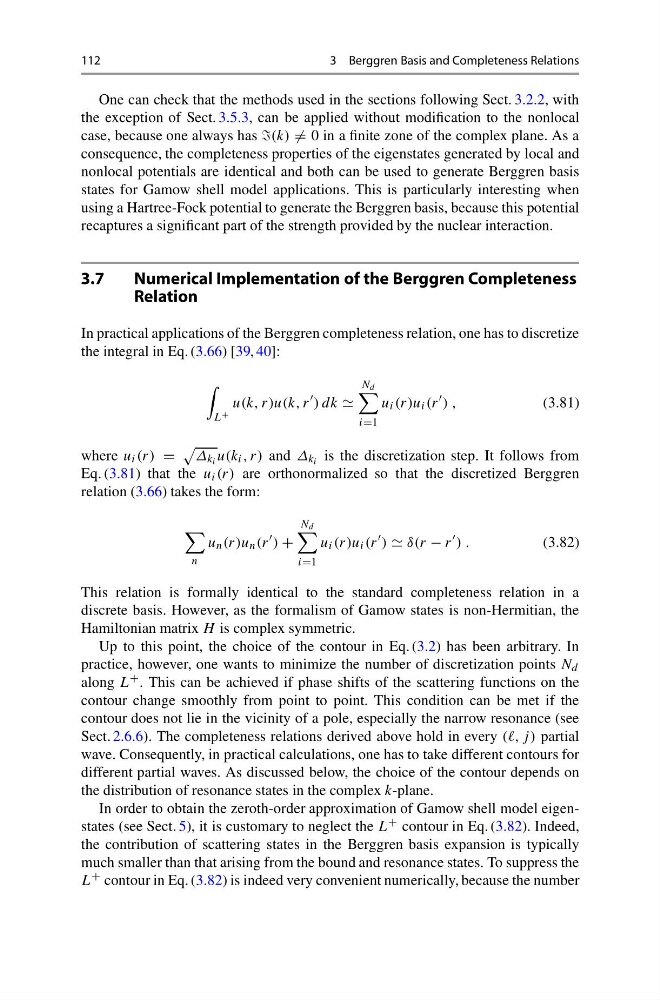
In practical applications of the Berggren completeness relation, one has to discretize
the integral in Eq. (3.66) [39, 40]:
L +
u(k, r)u(k, r
) dk
N d
i=1
u i (r)u i (r
) ,
(3.81)
where u i (r) =
Δ k i u(k i , r) and Δ k i is the discretization step. It follows from
Eq. (3.81) that the u i (r) are orthonormalized so that the discretized Berggren
relation (3.66) takes the form:
n
u n (r)u n (r
) +
N d
i=1
u i (r)u i (r
) δ(r − r
) .
(3.82)
This relation is formally identical to the standard completeness relation in a
discrete basis. However, as the formalism of Gamow states is non-Hermitian, the
Hamiltonian matrix H is complex symmetric.
Up to this point, the choice of the contour in Eq. (3.2) has been arbitrary. In
practice, however, one wants to minimize the number of discretization points N d
along L + . This can be achieved if phase shifts of the scattering functions on the
contour change smoothly from point to point. This condition can be met if the
contour does not lie in the vicinity of a pole, especially the narrow resonance (see
Sect. 2.6.6). The completeness relations derived above hold in every ((, j ) partial
wave. Consequently, in practical calculations, one has to take different contours for
different partial waves. As discussed below, the choice of the contour depends on
the distribution of resonance states in the complex k-plane.
In order to obtain the zeroth-order approximation of Gamow shell model eigenstates (see Sect. 5), it is customary to neglect the L + contour in Eq. (3.82). Indeed,
the contribution of scattering states in the Berggren basis expansion is typically
much smaller than that arising from the bound and resonance states. To suppress the
L + contour in Eq. (3.82) is indeed very convenient numerically, because the number
3 Berggren Basis and Completeness Relations
One can check that the methods used in the sections following Sect. 3.2.2, with
the exception of Sect. 3.5.3, can be applied without modification to the nonlocal
case, because one always has (k) = 0 in a finite zone of the complex plane. As a
consequence, the completeness properties of the eigenstates generated by local and
nonlocal potentials are identical and both can be used to generate Berggren basis
states for Gamow shell model applications. This is particularly interesting when
using a Hartree-Fock potential to generate the Berggren basis, because this potential
recaptures a significant part of the strength provided by the nuclear interaction.
3.7
Numerical Implementation of the Berggren Completeness
Relation
In practical applications of the Berggren completeness relation, one has to discretize
the integral in Eq. (3.66) [39, 40]:
L +
u(k, r)u(k, r
) dk
N d
i=1
u i (r)u i (r
) ,
(3.81)
where u i (r) =
Δ k i u(k i , r) and Δ k i is the discretization step. It follows from
Eq. (3.81) that the u i (r) are orthonormalized so that the discretized Berggren
relation (3.66) takes the form:
n
u n (r)u n (r
) +
N d
i=1
u i (r)u i (r
) δ(r − r
) .
(3.82)
This relation is formally identical to the standard completeness relation in a
discrete basis. However, as the formalism of Gamow states is non-Hermitian, the
Hamiltonian matrix H is complex symmetric.
Up to this point, the choice of the contour in Eq. (3.2) has been arbitrary. In
practice, however, one wants to minimize the number of discretization points N d
along L + . This can be achieved if phase shifts of the scattering functions on the
contour change smoothly from point to point. This condition can be met if the
contour does not lie in the vicinity of a pole, especially the narrow resonance (see
Sect. 2.6.6). The completeness relations derived above hold in every ((, j ) partial
wave. Consequently, in practical calculations, one has to take different contours for
different partial waves. As discussed below, the choice of the contour depends on
the distribution of resonance states in the complex k-plane.
In order to obtain the zeroth-order approximation of Gamow shell model eigenstates (see Sect. 5), it is customary to neglect the L + contour in Eq. (3.82). Indeed,
the contribution of scattering states in the Berggren basis expansion is typically
much smaller than that arising from the bound and resonance states. To suppress the
L + contour in Eq. (3.82) is indeed very convenient numerically, because the number