

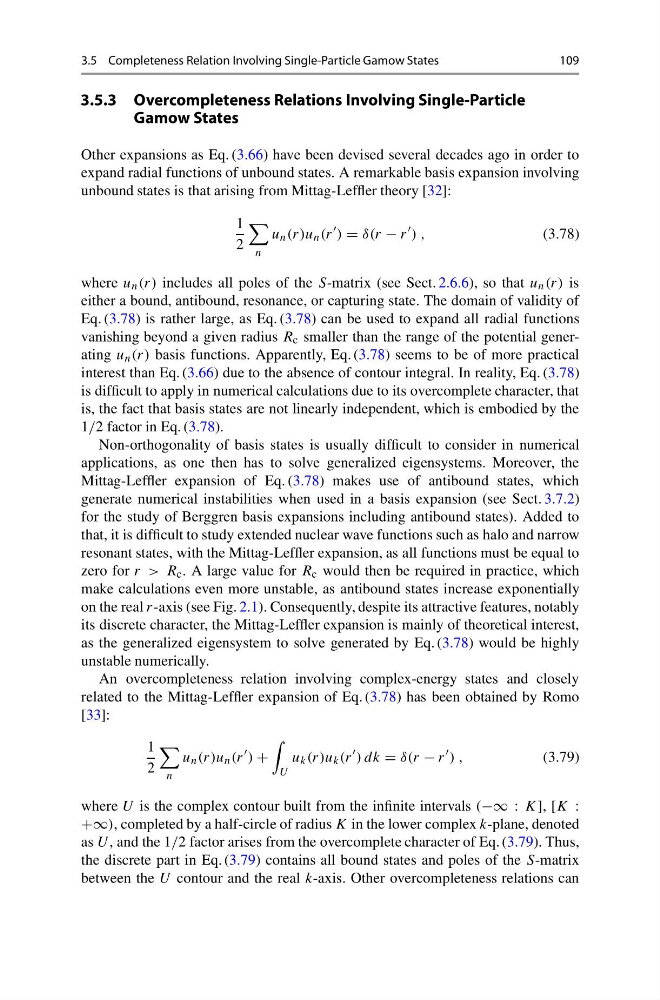
3.5 Completeness Relation Involving Single-Particle Gamow States
109
3.5.3 Overcompleteness Relations Involving Single-Particle
Gamow States
Other expansions as Eq. (3.66) have been devised several decades ago in order to
expand radial functions of unbound states. A remarkable basis expansion involving
unbound states is that arising from Mittag-Leffler theory [32]:
1
2
n
u n (r)u n (r
) = δ(r − r
) ,
(3.78)
where u n (r) includes all poles of the S-matrix (see Sect. 2.6.6), so that u n (r) is
either a bound, antibound, resonance, or capturing state. The domain of validity of
Eq. (3.78) is rather large, as Eq. (3.78) can be used to expand all radial functions
vanishing beyond a given radius R c smaller than the range of the potential generating u n (r) basis functions. Apparently, Eq. (3.78) seems to be of more practical
interest than Eq. (3.66) due to the absence of contour integral. In reality, Eq. (3.78)
is difficult to apply in numerical calculations due to its overcomplete character, that
is, the fact that basis states are not linearly independent, which is embodied by the
1/2 factor in Eq. (3.78).
Non-orthogonality of basis states is usually difficult to consider in numerical
applications, as one then has to solve generalized eigensystems. Moreover, the
Mittag-Leffler expansion of Eq. (3.78) makes use of antibound states, which
generate numerical instabilities when used in a basis expansion (see Sect. 3.7.2)
for the study of Berggren basis expansions including antibound states). Added to
that, it is difficult to study extended nuclear wave functions such as halo and narrow
resonant states, with the Mittag-Leffler expansion, as all functions must be equal to
zero for r > R c . A large value for R c would then be required in practice, which
make calculations even more unstable, as antibound states increase exponentially
on the real r-axis (see Fig. 2.1). Consequently, despite its attractive features, notably
its discrete character, the Mittag-Leffler expansion is mainly of theoretical interest,
as the generalized eigensystem to solve generated by Eq. (3.78) would be highly
unstable numerically.
An overcompleteness relation involving complex-energy states and closely
related to the Mittag-Leffler expansion of Eq. (3.78) has been obtained by Romo
[33]:
1
2
n
u n (r)u n (r
) +
U
u k (r)u k (r
) dk = δ(r − r
) ,
(3.79)
where U is the complex contour built from the infinite intervals (−∞ : K], [K :
+∞), completed by a half-circle of radius K in the lower complex k-plane, denoted
as U , and the 1/2 factor arises from the overcomplete character of Eq. (3.79). Thus,
the discrete part in Eq. (3.79) contains all bound states and poles of the S-matrix
between the U contour and the real k-axis. Other overcompleteness relations can
109
3.5.3 Overcompleteness Relations Involving Single-Particle
Gamow States
Other expansions as Eq. (3.66) have been devised several decades ago in order to
expand radial functions of unbound states. A remarkable basis expansion involving
unbound states is that arising from Mittag-Leffler theory [32]:
1
2
n
u n (r)u n (r
) = δ(r − r
) ,
(3.78)
where u n (r) includes all poles of the S-matrix (see Sect. 2.6.6), so that u n (r) is
either a bound, antibound, resonance, or capturing state. The domain of validity of
Eq. (3.78) is rather large, as Eq. (3.78) can be used to expand all radial functions
vanishing beyond a given radius R c smaller than the range of the potential generating u n (r) basis functions. Apparently, Eq. (3.78) seems to be of more practical
interest than Eq. (3.66) due to the absence of contour integral. In reality, Eq. (3.78)
is difficult to apply in numerical calculations due to its overcomplete character, that
is, the fact that basis states are not linearly independent, which is embodied by the
1/2 factor in Eq. (3.78).
Non-orthogonality of basis states is usually difficult to consider in numerical
applications, as one then has to solve generalized eigensystems. Moreover, the
Mittag-Leffler expansion of Eq. (3.78) makes use of antibound states, which
generate numerical instabilities when used in a basis expansion (see Sect. 3.7.2)
for the study of Berggren basis expansions including antibound states). Added to
that, it is difficult to study extended nuclear wave functions such as halo and narrow
resonant states, with the Mittag-Leffler expansion, as all functions must be equal to
zero for r > R c . A large value for R c would then be required in practice, which
make calculations even more unstable, as antibound states increase exponentially
on the real r-axis (see Fig. 2.1). Consequently, despite its attractive features, notably
its discrete character, the Mittag-Leffler expansion is mainly of theoretical interest,
as the generalized eigensystem to solve generated by Eq. (3.78) would be highly
unstable numerically.
An overcompleteness relation involving complex-energy states and closely
related to the Mittag-Leffler expansion of Eq. (3.78) has been obtained by Romo
[33]:
1
2
n
u n (r)u n (r
) +
U
u k (r)u k (r
) dk = δ(r − r
) ,
(3.79)
where U is the complex contour built from the infinite intervals (−∞ : K], [K :
+∞), completed by a half-circle of radius K in the lower complex k-plane, denoted
as U , and the 1/2 factor arises from the overcomplete character of Eq. (3.79). Thus,
the discrete part in Eq. (3.79) contains all bound states and poles of the S-matrix
between the U contour and the real k-axis. Other overcompleteness relations can