

108
3 Berggren Basis and Completeness Relations
coalesce in the complex k-plane. In this case, the Berggren set of states is no longer
complete. Nevertheless, one can recover a complete set by adding to the initial set
of resonant u n (r) and scattering u(k, r) states the derivative with respect to k of
the wave function associated to exceptional states [31]. In order to show the latter
property, let us consider two resonance states u n (r) and u m (r), where m = n, which
coalesce and form an exceptional point for a certain value of λ. Wave functions
associated to exceptional points have a vanishing Berggren norm (see Eq. (3.58)).
Consequently, one will consider in the following that u n (r) and u m (r) are no longer
normalized using Eq. (3.58). This obviously does not change the completeness
properties of that newly defined Berggren set of states. As u n (r) ∝ u m (r) when
k m = k n , the expansion coefficients of u n (r) and u m (r) of a given function can
diverge when k m − k n → 0. All other components are clearly well defined in that
limit. Hence, one replaces u m (r) by the finite difference (u n (r) − u m (r))/(k n − k m )
in Eq. (3.66), with k n and k m the linear momenta associated to u n (r) and u m (r),
respectively. As k n → k m , the latter finite differences become equal to ˙
u n (r), with
the dot denoting derivative with respect to k.
One will show that u n (r) and ˙
u n (r) are linearly independent. For this, one notices
that ˙
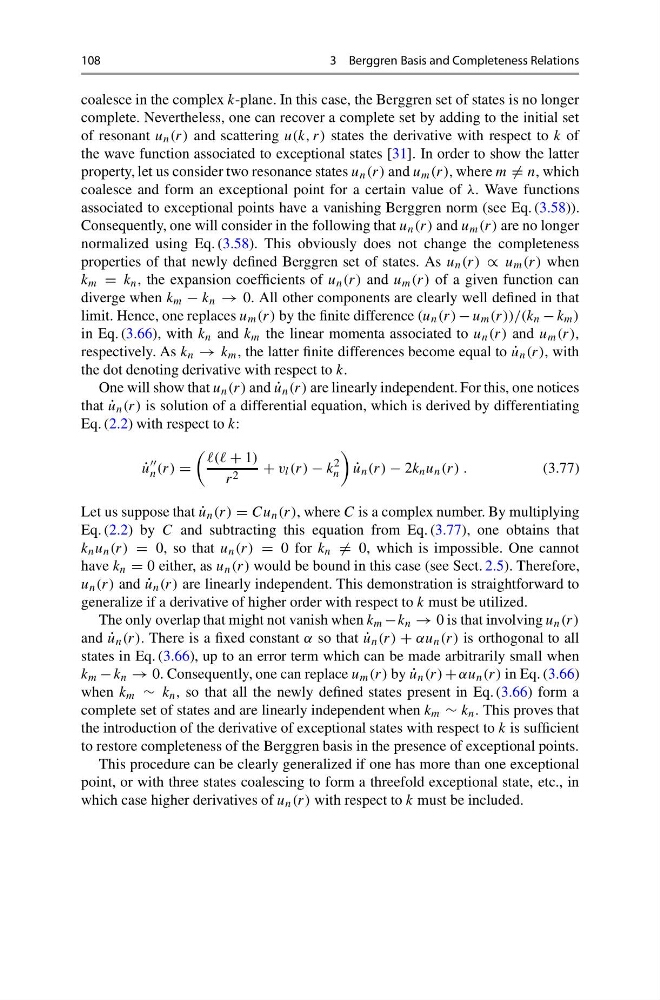
u n (r) is solution of a differential equation, which is derived by differentiating
Eq. (2.2) with respect to k:
˙
u
n (r) =
+ 1)
r 2
+ v l (r) − k
2
n
˙
u n (r) − 2k n u n (r) .
(3.77)
Let us suppose that ˙
u n (r) = Cu n (r), where C is a complex number. By multiplying
Eq. (2.2) by C and subtracting this equation from Eq. (3.77), one obtains that
k n u n (r) = 0, so that u n (r) = 0 for k n = 0, which is impossible. One cannot
have k n = 0 either, as u n (r) would be bound in this case (see Sect. 2.5). Therefore,
u n (r) and ˙
u n (r) are linearly independent. This demonstration is straightforward to
generalize if a derivative of higher order with respect to k must be utilized.
The only overlap that might not vanish when k m −k n → 0 is that involving u n (r)
and ˙
u n (r). There is a fixed constant α so that ˙
u n (r) + αu n (r) is orthogonal to all
states in Eq. (3.66), up to an error term which can be made arbitrarily small when
k m − k n → 0. Consequently, one can replace u m (r) by ˙
u n (r) + αu n (r) in Eq. (3.66)
when k m ∼ k n , so that all the newly defined states present in Eq. (3.66) form a
complete set of states and are linearly independent when k m ∼ k n . This proves that
the introduction of the derivative of exceptional states with respect to k is sufficient
to restore completeness of the Berggren basis in the presence of exceptional points.
This procedure can be clearly generalized if one has more than one exceptional
point, or with three states coalescing to form a threefold exceptional state, etc., in
which case higher derivatives of u n (r) with respect to k must be included.
3 Berggren Basis and Completeness Relations
coalesce in the complex k-plane. In this case, the Berggren set of states is no longer
complete. Nevertheless, one can recover a complete set by adding to the initial set
of resonant u n (r) and scattering u(k, r) states the derivative with respect to k of
the wave function associated to exceptional states [31]. In order to show the latter
property, let us consider two resonance states u n (r) and u m (r), where m = n, which
coalesce and form an exceptional point for a certain value of λ. Wave functions
associated to exceptional points have a vanishing Berggren norm (see Eq. (3.58)).
Consequently, one will consider in the following that u n (r) and u m (r) are no longer
normalized using Eq. (3.58). This obviously does not change the completeness
properties of that newly defined Berggren set of states. As u n (r) ∝ u m (r) when
k m = k n , the expansion coefficients of u n (r) and u m (r) of a given function can
diverge when k m − k n → 0. All other components are clearly well defined in that
limit. Hence, one replaces u m (r) by the finite difference (u n (r) − u m (r))/(k n − k m )
in Eq. (3.66), with k n and k m the linear momenta associated to u n (r) and u m (r),
respectively. As k n → k m , the latter finite differences become equal to ˙
u n (r), with
the dot denoting derivative with respect to k.
One will show that u n (r) and ˙
u n (r) are linearly independent. For this, one notices
that ˙
u n (r) is solution of a differential equation, which is derived by differentiating
Eq. (2.2) with respect to k:
˙
u
n (r) =
+ 1)
r 2
+ v l (r) − k
2
n
˙
u n (r) − 2k n u n (r) .
(3.77)
Let us suppose that ˙
u n (r) = Cu n (r), where C is a complex number. By multiplying
Eq. (2.2) by C and subtracting this equation from Eq. (3.77), one obtains that
k n u n (r) = 0, so that u n (r) = 0 for k n = 0, which is impossible. One cannot
have k n = 0 either, as u n (r) would be bound in this case (see Sect. 2.5). Therefore,
u n (r) and ˙
u n (r) are linearly independent. This demonstration is straightforward to
generalize if a derivative of higher order with respect to k must be utilized.
The only overlap that might not vanish when k m −k n → 0 is that involving u n (r)
and ˙
u n (r). There is a fixed constant α so that ˙
u n (r) + αu n (r) is orthogonal to all
states in Eq. (3.66), up to an error term which can be made arbitrarily small when
k m − k n → 0. Consequently, one can replace u m (r) by ˙
u n (r) + αu n (r) in Eq. (3.66)
when k m ∼ k n , so that all the newly defined states present in Eq. (3.66) form a
complete set of states and are linearly independent when k m ∼ k n . This proves that
the introduction of the derivative of exceptional states with respect to k is sufficient
to restore completeness of the Berggren basis in the presence of exceptional points.
This procedure can be clearly generalized if one has more than one exceptional
point, or with three states coalescing to form a threefold exceptional state, etc., in
which case higher derivatives of u n (r) with respect to k must be included.