

3.5 Completeness Relation Involving Single-Particle Gamow States
105
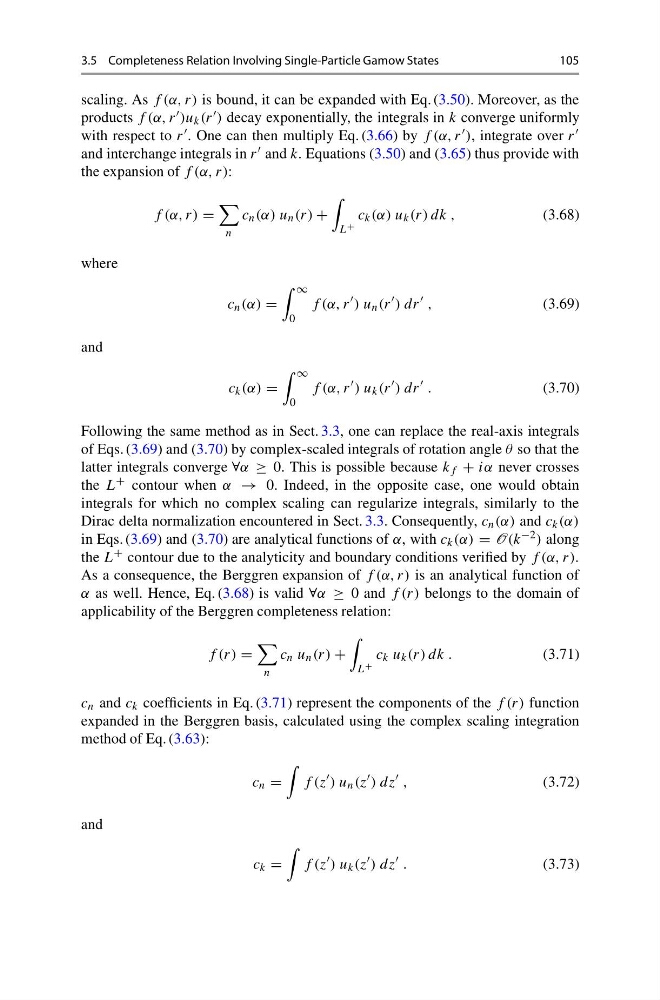
scaling. As f (α, r) is bound, it can be expanded with Eq. (3.50). Moreover, as the
products f (α, r )u k (r ) decay exponentially, the integrals in k converge uniformly
with respect to r . One can then multiply Eq. (3.66) by f (α, r ), integrate over r
and interchange integrals in r and k. Equations (3.50) and (3.65) thus provide with
the expansion of f (α, r):
f (α, r) =
n
c n (α) u n (r) +
L +
c k (α) u k (r) dk ,
(3.68)
where
c n (α) =
∞
0
f (α, r
) u n (r
) dr
,
(3.69)
and
c k (α) =
∞
0
f (α, r
) u k (r
) dr
.
(3.70)
Following the same method as in Sect. 3.3, one can replace the real-axis integrals
of Eqs. (3.69) and (3.70) by complex-scaled integrals of rotation angle θ so that the
latter integrals converge ∀α ≥ 0. This is possible because k f + iα never crosses
the L + contour when α → 0. Indeed, in the opposite case, one would obtain
integrals for which no complex scaling can regularize integrals, similarly to the
Dirac delta normalization encountered in Sect. 3.3. Consequently, c n (α) and c k (α)
in Eqs. (3.69) and (3.70) are analytical functions of α, with c k (α) = O(k −2 ) along
the L + contour due to the analyticity and boundary conditions verified by f (α, r).
As a consequence, the Berggren expansion of f (α, r) is an analytical function of
α as well. Hence, Eq. (3.68) is valid ∀α ≥ 0 and f (r) belongs to the domain of
applicability of the Berggren completeness relation:
f (r) =
n
c n u n (r) +
L +
c k u k (r) dk .
(3.71)
c n and c k coefficients in Eq. (3.71) represent the components of the f (r) function
expanded in the Berggren basis, calculated using the complex scaling integration
method of Eq. (3.63):
c n =
f (z
) u n (z
) dz
,
(3.72)
and
c k =
f (z
) u k (z
) dz
.
(3.73)
105
scaling. As f (α, r) is bound, it can be expanded with Eq. (3.50). Moreover, as the
products f (α, r )u k (r ) decay exponentially, the integrals in k converge uniformly
with respect to r . One can then multiply Eq. (3.66) by f (α, r ), integrate over r
and interchange integrals in r and k. Equations (3.50) and (3.65) thus provide with
the expansion of f (α, r):
f (α, r) =
n
c n (α) u n (r) +
L +
c k (α) u k (r) dk ,
(3.68)
where
c n (α) =
∞
0
f (α, r
) u n (r
) dr
,
(3.69)
and
c k (α) =
∞
0
f (α, r
) u k (r
) dr
.
(3.70)
Following the same method as in Sect. 3.3, one can replace the real-axis integrals
of Eqs. (3.69) and (3.70) by complex-scaled integrals of rotation angle θ so that the
latter integrals converge ∀α ≥ 0. This is possible because k f + iα never crosses
the L + contour when α → 0. Indeed, in the opposite case, one would obtain
integrals for which no complex scaling can regularize integrals, similarly to the
Dirac delta normalization encountered in Sect. 3.3. Consequently, c n (α) and c k (α)
in Eqs. (3.69) and (3.70) are analytical functions of α, with c k (α) = O(k −2 ) along
the L + contour due to the analyticity and boundary conditions verified by f (α, r).
As a consequence, the Berggren expansion of f (α, r) is an analytical function of
α as well. Hence, Eq. (3.68) is valid ∀α ≥ 0 and f (r) belongs to the domain of
applicability of the Berggren completeness relation:
f (r) =
n
c n u n (r) +
L +
c k u k (r) dk .
(3.71)
c n and c k coefficients in Eq. (3.71) represent the components of the f (r) function
expanded in the Berggren basis, calculated using the complex scaling integration
method of Eq. (3.63):
c n =
f (z
) u n (z
) dz
,
(3.72)
and
c k =
f (z
) u k (z
) dz
.
(3.73)