

104
3 Berggren Basis and Completeness Relations
k
p
k
m
Capturing
resonances
Bound States Antibound
States
Resonances
Re(k)
Im(k)
L +
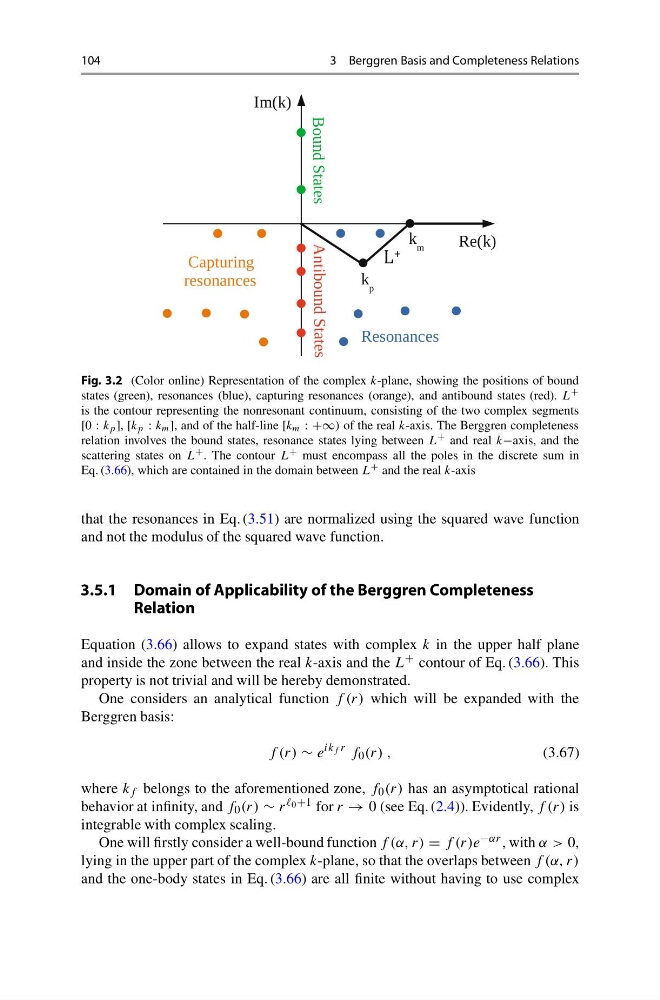
Fig. 3.2 (Color online) Representation of the complex k-plane, showing the positions of bound
states (green), resonances (blue), capturing resonances (orange), and antibound states (red). L +
is the contour representing the nonresonant continuum, consisting of the two complex segments
[0 : k p ], [k p : k m ], and of the half-line [k m : +∞) of the real k-axis. The Berggren completeness
relation involves the bound states, resonance states lying between L + and real k−axis, and the
scattering states on L + . The contour L + must encompass all the poles in the discrete sum in
Eq. (3.66), which are contained in the domain between L + and the real k-axis
that the resonances in Eq. (3.51) are normalized using the squared wave function
and not the modulus of the squared wave function.
3.5.1 Domain of Applicability of the Berggren Completeness
Relation
Equation (3.66) allows to expand states with complex k in the upper half plane
and inside the zone between the real k-axis and the L + contour of Eq. (3.66). This
property is not trivial and will be hereby demonstrated.
One considers an analytical function f (r) which will be expanded with the
Berggren basis:
f (r) ∼ e
ik f r f 0 (r) ,
(3.67)
where k f belongs to the aforementioned zone, f 0 (r) has an asymptotical rational
behavior at infinity, and f 0 (r) ∼ r 0 +1 for r → 0 (see Eq. (2.4)). Evidently, f (r) is
integrable with complex scaling.
One will firstly consider a well-bound function f (α, r) = f (r)e −αr , with α > 0,
lying in the upper part of the complex k-plane, so that the overlaps between f (α, r)
and the one-body states in Eq. (3.66) are all finite without having to use complex
3 Berggren Basis and Completeness Relations
k
p
k
m
Capturing
resonances
Bound States Antibound
States
Resonances
Re(k)
Im(k)
L +
Fig. 3.2 (Color online) Representation of the complex k-plane, showing the positions of bound
states (green), resonances (blue), capturing resonances (orange), and antibound states (red). L +
is the contour representing the nonresonant continuum, consisting of the two complex segments
[0 : k p ], [k p : k m ], and of the half-line [k m : +∞) of the real k-axis. The Berggren completeness
relation involves the bound states, resonance states lying between L + and real k−axis, and the
scattering states on L + . The contour L + must encompass all the poles in the discrete sum in
Eq. (3.66), which are contained in the domain between L + and the real k-axis
that the resonances in Eq. (3.51) are normalized using the squared wave function
and not the modulus of the squared wave function.
3.5.1 Domain of Applicability of the Berggren Completeness
Relation
Equation (3.66) allows to expand states with complex k in the upper half plane
and inside the zone between the real k-axis and the L + contour of Eq. (3.66). This
property is not trivial and will be hereby demonstrated.
One considers an analytical function f (r) which will be expanded with the
Berggren basis:
f (r) ∼ e
ik f r f 0 (r) ,
(3.67)
where k f belongs to the aforementioned zone, f 0 (r) has an asymptotical rational
behavior at infinity, and f 0 (r) ∼ r 0 +1 for r → 0 (see Eq. (2.4)). Evidently, f (r) is
integrable with complex scaling.
One will firstly consider a well-bound function f (α, r) = f (r)e −αr , with α > 0,
lying in the upper part of the complex k-plane, so that the overlaps between f (α, r)
and the one-body states in Eq. (3.66) are all finite without having to use complex