

3.2 Designing for Mainly Dual Activity
73
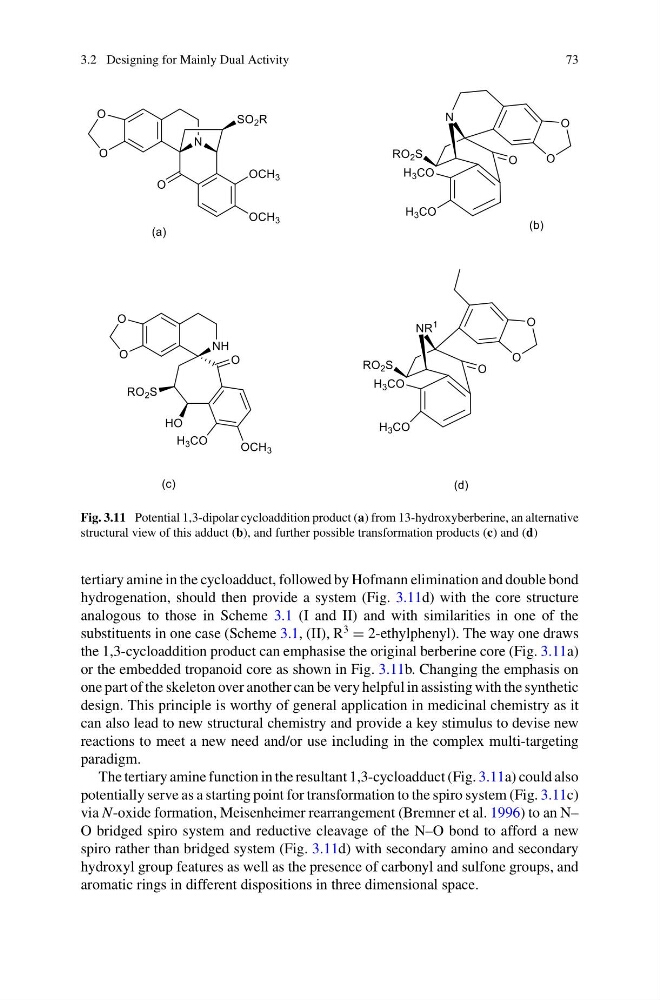
Fig. 3.11 Potential 1,3-dipolar cycloaddition product (a) from 13-hydroxyberberine, an alternative
structural view of this adduct (b), and further possible transformation products (c) and (d)
tertiary amine in the cycloadduct, followed by Hofmann elimination and double bond
hydrogenation, should then provide a system (Fig. 3.11d) with the core structure
analogous to those in Scheme 3.1 (I and II) and with similarities in one of the
substituents in one case (Scheme 3.1, (II), R
3
= 2-ethylphenyl). The way one draws
the 1,3-cycloaddition product can emphasise the original berberine core (Fig. 3.11a)
or the embedded tropanoid core as shown in Fig. 3.11b. Changing the emphasis on
one part of the skeleton over another can be very helpful in assisting with the synthetic
design. This principle is worthy of general application in medicinal chemistry as it
can also lead to new structural chemistry and provide a key stimulus to devise new
reactions to meet a new need and/or use including in the complex multi-targeting
paradigm.
The tertiary amine function in the resultant 1,3-cycloadduct (Fig. 3.11a) could also
potentially serve as a starting point for transformation to the spiro system (Fig. 3.11c)
via N-oxide formation, Meisenheimer rearrangement (Bremner et al. 1996) to an N–
O bridged spiro system and reductive cleavage of the N–O bond to afford a new
spiro rather than bridged system (Fig. 3.11d) with secondary amino and secondary
hydroxyl group features as well as the presence of carbonyl and sulfone groups, and
aromatic rings in different dispositions in three dimensional space.
73
Fig. 3.11 Potential 1,3-dipolar cycloaddition product (a) from 13-hydroxyberberine, an alternative
structural view of this adduct (b), and further possible transformation products (c) and (d)
tertiary amine in the cycloadduct, followed by Hofmann elimination and double bond
hydrogenation, should then provide a system (Fig. 3.11d) with the core structure
analogous to those in Scheme 3.1 (I and II) and with similarities in one of the
substituents in one case (Scheme 3.1, (II), R
3
= 2-ethylphenyl). The way one draws
the 1,3-cycloaddition product can emphasise the original berberine core (Fig. 3.11a)
or the embedded tropanoid core as shown in Fig. 3.11b. Changing the emphasis on
one part of the skeleton over another can be very helpful in assisting with the synthetic
design. This principle is worthy of general application in medicinal chemistry as it
can also lead to new structural chemistry and provide a key stimulus to devise new
reactions to meet a new need and/or use including in the complex multi-targeting
paradigm.
The tertiary amine function in the resultant 1,3-cycloadduct (Fig. 3.11a) could also
potentially serve as a starting point for transformation to the spiro system (Fig. 3.11c)
via N-oxide formation, Meisenheimer rearrangement (Bremner et al. 1996) to an N–
O bridged spiro system and reductive cleavage of the N–O bond to afford a new
spiro rather than bridged system (Fig. 3.11d) with secondary amino and secondary
hydroxyl group features as well as the presence of carbonyl and sulfone groups, and
aromatic rings in different dispositions in three dimensional space.