

42
2 Antibacterial Combinations
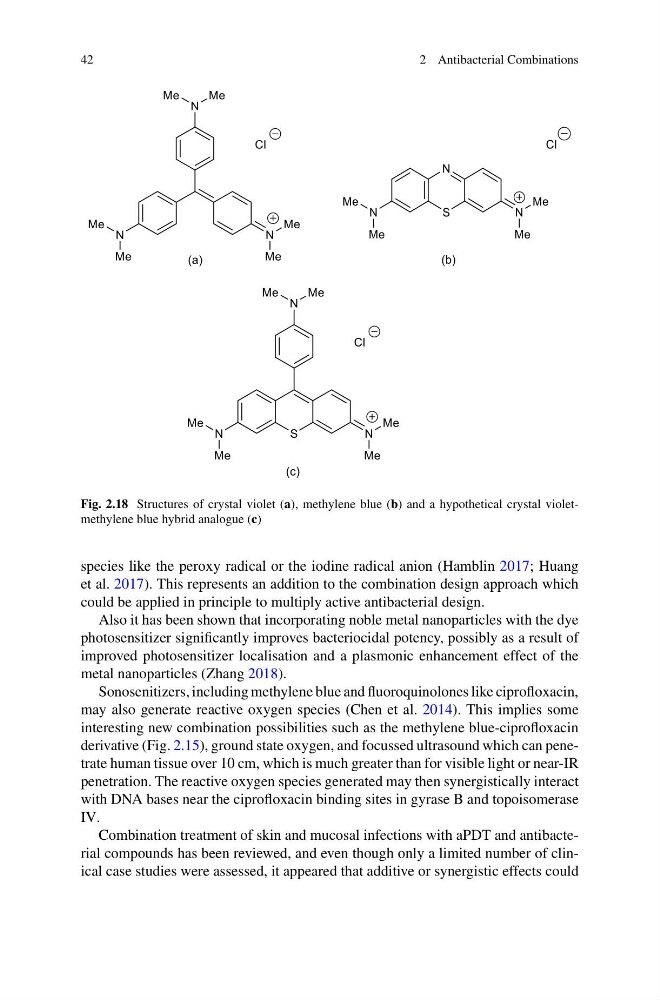
Fig. 2.18 Structures of crystal violet (a), methylene blue (b) and a hypothetical crystal violetmethylene blue hybrid analogue (c)
species like the peroxy radical or the iodine radical anion (Hamblin 2017; Huang
et al. 2017). This represents an addition to the combination design approach which
could be applied in principle to multiply active antibacterial design.
Also it has been shown that incorporating noble metal nanoparticles with the dye
photosensitizer significantly improves bacteriocidal potency, possibly as a result of
improved photosensitizer localisation and a plasmonic enhancement effect of the
metal nanoparticles (Zhang 2018).
Sonosenitizers, including methylene blue and fluoroquinolones like ciprofloxacin,
may also generate reactive oxygen species (Chen et al. 2014). This implies some
interesting new combination possibilities such as the methylene blue-ciprofloxacin
derivative (Fig. 2.15), ground state oxygen, and focussed ultrasound which can penetrate human tissue over 10 cm, which is much greater than for visible light or near-IR
penetration. The reactive oxygen species generated may then synergistically interact
with DNA bases near the ciprofloxacin binding sites in gyrase B and topoisomerase
IV.
Combination treatment of skin and mucosal infections with aPDT and antibacterial compounds has been reviewed, and even though only a limited number of clinical case studies were assessed, it appeared that additive or synergistic effects could
2 Antibacterial Combinations
Fig. 2.18 Structures of crystal violet (a), methylene blue (b) and a hypothetical crystal violetmethylene blue hybrid analogue (c)
species like the peroxy radical or the iodine radical anion (Hamblin 2017; Huang
et al. 2017). This represents an addition to the combination design approach which
could be applied in principle to multiply active antibacterial design.
Also it has been shown that incorporating noble metal nanoparticles with the dye
photosensitizer significantly improves bacteriocidal potency, possibly as a result of
improved photosensitizer localisation and a plasmonic enhancement effect of the
metal nanoparticles (Zhang 2018).
Sonosenitizers, including methylene blue and fluoroquinolones like ciprofloxacin,
may also generate reactive oxygen species (Chen et al. 2014). This implies some
interesting new combination possibilities such as the methylene blue-ciprofloxacin
derivative (Fig. 2.15), ground state oxygen, and focussed ultrasound which can penetrate human tissue over 10 cm, which is much greater than for visible light or near-IR
penetration. The reactive oxygen species generated may then synergistically interact
with DNA bases near the ciprofloxacin binding sites in gyrase B and topoisomerase
IV.
Combination treatment of skin and mucosal infections with aPDT and antibacterial compounds has been reviewed, and even though only a limited number of clinical case studies were assessed, it appeared that additive or synergistic effects could