

38
2 Antibacterial Combinations
that it requires light to complete the production of a third active species for attack
on multiple potential bacterial sites. Light is not a third ‘molecular entity C’ as such
but a substitute for it and a necessary third ‘component’ as an activating agent. One
compound in the mixture is triplet oxygen (A) as a ‘prodrug’ which is converted to the
active singlet oxygen through visible light irradiation in the presence of a sensitiser
(B) and energy transfer (Type II mechanism), or to other cytotoxic reactive oxygen
species such as superoxide (a radical anion) or free radicals ( for example hydroxyl
radicals) through charge transfer (Type I mechanism). These reactive species have
potentially three or possibly more actions through reactions with susceptible sites
in bacterial proteins, lipids or nucleic acids. Antibacterial photodynamic therapy
(aPDT) is a significant research area and a good review of the field is presented in
Liu et al. (2015). Dharmaratne et al. (2020) have reviewed a PDT for MRSA and
general outstanding issues or problems are covered at the end of this review.
Light can also activate in other ways for example through reversible switching
(Klaue et al. 2018), photoisomerisation, light induced electrocyclic reactions, through
alterations in molecular shape and polarity, and also through phototriggered targeting
with nanomedicine applications (Arrue and Ratjen 2017; Velema et al. 2014 see also
Sect. 4.3.3 for photopharmacology).
A further useful variation on the light-activated combination theme is to add other
functions to the photosensitising molecule to increase the likelihood of more potent
antibacterial outcomes. For example the sensitiser may be converted into a dual
function hybrid-photosensitiser and efflux pump evader/blocker (B − C) and this
variation could then be expressed as A + (B − C) + light, where A is triplet oxygen.
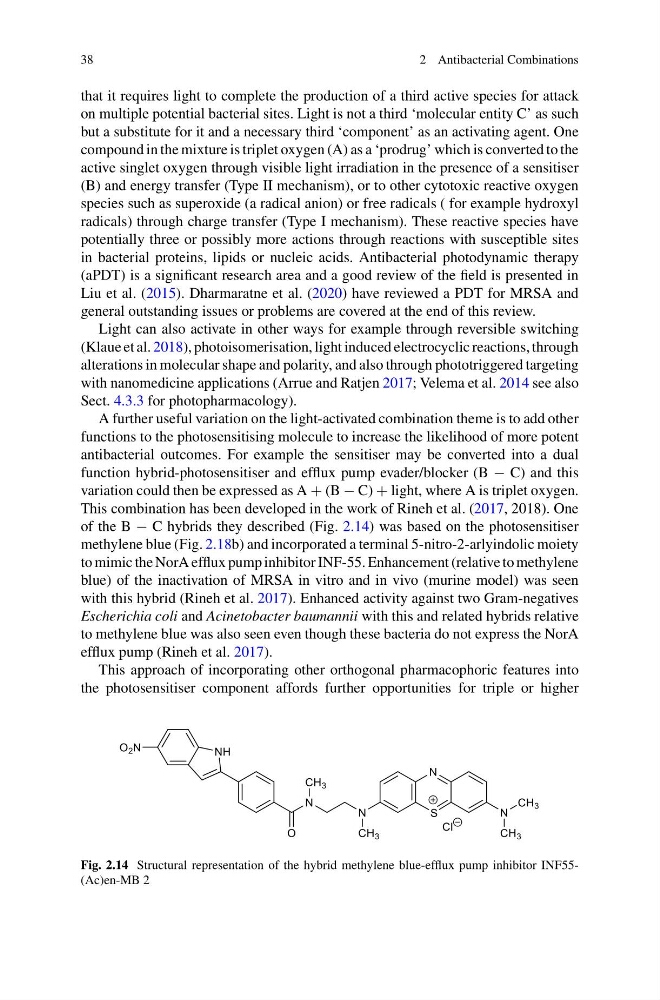
This combination has been developed in the work of Rineh et al. (2017, 2018). One
of the B − C hybrids they described (Fig. 2.14) was based on the photosensitiser
methylene blue (Fig. 2.18b) and incorporated a terminal 5-nitro-2-arlyindolic moiety
to mimic the NorA efflux pump inhibitor INF-55. Enhancement (relative to methylene
blue) of the inactivation of MRSA in vitro and in vivo (murine model) was seen
with this hybrid (Rineh et al. 2017). Enhanced activity against two Gram-negatives
Escherichia coli and Acinetobacter baumannii with this and related hybrids relative
to methylene blue was also seen even though these bacteria do not express the NorA
efflux pump (Rineh et al. 2017).
This approach of incorporating other orthogonal pharmacophoric features into
the photosensitiser component affords further opportunities for triple or higher
Fig. 2.14 Structural representation of the hybrid methylene blue-efflux pump inhibitor INF55(Ac)en-MB 2
2 Antibacterial Combinations
that it requires light to complete the production of a third active species for attack
on multiple potential bacterial sites. Light is not a third ‘molecular entity C’ as such
but a substitute for it and a necessary third ‘component’ as an activating agent. One
compound in the mixture is triplet oxygen (A) as a ‘prodrug’ which is converted to the
active singlet oxygen through visible light irradiation in the presence of a sensitiser
(B) and energy transfer (Type II mechanism), or to other cytotoxic reactive oxygen
species such as superoxide (a radical anion) or free radicals ( for example hydroxyl
radicals) through charge transfer (Type I mechanism). These reactive species have
potentially three or possibly more actions through reactions with susceptible sites
in bacterial proteins, lipids or nucleic acids. Antibacterial photodynamic therapy
(aPDT) is a significant research area and a good review of the field is presented in
Liu et al. (2015). Dharmaratne et al. (2020) have reviewed a PDT for MRSA and
general outstanding issues or problems are covered at the end of this review.
Light can also activate in other ways for example through reversible switching
(Klaue et al. 2018), photoisomerisation, light induced electrocyclic reactions, through
alterations in molecular shape and polarity, and also through phototriggered targeting
with nanomedicine applications (Arrue and Ratjen 2017; Velema et al. 2014 see also
Sect. 4.3.3 for photopharmacology).
A further useful variation on the light-activated combination theme is to add other
functions to the photosensitising molecule to increase the likelihood of more potent
antibacterial outcomes. For example the sensitiser may be converted into a dual
function hybrid-photosensitiser and efflux pump evader/blocker (B − C) and this
variation could then be expressed as A + (B − C) + light, where A is triplet oxygen.
This combination has been developed in the work of Rineh et al. (2017, 2018). One
of the B − C hybrids they described (Fig. 2.14) was based on the photosensitiser
methylene blue (Fig. 2.18b) and incorporated a terminal 5-nitro-2-arlyindolic moiety
to mimic the NorA efflux pump inhibitor INF-55. Enhancement (relative to methylene
blue) of the inactivation of MRSA in vitro and in vivo (murine model) was seen
with this hybrid (Rineh et al. 2017). Enhanced activity against two Gram-negatives
Escherichia coli and Acinetobacter baumannii with this and related hybrids relative
to methylene blue was also seen even though these bacteria do not express the NorA
efflux pump (Rineh et al. 2017).
This approach of incorporating other orthogonal pharmacophoric features into
the photosensitiser component affords further opportunities for triple or higher
Fig. 2.14 Structural representation of the hybrid methylene blue-efflux pump inhibitor INF55(Ac)en-MB 2