

24
2 Antibacterial Combinations
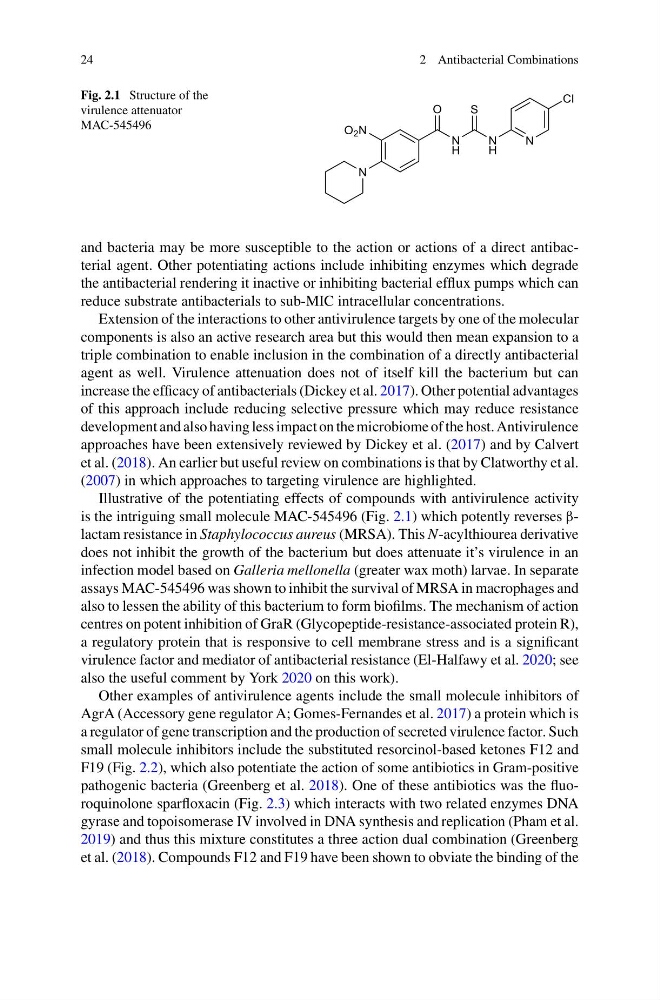
Fig. 2.1 Structure of the
virulence attenuator
MAC-545496
and bacteria may be more susceptible to the action or actions of a direct antibacterial agent. Other potentiating actions include inhibiting enzymes which degrade
the antibacterial rendering it inactive or inhibiting bacterial efflux pumps which can
reduce substrate antibacterials to sub-MIC intracellular concentrations.
Extension of the interactions to other antivirulence targets by one of the molecular
components is also an active research area but this would then mean expansion to a
triple combination to enable inclusion in the combination of a directly antibacterial
agent as well. Virulence attenuation does not of itself kill the bacterium but can
increase the efficacy of antibacterials (Dickey et al. 2017). Other potential advantages
of this approach include reducing selective pressure which may reduce resistance
development and also having less impact on the microbiome of the host. Antivirulence
approaches have been extensively reviewed by Dickey et al. (2017) and by Calvert
et al. (2018). An earlier but useful review on combinations is that by Clatworthy et al.
(2007) in which approaches to targeting virulence are highlighted.
Illustrative of the potentiating effects of compounds with antivirulence activity
is the intriguing small molecule MAC-545496 (Fig. 2.1) which potently reverses βlactam resistance in Staphylococcus aureus (MRSA). This N-acylthiourea derivative
does not inhibit the growth of the bacterium but does attenuate it’s virulence in an
infection model based on Galleria mellonella (greater wax moth) larvae. In separate
assays MAC-545496 was shown to inhibit the survival of MRSA in macrophages and
also to lessen the ability of this bacterium to form biofilms. The mechanism of action
centres on potent inhibition of GraR (Glycopeptide-resistance-associated protein R),
a regulatory protein that is responsive to cell membrane stress and is a significant
virulence factor and mediator of antibacterial resistance (El-Halfawy et al. 2020; see
also the useful comment by York 2020 on this work).
Other examples of antivirulence agents include the small molecule inhibitors of
AgrA (Accessory gene regulator A; Gomes-Fernandes et al. 2017) a protein which is
a regulator of gene transcription and the production of secreted virulence factor. Such
small molecule inhibitors include the substituted resorcinol-based ketones F12 and
F19 (Fig. 2.2), which also potentiate the action of some antibiotics in Gram-positive
pathogenic bacteria (Greenberg et al. 2018). One of these antibiotics was the fluoroquinolone sparfloxacin (Fig. 2.3) which interacts with two related enzymes DNA
gyrase and topoisomerase IV involved in DNA synthesis and replication (Pham et al.
2019) and thus this mixture constitutes a three action dual combination (Greenberg
et al. (2018). Compounds F12 and F19 have been shown to obviate the binding of the
2 Antibacterial Combinations
Fig. 2.1 Structure of the
virulence attenuator
MAC-545496
and bacteria may be more susceptible to the action or actions of a direct antibacterial agent. Other potentiating actions include inhibiting enzymes which degrade
the antibacterial rendering it inactive or inhibiting bacterial efflux pumps which can
reduce substrate antibacterials to sub-MIC intracellular concentrations.
Extension of the interactions to other antivirulence targets by one of the molecular
components is also an active research area but this would then mean expansion to a
triple combination to enable inclusion in the combination of a directly antibacterial
agent as well. Virulence attenuation does not of itself kill the bacterium but can
increase the efficacy of antibacterials (Dickey et al. 2017). Other potential advantages
of this approach include reducing selective pressure which may reduce resistance
development and also having less impact on the microbiome of the host. Antivirulence
approaches have been extensively reviewed by Dickey et al. (2017) and by Calvert
et al. (2018). An earlier but useful review on combinations is that by Clatworthy et al.
(2007) in which approaches to targeting virulence are highlighted.
Illustrative of the potentiating effects of compounds with antivirulence activity
is the intriguing small molecule MAC-545496 (Fig. 2.1) which potently reverses βlactam resistance in Staphylococcus aureus (MRSA). This N-acylthiourea derivative
does not inhibit the growth of the bacterium but does attenuate it’s virulence in an
infection model based on Galleria mellonella (greater wax moth) larvae. In separate
assays MAC-545496 was shown to inhibit the survival of MRSA in macrophages and
also to lessen the ability of this bacterium to form biofilms. The mechanism of action
centres on potent inhibition of GraR (Glycopeptide-resistance-associated protein R),
a regulatory protein that is responsive to cell membrane stress and is a significant
virulence factor and mediator of antibacterial resistance (El-Halfawy et al. 2020; see
also the useful comment by York 2020 on this work).
Other examples of antivirulence agents include the small molecule inhibitors of
AgrA (Accessory gene regulator A; Gomes-Fernandes et al. 2017) a protein which is
a regulator of gene transcription and the production of secreted virulence factor. Such
small molecule inhibitors include the substituted resorcinol-based ketones F12 and
F19 (Fig. 2.2), which also potentiate the action of some antibiotics in Gram-positive
pathogenic bacteria (Greenberg et al. 2018). One of these antibiotics was the fluoroquinolone sparfloxacin (Fig. 2.3) which interacts with two related enzymes DNA
gyrase and topoisomerase IV involved in DNA synthesis and replication (Pham et al.
2019) and thus this mixture constitutes a three action dual combination (Greenberg
et al. (2018). Compounds F12 and F19 have been shown to obviate the binding of the