

12
1 Antibacterials
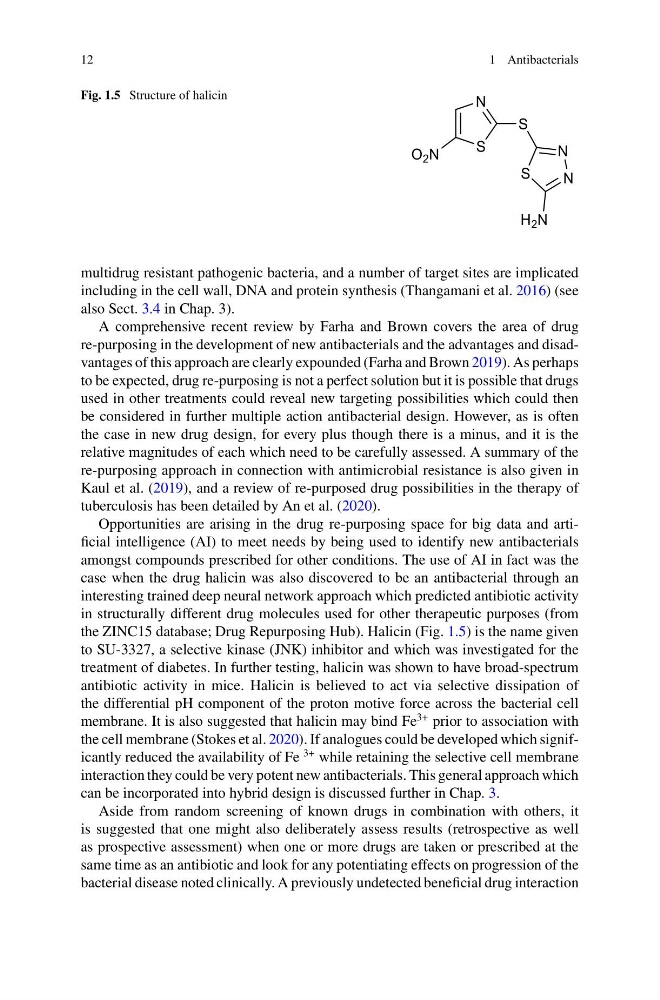
Fig. 1.5 Structure of halicin
multidrug resistant pathogenic bacteria, and a number of target sites are implicated
including in the cell wall, DNA and protein synthesis (Thangamani et al. 2016) (see
also Sect. 3.4 in Chap. 3).
A comprehensive recent review by Farha and Brown covers the area of drug
re-purposing in the development of new antibacterials and the advantages and disadvantages of this approach are clearly expounded (Farha and Brown 2019). As perhaps
to be expected, drug re-purposing is not a perfect solution but it is possible that drugs
used in other treatments could reveal new targeting possibilities which could then
be considered in further multiple action antibacterial design. However, as is often
the case in new drug design, for every plus though there is a minus, and it is the
relative magnitudes of each which need to be carefully assessed. A summary of the
re-purposing approach in connection with antimicrobial resistance is also given in
Kaul et al. (2019), and a review of re-purposed drug possibilities in the therapy of
tuberculosis has been detailed by An et al. (2020).
Opportunities are arising in the drug re-purposing space for big data and artificial intelligence (AI) to meet needs by being used to identify new antibacterials
amongst compounds prescribed for other conditions. The use of AI in fact was the
case when the drug halicin was also discovered to be an antibacterial through an
interesting trained deep neural network approach which predicted antibiotic activity
in structurally different drug molecules used for other therapeutic purposes (from
the ZINC15 database; Drug Repurposing Hub). Halicin (Fig. 1.5) is the name given
to SU-3327, a selective kinase (JNK) inhibitor and which was investigated for the
treatment of diabetes. In further testing, halicin was shown to have broad-spectrum
antibiotic activity in mice. Halicin is believed to act via selective dissipation of
the differential pH component of the proton motive force across the bacterial cell
membrane. It is also suggested that halicin may bind Fe
3+ prior to association with
the cell membrane (Stokes et al. 2020). If analogues could be developed which significantly reduced the availability of Fe
3+ while retaining the selective cell membrane
interaction they could be very potent new antibacterials. This general approach which
can be incorporated into hybrid design is discussed further in Chap. 3.
Aside from random screening of known drugs in combination with others, it
is suggested that one might also deliberately assess results (retrospective as well
as prospective assessment) when one or more drugs are taken or prescribed at the
same time as an antibiotic and look for any potentiating effects on progression of the
bacterial disease noted clinically. A previously undetected beneficial drug interaction
1 Antibacterials
Fig. 1.5 Structure of halicin
multidrug resistant pathogenic bacteria, and a number of target sites are implicated
including in the cell wall, DNA and protein synthesis (Thangamani et al. 2016) (see
also Sect. 3.4 in Chap. 3).
A comprehensive recent review by Farha and Brown covers the area of drug
re-purposing in the development of new antibacterials and the advantages and disadvantages of this approach are clearly expounded (Farha and Brown 2019). As perhaps
to be expected, drug re-purposing is not a perfect solution but it is possible that drugs
used in other treatments could reveal new targeting possibilities which could then
be considered in further multiple action antibacterial design. However, as is often
the case in new drug design, for every plus though there is a minus, and it is the
relative magnitudes of each which need to be carefully assessed. A summary of the
re-purposing approach in connection with antimicrobial resistance is also given in
Kaul et al. (2019), and a review of re-purposed drug possibilities in the therapy of
tuberculosis has been detailed by An et al. (2020).
Opportunities are arising in the drug re-purposing space for big data and artificial intelligence (AI) to meet needs by being used to identify new antibacterials
amongst compounds prescribed for other conditions. The use of AI in fact was the
case when the drug halicin was also discovered to be an antibacterial through an
interesting trained deep neural network approach which predicted antibiotic activity
in structurally different drug molecules used for other therapeutic purposes (from
the ZINC15 database; Drug Repurposing Hub). Halicin (Fig. 1.5) is the name given
to SU-3327, a selective kinase (JNK) inhibitor and which was investigated for the
treatment of diabetes. In further testing, halicin was shown to have broad-spectrum
antibiotic activity in mice. Halicin is believed to act via selective dissipation of
the differential pH component of the proton motive force across the bacterial cell
membrane. It is also suggested that halicin may bind Fe
3+ prior to association with
the cell membrane (Stokes et al. 2020). If analogues could be developed which significantly reduced the availability of Fe
3+ while retaining the selective cell membrane
interaction they could be very potent new antibacterials. This general approach which
can be incorporated into hybrid design is discussed further in Chap. 3.
Aside from random screening of known drugs in combination with others, it
is suggested that one might also deliberately assess results (retrospective as well
as prospective assessment) when one or more drugs are taken or prescribed at the
same time as an antibiotic and look for any potentiating effects on progression of the
bacterial disease noted clinically. A previously undetected beneficial drug interaction