

1.4 Approaches to Meeting Needs
11
to the bacterial rRNA A-site it is proposed that the warhead is then positioned to
catalyse the cleavage of a phosphodiester bond between a guanidine and adenine
unit thus impairing the bacterial ribosomes (Smolkin et al. 2019). Encouragingly,
this derivative was particularly active against problematic strains of Pseudomonas
aeruginosa and methicillin-resistant Staphylococcus aureus (MRSA).
To try and discover and develop radically new antibacterials (Gadakh and
Aerschot 2015; Gilbert 2018; Theuretzbacher 2020b) with new modes of action
is another option but this is often a complex and difficult process. The insightful
and detailed perspective review by Lewis (2020) highlights this complexity and indicates promising evolving strategies to tease out key elements of the discovery process.
From their new approach involving looking for new antibiotics from unculturable
bacteria, the Lewis group discovered teixobactin, an antibiotic with a new dual mode
of action (Ling et al. 2015).This antibiotic was discovered from the elegant in situ
approach to bacterial cultivation introduced by Lewis and Epstein. Teixobactin acts
by attacking two critical cell wall components lipid II (Wen et al. 2018) and lipid
III, but unfortunately it is not active against Gram-negative pathogens. Teixobactin
is discussed further in Chap. 3, Sect. 3.2.2 in the context of new hybrid design.
Mining the so-called microbial dark matter via a number of approaches has also
been used by other investigators looking for new antibiotics from new bacteria,
including amongst others single–cell genetic sequencing and other techniques to
identify uncultured bacteria, as well as the different approach of analysing whole
banks of bacterial data for example from the human microbiome (Lok 2015).
Another approach towards meeting the needs arising from bacterial resistance
is one based on assessing new combinations of known drugs where drugs can be
improved in efficacy through combination with others as separate compounds. An
example of such an approach is the development of the synergistic triple combination
of the approved β-lactam drugs meropenem (a carbapenem), piperacillin (a penicillin) and tazobactam (a bacterial β-lactamase inhibitor) which is effective in vitro
against MRSA, including clinical strains, and against the MRSA strain N315-induced
infection in vivo in a mouse model. These drugs have compromised antibacterial efficacy when administered alone (Gonzales et al. 2015). This combination approach,
particularly involving three or more drugs, is discussed further in Chap. 2.
A different line of enquiry hinges on developing or re-purposing known drugs used
for other indications into use as antibacterials. Such agents can be re-purposed as is
or serve as the basis for further structural change to improve potency. For example,
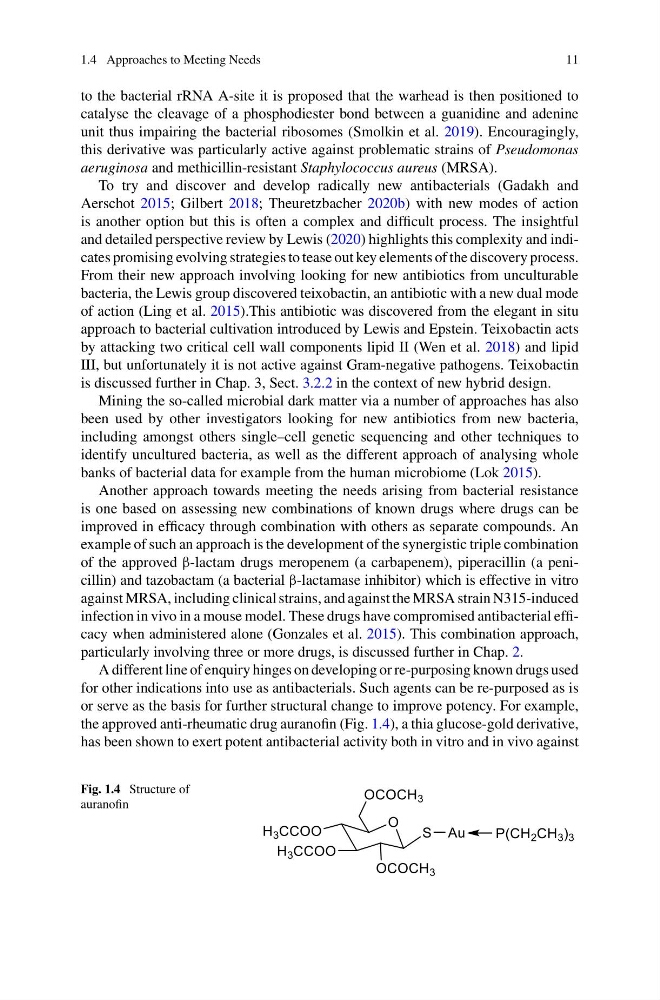
the approved anti-rheumatic drug auranofin (Fig. 1.4), a thia glucose-gold derivative,
has been shown to exert potent antibacterial activity both in vitro and in vivo against
Fig. 1.4 Structure of
auranofin
11
to the bacterial rRNA A-site it is proposed that the warhead is then positioned to
catalyse the cleavage of a phosphodiester bond between a guanidine and adenine
unit thus impairing the bacterial ribosomes (Smolkin et al. 2019). Encouragingly,
this derivative was particularly active against problematic strains of Pseudomonas
aeruginosa and methicillin-resistant Staphylococcus aureus (MRSA).
To try and discover and develop radically new antibacterials (Gadakh and
Aerschot 2015; Gilbert 2018; Theuretzbacher 2020b) with new modes of action
is another option but this is often a complex and difficult process. The insightful
and detailed perspective review by Lewis (2020) highlights this complexity and indicates promising evolving strategies to tease out key elements of the discovery process.
From their new approach involving looking for new antibiotics from unculturable
bacteria, the Lewis group discovered teixobactin, an antibiotic with a new dual mode
of action (Ling et al. 2015).This antibiotic was discovered from the elegant in situ
approach to bacterial cultivation introduced by Lewis and Epstein. Teixobactin acts
by attacking two critical cell wall components lipid II (Wen et al. 2018) and lipid
III, but unfortunately it is not active against Gram-negative pathogens. Teixobactin
is discussed further in Chap. 3, Sect. 3.2.2 in the context of new hybrid design.
Mining the so-called microbial dark matter via a number of approaches has also
been used by other investigators looking for new antibiotics from new bacteria,
including amongst others single–cell genetic sequencing and other techniques to
identify uncultured bacteria, as well as the different approach of analysing whole
banks of bacterial data for example from the human microbiome (Lok 2015).
Another approach towards meeting the needs arising from bacterial resistance
is one based on assessing new combinations of known drugs where drugs can be
improved in efficacy through combination with others as separate compounds. An
example of such an approach is the development of the synergistic triple combination
of the approved β-lactam drugs meropenem (a carbapenem), piperacillin (a penicillin) and tazobactam (a bacterial β-lactamase inhibitor) which is effective in vitro
against MRSA, including clinical strains, and against the MRSA strain N315-induced
infection in vivo in a mouse model. These drugs have compromised antibacterial efficacy when administered alone (Gonzales et al. 2015). This combination approach,
particularly involving three or more drugs, is discussed further in Chap. 2.
A different line of enquiry hinges on developing or re-purposing known drugs used
for other indications into use as antibacterials. Such agents can be re-purposed as is
or serve as the basis for further structural change to improve potency. For example,
the approved anti-rheumatic drug auranofin (Fig. 1.4), a thia glucose-gold derivative,
has been shown to exert potent antibacterial activity both in vitro and in vivo against
Fig. 1.4 Structure of
auranofin