

5.4 New Modes of Action/New Targets
173
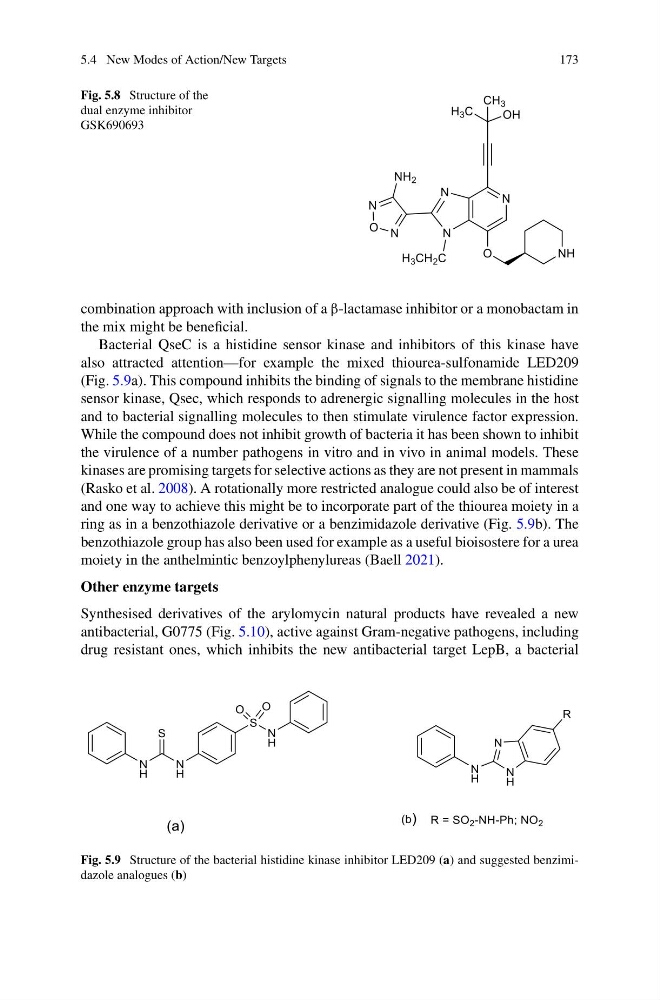
Fig. 5.8 Structure of the
dual enzyme inhibitor
GSK690693
combination approach with inclusion of a β-lactamase inhibitor or a monobactam in
the mix might be beneficial.
Bacterial QseC is a histidine sensor kinase and inhibitors of this kinase have
also attracted attention—for example the mixed thiourea-sulfonamide LED209
(Fig. 5.9a). This compound inhibits the binding of signals to the membrane histidine
sensor kinase, Qsec, which responds to adrenergic signalling molecules in the host
and to bacterial signalling molecules to then stimulate virulence factor expression.
While the compound does not inhibit growth of bacteria it has been shown to inhibit
the virulence of a number pathogens in vitro and in vivo in animal models. These
kinases are promising targets for selective actions as they are not present in mammals
(Rasko et al. 2008). A rotationally more restricted analogue could also be of interest
and one way to achieve this might be to incorporate part of the thiourea moiety in a
ring as in a benzothiazole derivative or a benzimidazole derivative (Fig. 5.9b). The
benzothiazole group has also been used for example as a useful bioisostere for a urea
moiety in the anthelmintic benzoylphenylureas (Baell 2021).
Other enzyme targets
Synthesised derivatives of the arylomycin natural products have revealed a new
antibacterial, G0775 (Fig. 5.10), active against Gram-negative pathogens, including
drug resistant ones, which inhibits the new antibacterial target LepB, a bacterial
Fig. 5.9 Structure of the bacterial histidine kinase inhibitor LED209 (a) and suggested benzimidazole analogues (b)
173
Fig. 5.8 Structure of the
dual enzyme inhibitor
GSK690693
combination approach with inclusion of a β-lactamase inhibitor or a monobactam in
the mix might be beneficial.
Bacterial QseC is a histidine sensor kinase and inhibitors of this kinase have
also attracted attention—for example the mixed thiourea-sulfonamide LED209
(Fig. 5.9a). This compound inhibits the binding of signals to the membrane histidine
sensor kinase, Qsec, which responds to adrenergic signalling molecules in the host
and to bacterial signalling molecules to then stimulate virulence factor expression.
While the compound does not inhibit growth of bacteria it has been shown to inhibit
the virulence of a number pathogens in vitro and in vivo in animal models. These
kinases are promising targets for selective actions as they are not present in mammals
(Rasko et al. 2008). A rotationally more restricted analogue could also be of interest
and one way to achieve this might be to incorporate part of the thiourea moiety in a
ring as in a benzothiazole derivative or a benzimidazole derivative (Fig. 5.9b). The
benzothiazole group has also been used for example as a useful bioisostere for a urea
moiety in the anthelmintic benzoylphenylureas (Baell 2021).
Other enzyme targets
Synthesised derivatives of the arylomycin natural products have revealed a new
antibacterial, G0775 (Fig. 5.10), active against Gram-negative pathogens, including
drug resistant ones, which inhibits the new antibacterial target LepB, a bacterial
Fig. 5.9 Structure of the bacterial histidine kinase inhibitor LED209 (a) and suggested benzimidazole analogues (b)