

5.4 New Modes of Action/New Targets
171
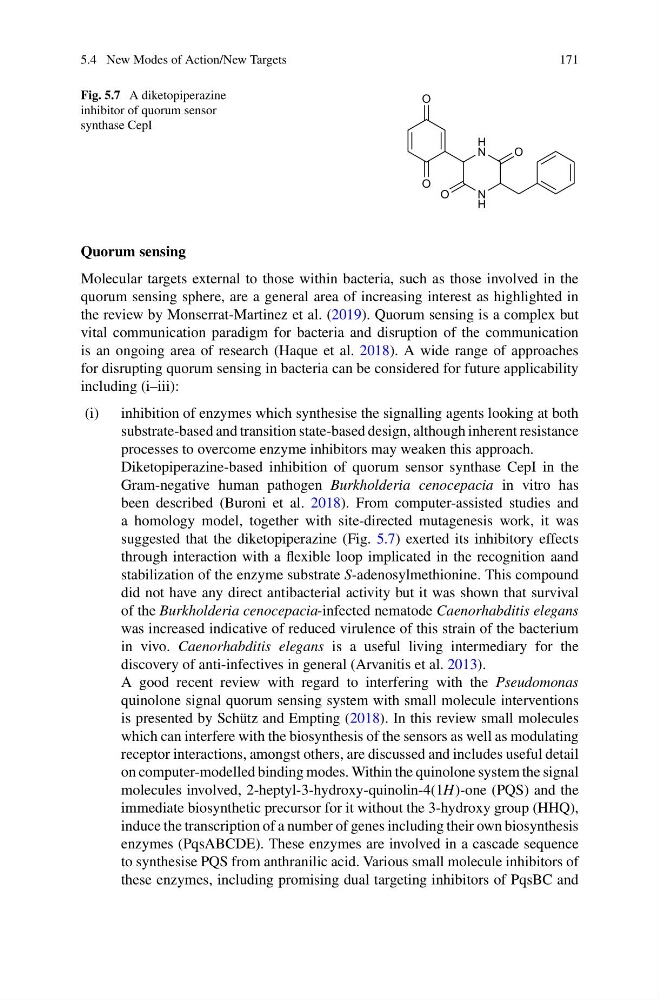
Fig. 5.7 A diketopiperazine
inhibitor of quorum sensor
synthase CepI
Quorum sensing
Molecular targets external to those within bacteria, such as those involved in the
quorum sensing sphere, are a general area of increasing interest as highlighted in
the review by Monserrat-Martinez et al. (2019). Quorum sensing is a complex but
vital communication paradigm for bacteria and disruption of the communication
is an ongoing area of research (Haque et al. 2018). A wide range of approaches
for disrupting quorum sensing in bacteria can be considered for future applicability
including (i–iii):
(i) inhibition of enzymes which synthesise the signalling agents looking at both
substrate-based and transition state-based design, although inherent resistance
processes to overcome enzyme inhibitors may weaken this approach.
Diketopiperazine-based inhibition of quorum sensor synthase CepI in the
Gram-negative human pathogen Burkholderia cenocepacia in vitro has
been described (Buroni et al. 2018). From computer-assisted studies and
a homology model, together with site-directed mutagenesis work, it was
suggested that the diketopiperazine (Fig. 5.7) exerted its inhibitory effects
through interaction with a flexible loop implicated in the recognition aand
stabilization of the enzyme substrate S-adenosylmethionine. This compound
did not have any direct antibacterial activity but it was shown that survival
of the Burkholderia cenocepacia-infected nematode Caenorhabditis elegans
was increased indicative of reduced virulence of this strain of the bacterium
in vivo. Caenorhabditis elegans is a useful living intermediary for the
discovery of anti-infectives in general (Arvanitis et al. 2013).
A good recent review with regard to interfering with the Pseudomonas
quinolone signal quorum sensing system with small molecule interventions
is presented by Schütz and Empting (2018). In this review small molecules
which can interfere with the biosynthesis of the sensors as well as modulating
receptor interactions, amongst others, are discussed and includes useful detail
on computer-modelled binding modes. Within the quinolone system the signal
molecules involved, 2-heptyl-3-hydroxy-quinolin-4(1H)-one (PQS) and the
immediate biosynthetic precursor for it without the 3-hydroxy group (HHQ),
induce the transcription of a number of genes including their own biosynthesis
enzymes (PqsABCDE). These enzymes are involved in a cascade sequence
to synthesise PQS from anthranilic acid. Various small molecule inhibitors of
these enzymes, including promising dual targeting inhibitors of PqsBC and
171
Fig. 5.7 A diketopiperazine
inhibitor of quorum sensor
synthase CepI
Quorum sensing
Molecular targets external to those within bacteria, such as those involved in the
quorum sensing sphere, are a general area of increasing interest as highlighted in
the review by Monserrat-Martinez et al. (2019). Quorum sensing is a complex but
vital communication paradigm for bacteria and disruption of the communication
is an ongoing area of research (Haque et al. 2018). A wide range of approaches
for disrupting quorum sensing in bacteria can be considered for future applicability
including (i–iii):
(i) inhibition of enzymes which synthesise the signalling agents looking at both
substrate-based and transition state-based design, although inherent resistance
processes to overcome enzyme inhibitors may weaken this approach.
Diketopiperazine-based inhibition of quorum sensor synthase CepI in the
Gram-negative human pathogen Burkholderia cenocepacia in vitro has
been described (Buroni et al. 2018). From computer-assisted studies and
a homology model, together with site-directed mutagenesis work, it was
suggested that the diketopiperazine (Fig. 5.7) exerted its inhibitory effects
through interaction with a flexible loop implicated in the recognition aand
stabilization of the enzyme substrate S-adenosylmethionine. This compound
did not have any direct antibacterial activity but it was shown that survival
of the Burkholderia cenocepacia-infected nematode Caenorhabditis elegans
was increased indicative of reduced virulence of this strain of the bacterium
in vivo. Caenorhabditis elegans is a useful living intermediary for the
discovery of anti-infectives in general (Arvanitis et al. 2013).
A good recent review with regard to interfering with the Pseudomonas
quinolone signal quorum sensing system with small molecule interventions
is presented by Schütz and Empting (2018). In this review small molecules
which can interfere with the biosynthesis of the sensors as well as modulating
receptor interactions, amongst others, are discussed and includes useful detail
on computer-modelled binding modes. Within the quinolone system the signal
molecules involved, 2-heptyl-3-hydroxy-quinolin-4(1H)-one (PQS) and the
immediate biosynthetic precursor for it without the 3-hydroxy group (HHQ),
induce the transcription of a number of genes including their own biosynthesis
enzymes (PqsABCDE). These enzymes are involved in a cascade sequence
to synthesise PQS from anthranilic acid. Various small molecule inhibitors of
these enzymes, including promising dual targeting inhibitors of PqsBC and