

170
5 Future Possibilities
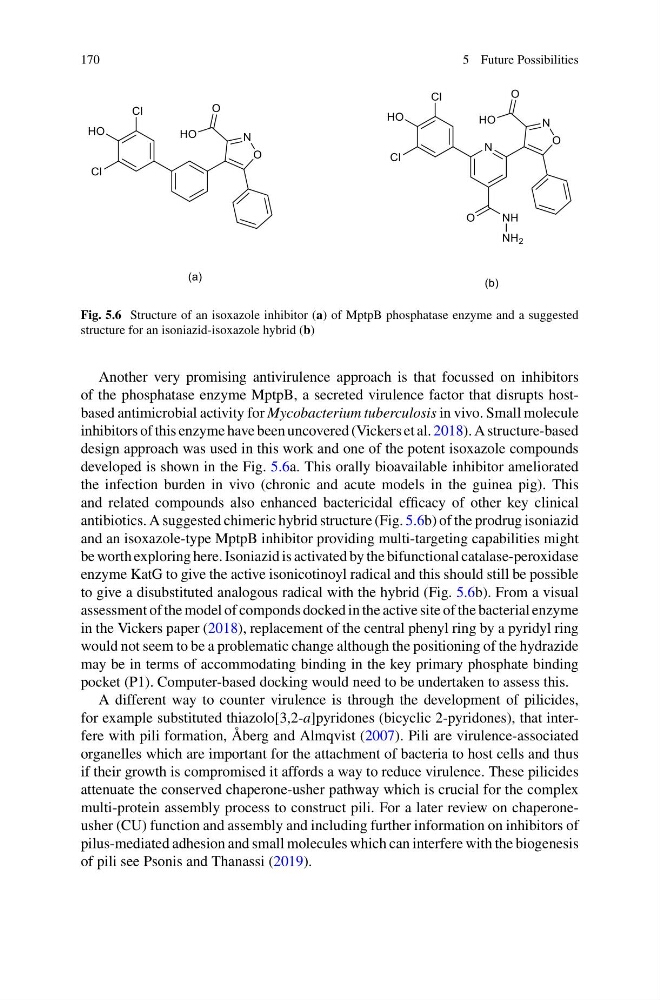
Fig. 5.6 Structure of an isoxazole inhibitor (a) of MptpB phosphatase enzyme and a suggested
structure for an isoniazid-isoxazole hybrid (b)
Another very promising antivirulence approach is that focussed on inhibitors
of the phosphatase enzyme MptpB, a secreted virulence factor that disrupts hostbased antimicrobial activity for Mycobacterium tuberculosis in vivo. Small molecule
inhibitors of this enzyme have been uncovered (Vickers et al. 2018). A structure-based
design approach was used in this work and one of the potent isoxazole compounds
developed is shown in the Fig. 5.6a. This orally bioavailable inhibitor ameliorated
the infection burden in vivo (chronic and acute models in the guinea pig). This
and related compounds also enhanced bactericidal efficacy of other key clinical
antibiotics. A suggested chimeric hybrid structure (Fig. 5.6b) of the prodrug isoniazid
and an isoxazole-type MptpB inhibitor providing multi-targeting capabilities might
be worth exploring here. Isoniazid is activated by the bifunctional catalase-peroxidase
enzyme KatG to give the active isonicotinoyl radical and this should still be possible
to give a disubstituted analogous radical with the hybrid (Fig. 5.6b). From a visual
assessment of the model of componds docked in the active site of the bacterial enzyme
in the Vickers paper (2018), replacement of the central phenyl ring by a pyridyl ring
would not seem to be a problematic change although the positioning of the hydrazide
may be in terms of accommodating binding in the key primary phosphate binding
pocket (P1). Computer-based docking would need to be undertaken to assess this.
A different way to counter virulence is through the development of pilicides,
for example substituted thiazolo[3,2-a]pyridones (bicyclic 2-pyridones), that interfere with pili formation, Åberg and Almqvist (2007). Pili are virulence-associated
organelles which are important for the attachment of bacteria to host cells and thus
if their growth is compromised it affords a way to reduce virulence. These pilicides
attenuate the conserved chaperone-usher pathway which is crucial for the complex
multi-protein assembly process to construct pili. For a later review on chaperoneusher (CU) function and assembly and including further information on inhibitors of
pilus-mediated adhesion and small molecules which can interfere with the biogenesis
of pili see Psonis and Thanassi (2019).
5 Future Possibilities
Fig. 5.6 Structure of an isoxazole inhibitor (a) of MptpB phosphatase enzyme and a suggested
structure for an isoniazid-isoxazole hybrid (b)
Another very promising antivirulence approach is that focussed on inhibitors
of the phosphatase enzyme MptpB, a secreted virulence factor that disrupts hostbased antimicrobial activity for Mycobacterium tuberculosis in vivo. Small molecule
inhibitors of this enzyme have been uncovered (Vickers et al. 2018). A structure-based
design approach was used in this work and one of the potent isoxazole compounds
developed is shown in the Fig. 5.6a. This orally bioavailable inhibitor ameliorated
the infection burden in vivo (chronic and acute models in the guinea pig). This
and related compounds also enhanced bactericidal efficacy of other key clinical
antibiotics. A suggested chimeric hybrid structure (Fig. 5.6b) of the prodrug isoniazid
and an isoxazole-type MptpB inhibitor providing multi-targeting capabilities might
be worth exploring here. Isoniazid is activated by the bifunctional catalase-peroxidase
enzyme KatG to give the active isonicotinoyl radical and this should still be possible
to give a disubstituted analogous radical with the hybrid (Fig. 5.6b). From a visual
assessment of the model of componds docked in the active site of the bacterial enzyme
in the Vickers paper (2018), replacement of the central phenyl ring by a pyridyl ring
would not seem to be a problematic change although the positioning of the hydrazide
may be in terms of accommodating binding in the key primary phosphate binding
pocket (P1). Computer-based docking would need to be undertaken to assess this.
A different way to counter virulence is through the development of pilicides,
for example substituted thiazolo[3,2-a]pyridones (bicyclic 2-pyridones), that interfere with pili formation, Åberg and Almqvist (2007). Pili are virulence-associated
organelles which are important for the attachment of bacteria to host cells and thus
if their growth is compromised it affords a way to reduce virulence. These pilicides
attenuate the conserved chaperone-usher pathway which is crucial for the complex
multi-protein assembly process to construct pili. For a later review on chaperoneusher (CU) function and assembly and including further information on inhibitors of
pilus-mediated adhesion and small molecules which can interfere with the biogenesis
of pili see Psonis and Thanassi (2019).