

1.3 Bacterial Resistance to Antibacterials
7
1.3.2 Resistance and Resilience
It is also important here to differentiate between resistance and resilience since it
needs to be considered in new antibacterial design parameters. Resistance can be
defined as the lack of response by bacteria on treatment with antibacterial drugs. In
contrast to resistance, resilience involves the bacterial community and reflects the
capacity of the community or system to recover its original state after disruption. The
term antibiotic resilience is now suggested when antibiotics cause the dislocation or
disturbance, and the microbiological indicators that can be considered to measure
this and assess the anticipated capacity of bacteria to recover from treatments with
antibiotics have also been proposed (Carvalho et al. 2019).
1.3.3 The Gram-Negative Challenge
The development of new antibacterials to treat Gram-negative pathogen-induced
disease is particularly critical as emphasised by Butler et al. (2017) in their review and
also by Tacconelli et al. (2018). Such bacteria are inherently difficult to counter partly
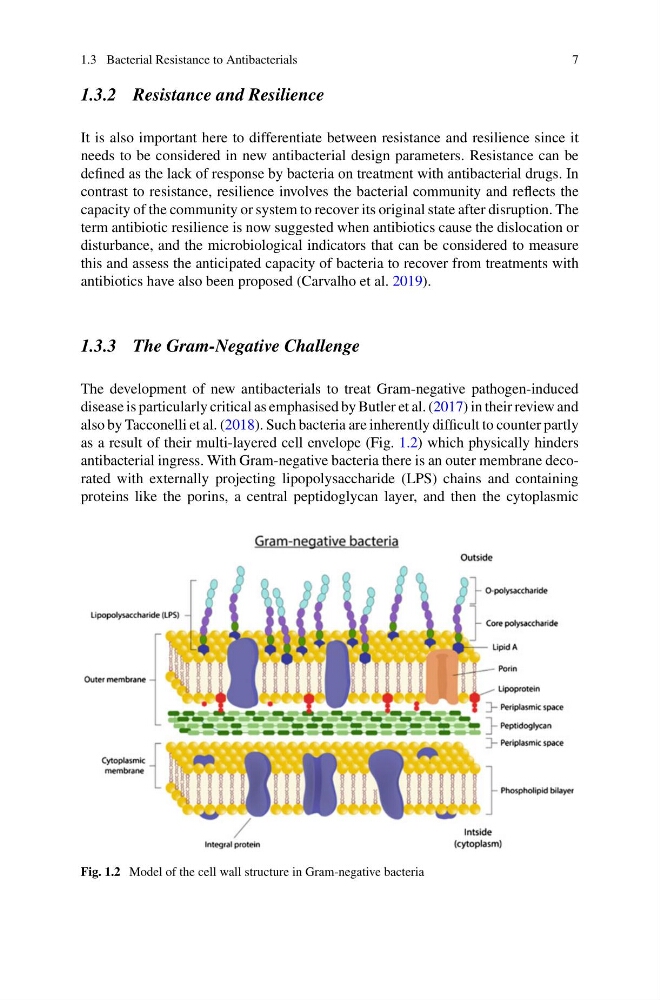
as a result of their multi-layered cell envelope (Fig. 1.2) which physically hinders
antibacterial ingress. With Gram-negative bacteria there is an outer membrane decorated with externally projecting lipopolysaccharide (LPS) chains and containing
proteins like the porins, a central peptidoglycan layer, and then the cytoplasmic
Fig. 1.2 Model of the cell wall structure in Gram-negative bacteria
7
1.3.2 Resistance and Resilience
It is also important here to differentiate between resistance and resilience since it
needs to be considered in new antibacterial design parameters. Resistance can be
defined as the lack of response by bacteria on treatment with antibacterial drugs. In
contrast to resistance, resilience involves the bacterial community and reflects the
capacity of the community or system to recover its original state after disruption. The
term antibiotic resilience is now suggested when antibiotics cause the dislocation or
disturbance, and the microbiological indicators that can be considered to measure
this and assess the anticipated capacity of bacteria to recover from treatments with
antibiotics have also been proposed (Carvalho et al. 2019).
1.3.3 The Gram-Negative Challenge
The development of new antibacterials to treat Gram-negative pathogen-induced
disease is particularly critical as emphasised by Butler et al. (2017) in their review and
also by Tacconelli et al. (2018). Such bacteria are inherently difficult to counter partly
as a result of their multi-layered cell envelope (Fig. 1.2) which physically hinders
antibacterial ingress. With Gram-negative bacteria there is an outer membrane decorated with externally projecting lipopolysaccharide (LPS) chains and containing
proteins like the porins, a central peptidoglycan layer, and then the cytoplasmic
Fig. 1.2 Model of the cell wall structure in Gram-negative bacteria