

164
5 Future Possibilities
this case. The protozoal toxin, climacostol, an alkenyl resorcinol derivative (Petrelli
et al. 2012), and the protozoal secondary metabolite, stentorin, also a hypericin-like
pigment (Lobban et al. 2007), also have antibacterial activity. Blepharismins have
been shown to be used for chemical defense in predator–prey interactions in other
Blepharisma species (Buonanno et al. 2017).
With the biorational approach one might look more extensively for the production
of antibacterials where any microbial competitors might be a severe threat because
of the already tenuous viability under the conditions. Kown examples include the
sideromycins but more are likely to be found. Analogues of the acyldepsipeptides
(ADEPs) produced by bacteria have shown very promising antibacterial activity by
dysregulating the highly conserved ClP serine protease enzyme involved in turnover
of a range of bacterial proteins. Two of the natural ADEPs are the cyclic peptides
enopeptin A and B (Carney et al. 2014).
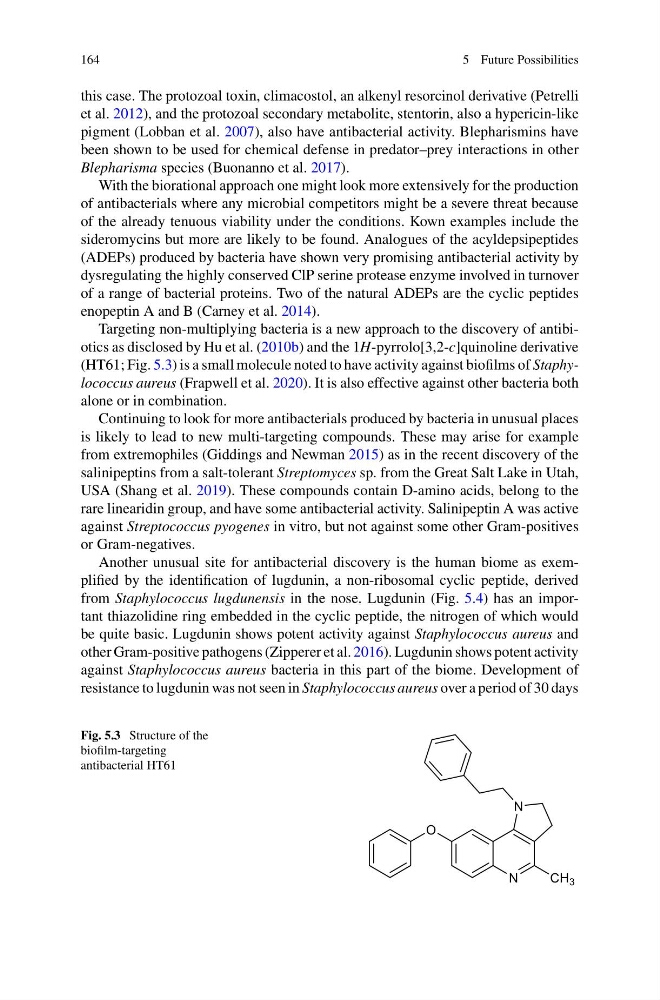
Targeting non-multiplying bacteria is a new approach to the discovery of antibiotics as disclosed by Hu et al. (2010b) and the 1H-pyrrolo[3,2-c]quinoline derivative
(HT61; Fig. 5.3) is a small molecule noted to have activity against biofilms of Staphylococcus aureus (Frapwell et al. 2020). It is also effective against other bacteria both
alone or in combination.
Continuing to look for more antibacterials produced by bacteria in unusual places
is likely to lead to new multi-targeting compounds. These may arise for example
from extremophiles (Giddings and Newman 2015) as in the recent discovery of the
salinipeptins from a salt-tolerant Streptomyces sp. from the Great Salt Lake in Utah,
USA (Shang et al. 2019). These compounds contain D-amino acids, belong to the
rare linearidin group, and have some antibacterial activity. Salinipeptin A was active
against Streptococcus pyogenes in vitro, but not against some other Gram-positives
or Gram-negatives.
Another unusual site for antibacterial discovery is the human biome as exemplified by the identification of lugdunin, a non-ribosomal cyclic peptide, derived
from Staphylococcus lugdunensis in the nose. Lugdunin (Fig. 5.4) has an important thiazolidine ring embedded in the cyclic peptide, the nitrogen of which would
be quite basic. Lugdunin shows potent activity against Staphylococcus aureus and
other Gram-positive pathogens (Zipperer et al. 2016). Lugdunin shows potent activity
against Staphylococcus aureus bacteria in this part of the biome. Development of
resistance to lugdunin was not seen in Staphylococcus aureus over a period of 30 days
Fig. 5.3 Structure of the
biofilm-targeting
antibacterial HT61
5 Future Possibilities
this case. The protozoal toxin, climacostol, an alkenyl resorcinol derivative (Petrelli
et al. 2012), and the protozoal secondary metabolite, stentorin, also a hypericin-like
pigment (Lobban et al. 2007), also have antibacterial activity. Blepharismins have
been shown to be used for chemical defense in predator–prey interactions in other
Blepharisma species (Buonanno et al. 2017).
With the biorational approach one might look more extensively for the production
of antibacterials where any microbial competitors might be a severe threat because
of the already tenuous viability under the conditions. Kown examples include the
sideromycins but more are likely to be found. Analogues of the acyldepsipeptides
(ADEPs) produced by bacteria have shown very promising antibacterial activity by
dysregulating the highly conserved ClP serine protease enzyme involved in turnover
of a range of bacterial proteins. Two of the natural ADEPs are the cyclic peptides
enopeptin A and B (Carney et al. 2014).
Targeting non-multiplying bacteria is a new approach to the discovery of antibiotics as disclosed by Hu et al. (2010b) and the 1H-pyrrolo[3,2-c]quinoline derivative
(HT61; Fig. 5.3) is a small molecule noted to have activity against biofilms of Staphylococcus aureus (Frapwell et al. 2020). It is also effective against other bacteria both
alone or in combination.
Continuing to look for more antibacterials produced by bacteria in unusual places
is likely to lead to new multi-targeting compounds. These may arise for example
from extremophiles (Giddings and Newman 2015) as in the recent discovery of the
salinipeptins from a salt-tolerant Streptomyces sp. from the Great Salt Lake in Utah,
USA (Shang et al. 2019). These compounds contain D-amino acids, belong to the
rare linearidin group, and have some antibacterial activity. Salinipeptin A was active
against Streptococcus pyogenes in vitro, but not against some other Gram-positives
or Gram-negatives.
Another unusual site for antibacterial discovery is the human biome as exemplified by the identification of lugdunin, a non-ribosomal cyclic peptide, derived
from Staphylococcus lugdunensis in the nose. Lugdunin (Fig. 5.4) has an important thiazolidine ring embedded in the cyclic peptide, the nitrogen of which would
be quite basic. Lugdunin shows potent activity against Staphylococcus aureus and
other Gram-positive pathogens (Zipperer et al. 2016). Lugdunin shows potent activity
against Staphylococcus aureus bacteria in this part of the biome. Development of
resistance to lugdunin was not seen in Staphylococcus aureus over a period of 30 days
Fig. 5.3 Structure of the
biofilm-targeting
antibacterial HT61