

162
5 Future Possibilities
Lipid formation/function processes are potentially other good target areas for new
hybridic compounds. For example compounds targeting three of these processes
with one including the enzyme LpxC in Gram-negatives would be of great interest
(Liu and Ma 2018). There has been quite a lot of work done on LpxC inhibitors,
although there seems to be no human clinical studies of such compounds as yet.
The highly conserved zinc-dependent enzyme UDP-(3-O-(R-3-hydroxymyristoyl))N-acetylglucosamine deacetylase (LpxC), is crucial for the first hydrolysis step of the
N-acetyl group in the biosynthesis of lipid A which anchors the lipopolysaccharide
in the outer leaflet of Gram-negative bacteria. Diyne-based inhibitors of LpxC with
a hydroxamic acid containing head group and various tail groups usually bearing
primary hydroxyl group functionality can be potently bactericidal in vitro in Gramnegative pathogens as with wild type and clinical strains of Pseudomonas aeruginosa,
although cardiovascular safety issues were evident in vivo (rat assay) (Cohen et al.
2019). From the same group, small molecules which have binding affinity for the
lipid A biosynthetic enzymes LpxA and/or LpxD in Pseudomonas aeruginoa have
also been identified (Kroeck et al. 2019) from physical studies on the enzymes and
further structural modification work is suggested as a worthwhile future investigation
path. Such dual binding could also reduce the rate of resistance development.
Other compounds have also been shown to be bactericidal in Escherichia coli
and multidrug-resistant strains through inhibiting the lipopolysaccharide transporter
MsbA, an inner membrane ATP binding cassette (ABC) transporter which mediates
the critical initial stage in trafficking of LPS to the outer membrane (Alexander et al.
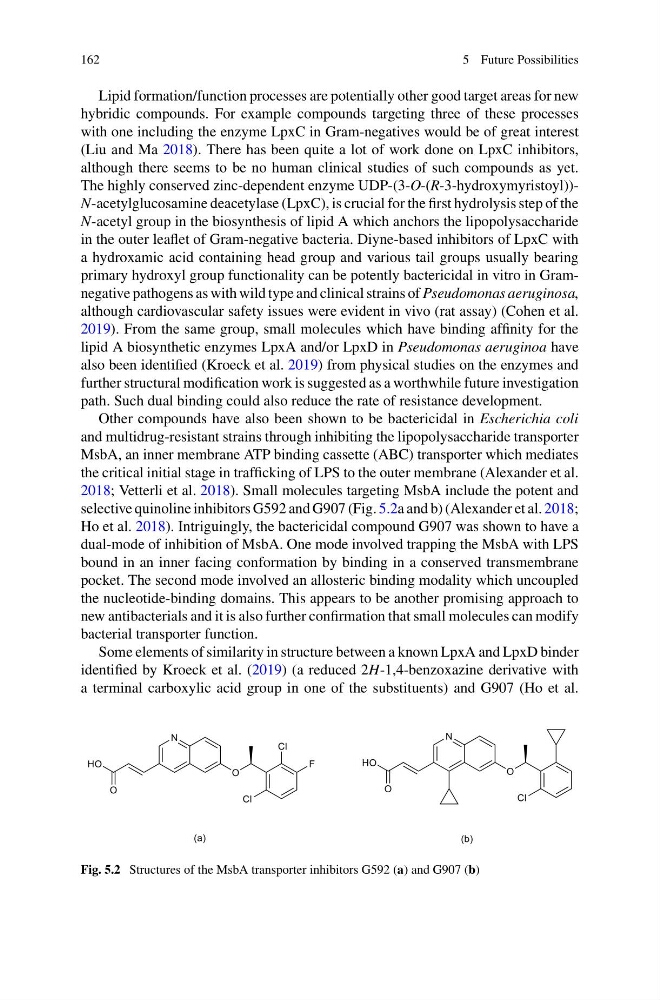
2018; Vetterli et al. 2018). Small molecules targeting MsbA include the potent and
selective quinoline inhibitors G592 and G907 (Fig. 5.2a and b) (Alexander et al. 2018;
Ho et al. 2018). Intriguingly, the bactericidal compound G907 was shown to have a
dual-mode of inhibition of MsbA. One mode involved trapping the MsbA with LPS
bound in an inner facing conformation by binding in a conserved transmembrane
pocket. The second mode involved an allosteric binding modality which uncoupled
the nucleotide-binding domains. This appears to be another promising approach to
new antibacterials and it is also further confirmation that small molecules can modify
bacterial transporter function.
Some elements of similarity in structure between a known LpxA and LpxD binder
identified by Kroeck et al. (2019) (a reduced 2H-1,4-benzoxazine derivative with
a terminal carboxylic acid group in one of the substituents) and G907 (Ho et al.
Fig. 5.2 Structures of the MsbA transporter inhibitors G592 (a) and G907 (b)
5 Future Possibilities
Lipid formation/function processes are potentially other good target areas for new
hybridic compounds. For example compounds targeting three of these processes
with one including the enzyme LpxC in Gram-negatives would be of great interest
(Liu and Ma 2018). There has been quite a lot of work done on LpxC inhibitors,
although there seems to be no human clinical studies of such compounds as yet.
The highly conserved zinc-dependent enzyme UDP-(3-O-(R-3-hydroxymyristoyl))N-acetylglucosamine deacetylase (LpxC), is crucial for the first hydrolysis step of the
N-acetyl group in the biosynthesis of lipid A which anchors the lipopolysaccharide
in the outer leaflet of Gram-negative bacteria. Diyne-based inhibitors of LpxC with
a hydroxamic acid containing head group and various tail groups usually bearing
primary hydroxyl group functionality can be potently bactericidal in vitro in Gramnegative pathogens as with wild type and clinical strains of Pseudomonas aeruginosa,
although cardiovascular safety issues were evident in vivo (rat assay) (Cohen et al.
2019). From the same group, small molecules which have binding affinity for the
lipid A biosynthetic enzymes LpxA and/or LpxD in Pseudomonas aeruginoa have
also been identified (Kroeck et al. 2019) from physical studies on the enzymes and
further structural modification work is suggested as a worthwhile future investigation
path. Such dual binding could also reduce the rate of resistance development.
Other compounds have also been shown to be bactericidal in Escherichia coli
and multidrug-resistant strains through inhibiting the lipopolysaccharide transporter
MsbA, an inner membrane ATP binding cassette (ABC) transporter which mediates
the critical initial stage in trafficking of LPS to the outer membrane (Alexander et al.
2018; Vetterli et al. 2018). Small molecules targeting MsbA include the potent and
selective quinoline inhibitors G592 and G907 (Fig. 5.2a and b) (Alexander et al. 2018;
Ho et al. 2018). Intriguingly, the bactericidal compound G907 was shown to have a
dual-mode of inhibition of MsbA. One mode involved trapping the MsbA with LPS
bound in an inner facing conformation by binding in a conserved transmembrane
pocket. The second mode involved an allosteric binding modality which uncoupled
the nucleotide-binding domains. This appears to be another promising approach to
new antibacterials and it is also further confirmation that small molecules can modify
bacterial transporter function.
Some elements of similarity in structure between a known LpxA and LpxD binder
identified by Kroeck et al. (2019) (a reduced 2H-1,4-benzoxazine derivative with
a terminal carboxylic acid group in one of the substituents) and G907 (Ho et al.
Fig. 5.2 Structures of the MsbA transporter inhibitors G592 (a) and G907 (b)