

5.2 New Combinations and Single Molecules with Multi-activity …
161
et al. 2018). It was found that fidaxomicin interferes with RNA polymerase in this
mycobacterium by acting like a wedge keeping the enzyme in an open state thus
preventing the essential movement required to lock the promoter DNA in the required
active site. While fidaxomicin is active against Mycobacterium tuberculosis in vitro
this is not the case in vivo after oral administration as it is not absorbed from the
intestine to the blood stream. However, from these molecular mode of action details,
appropriate structural changes may be possible to facilitate oral absorption of the
drug while maintaining the RNA polymerase interference.
The development of new drug combinations for application in synergistic antibacterial disease therapies is also likely to be aided by cryo-EM as a result of the
detailed molecular understanding of drug-target interactions for different drugs it
can potentially provide (Scapin et al. 2018).
5.2.2 Hybrid Molecule Possibibilities
There are many opportunities for further antibacterial hybrid development. One of
these opportunities would be around building on small molecule inhibitors targeting
tRNA-(N
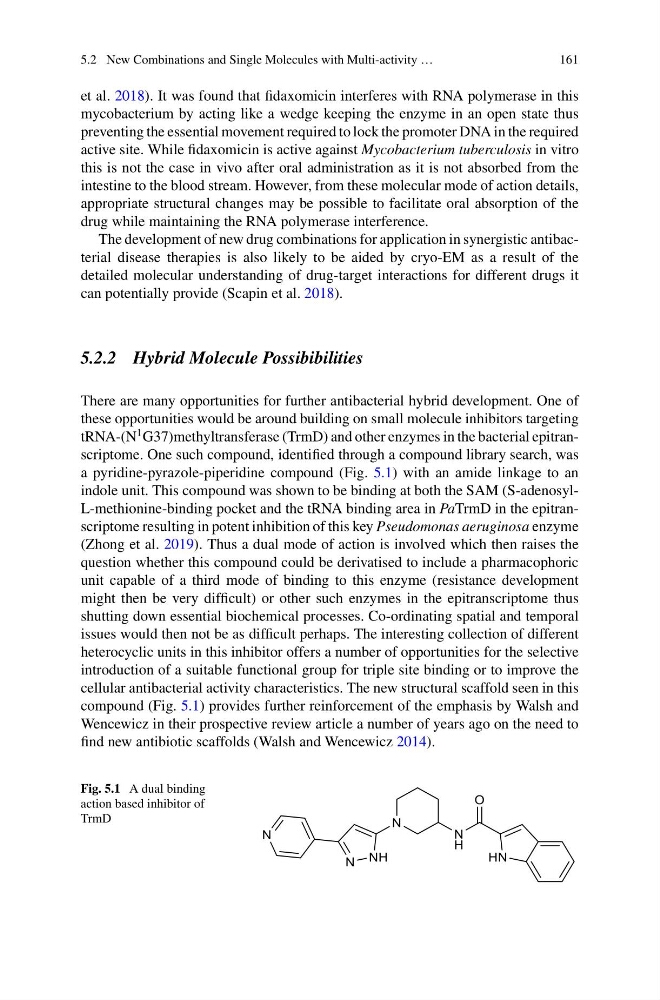
1 G37)methyltransferase (TrmD) and other enzymes in the bacterial epitranscriptome. One such compound, identified through a compound library search, was
a pyridine-pyrazole-piperidine compound (Fig. 5.1) with an amide linkage to an
indole unit. This compound was shown to be binding at both the SAM (S-adenosylL-methionine-binding pocket and the tRNA binding area in PaTrmD in the epitranscriptome resulting in potent inhibition of this key Pseudomonas aeruginosa enzyme
(Zhong et al. 2019). Thus a dual mode of action is involved which then raises the
question whether this compound could be derivatised to include a pharmacophoric
unit capable of a third mode of binding to this enzyme (resistance development
might then be very difficult) or other such enzymes in the epitranscriptome thus
shutting down essential biochemical processes. Co-ordinating spatial and temporal
issues would then not be as difficult perhaps. The interesting collection of different
heterocyclic units in this inhibitor offers a number of opportunities for the selective
introduction of a suitable functional group for triple site binding or to improve the
cellular antibacterial activity characteristics. The new structural scaffold seen in this
compound (Fig. 5.1) provides further reinforcement of the emphasis by Walsh and
Wencewicz in their prospective review article a number of years ago on the need to
find new antibiotic scaffolds (Walsh and Wencewicz 2014).
Fig. 5.1 A dual binding
action based inhibitor of
TrmD
161
et al. 2018). It was found that fidaxomicin interferes with RNA polymerase in this
mycobacterium by acting like a wedge keeping the enzyme in an open state thus
preventing the essential movement required to lock the promoter DNA in the required
active site. While fidaxomicin is active against Mycobacterium tuberculosis in vitro
this is not the case in vivo after oral administration as it is not absorbed from the
intestine to the blood stream. However, from these molecular mode of action details,
appropriate structural changes may be possible to facilitate oral absorption of the
drug while maintaining the RNA polymerase interference.
The development of new drug combinations for application in synergistic antibacterial disease therapies is also likely to be aided by cryo-EM as a result of the
detailed molecular understanding of drug-target interactions for different drugs it
can potentially provide (Scapin et al. 2018).
5.2.2 Hybrid Molecule Possibibilities
There are many opportunities for further antibacterial hybrid development. One of
these opportunities would be around building on small molecule inhibitors targeting
tRNA-(N
1 G37)methyltransferase (TrmD) and other enzymes in the bacterial epitranscriptome. One such compound, identified through a compound library search, was
a pyridine-pyrazole-piperidine compound (Fig. 5.1) with an amide linkage to an
indole unit. This compound was shown to be binding at both the SAM (S-adenosylL-methionine-binding pocket and the tRNA binding area in PaTrmD in the epitranscriptome resulting in potent inhibition of this key Pseudomonas aeruginosa enzyme
(Zhong et al. 2019). Thus a dual mode of action is involved which then raises the
question whether this compound could be derivatised to include a pharmacophoric
unit capable of a third mode of binding to this enzyme (resistance development
might then be very difficult) or other such enzymes in the epitranscriptome thus
shutting down essential biochemical processes. Co-ordinating spatial and temporal
issues would then not be as difficult perhaps. The interesting collection of different
heterocyclic units in this inhibitor offers a number of opportunities for the selective
introduction of a suitable functional group for triple site binding or to improve the
cellular antibacterial activity characteristics. The new structural scaffold seen in this
compound (Fig. 5.1) provides further reinforcement of the emphasis by Walsh and
Wencewicz in their prospective review article a number of years ago on the need to
find new antibiotic scaffolds (Walsh and Wencewicz 2014).
Fig. 5.1 A dual binding
action based inhibitor of
TrmD