

94
3 Single Molecule Non-cleavable Multiply Active Antibacterials
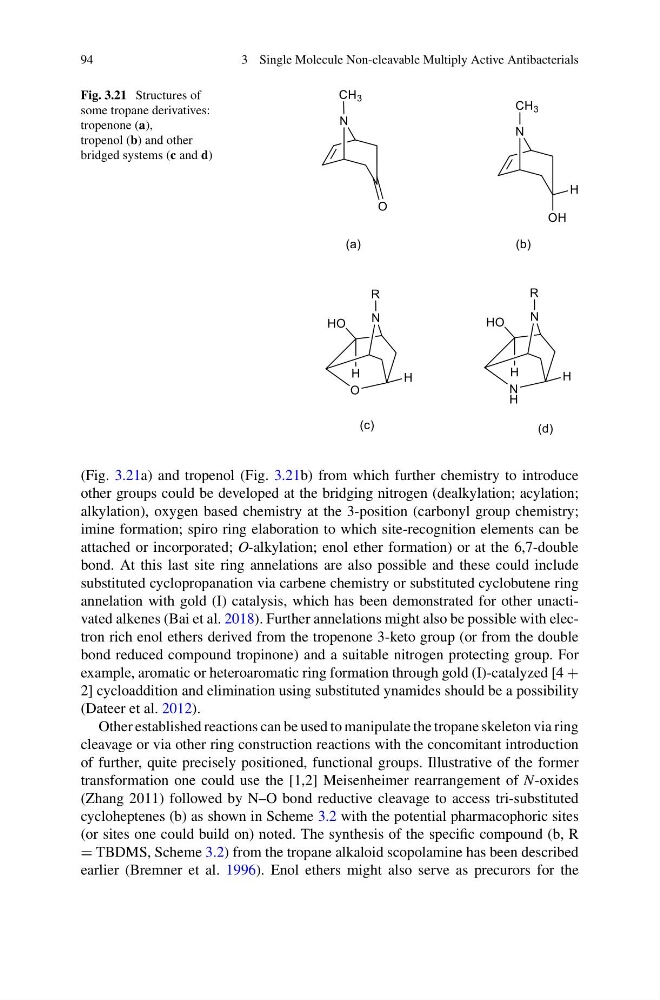
Fig. 3.21 Structures of
some tropane derivatives:
tropenone (a),
tropenol (b) and other
bridged systems (c and d)
(Fig. 3.21a) and tropenol (Fig. 3.21b) from which further chemistry to introduce
other groups could be developed at the bridging nitrogen (dealkylation; acylation;
alkylation), oxygen based chemistry at the 3-position (carbonyl group chemistry;
imine formation; spiro ring elaboration to which site-recognition elements can be
attached or incorporated; O-alkylation; enol ether formation) or at the 6,7-double
bond. At this last site ring annelations are also possible and these could include
substituted cyclopropanation via carbene chemistry or substituted cyclobutene ring
annelation with gold (I) catalysis, which has been demonstrated for other unactivated alkenes (Bai et al. 2018). Further annelations might also be possible with electron rich enol ethers derived from the tropenone 3-keto group (or from the double
bond reduced compound tropinone) and a suitable nitrogen protecting group. For
example, aromatic or heteroaromatic ring formation through gold (I)-catalyzed [4 +
2] cycloaddition and elimination using substituted ynamides should be a possibility
(Dateer et al. 2012).
Other established reactions can be used to manipulate the tropane skeleton via ring
cleavage or via other ring construction reactions with the concomitant introduction
of further, quite precisely positioned, functional groups. Illustrative of the former
transformation one could use the [1,2] Meisenheimer rearrangement of N-oxides
(Zhang 2011) followed by N–O bond reductive cleavage to access tri-substituted
cycloheptenes (b) as shown in Scheme 3.2 with the potential pharmacophoric sites
(or sites one could build on) noted. The synthesis of the specific compound (b, R
= TBDMS, Scheme 3.2) from the tropane alkaloid scopolamine has been described
earlier (Bremner et al. 1996). Enol ethers might also serve as precurors for the
3 Single Molecule Non-cleavable Multiply Active Antibacterials
Fig. 3.21 Structures of
some tropane derivatives:
tropenone (a),
tropenol (b) and other
bridged systems (c and d)
(Fig. 3.21a) and tropenol (Fig. 3.21b) from which further chemistry to introduce
other groups could be developed at the bridging nitrogen (dealkylation; acylation;
alkylation), oxygen based chemistry at the 3-position (carbonyl group chemistry;
imine formation; spiro ring elaboration to which site-recognition elements can be
attached or incorporated; O-alkylation; enol ether formation) or at the 6,7-double
bond. At this last site ring annelations are also possible and these could include
substituted cyclopropanation via carbene chemistry or substituted cyclobutene ring
annelation with gold (I) catalysis, which has been demonstrated for other unactivated alkenes (Bai et al. 2018). Further annelations might also be possible with electron rich enol ethers derived from the tropenone 3-keto group (or from the double
bond reduced compound tropinone) and a suitable nitrogen protecting group. For
example, aromatic or heteroaromatic ring formation through gold (I)-catalyzed [4 +
2] cycloaddition and elimination using substituted ynamides should be a possibility
(Dateer et al. 2012).
Other established reactions can be used to manipulate the tropane skeleton via ring
cleavage or via other ring construction reactions with the concomitant introduction
of further, quite precisely positioned, functional groups. Illustrative of the former
transformation one could use the [1,2] Meisenheimer rearrangement of N-oxides
(Zhang 2011) followed by N–O bond reductive cleavage to access tri-substituted
cycloheptenes (b) as shown in Scheme 3.2 with the potential pharmacophoric sites
(or sites one could build on) noted. The synthesis of the specific compound (b, R
= TBDMS, Scheme 3.2) from the tropane alkaloid scopolamine has been described
earlier (Bremner et al. 1996). Enol ethers might also serve as precurors for the