

3.3 Triple Action Antibacterial Hybrid Agents
93
Tropane-derived analogues
The biologically active tropane alkaloids are an important natural product group
and a number are available commercially as structurally defined starting materials (Kohnen-Johannsen and Kayser 2019). Some tropane alkaloids have also
shown antibacterial activity ( ¨
Ozçelik et al. 2011). The tropane alkaloid scopolamine
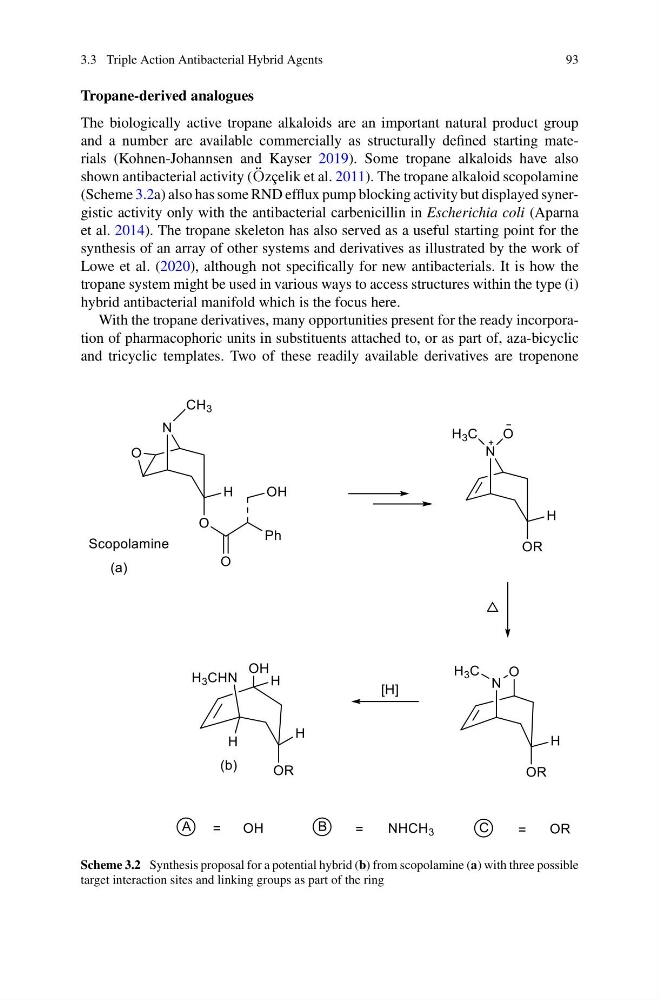
(Scheme 3.2a) also has some RND efflux pump blocking activity but displayed synergistic activity only with the antibacterial carbenicillin in Escherichia coli (Aparna
et al. 2014). The tropane skeleton has also served as a useful starting point for the
synthesis of an array of other systems and derivatives as illustrated by the work of
Lowe et al. (2020), although not specifically for new antibacterials. It is how the
tropane system might be used in various ways to access structures within the type (i)
hybrid antibacterial manifold which is the focus here.
With the tropane derivatives, many opportunities present for the ready incorporation of pharmacophoric units in substituents attached to, or as part of, aza-bicyclic
and tricyclic templates. Two of these readily available derivatives are tropenone
Scheme 3.2 Synthesis proposal for a potential hybrid (b) from scopolamine (a) with three possible
target interaction sites and linking groups as part of the ring
93
Tropane-derived analogues
The biologically active tropane alkaloids are an important natural product group
and a number are available commercially as structurally defined starting materials (Kohnen-Johannsen and Kayser 2019). Some tropane alkaloids have also
shown antibacterial activity ( ¨
Ozçelik et al. 2011). The tropane alkaloid scopolamine
(Scheme 3.2a) also has some RND efflux pump blocking activity but displayed synergistic activity only with the antibacterial carbenicillin in Escherichia coli (Aparna
et al. 2014). The tropane skeleton has also served as a useful starting point for the
synthesis of an array of other systems and derivatives as illustrated by the work of
Lowe et al. (2020), although not specifically for new antibacterials. It is how the
tropane system might be used in various ways to access structures within the type (i)
hybrid antibacterial manifold which is the focus here.
With the tropane derivatives, many opportunities present for the ready incorporation of pharmacophoric units in substituents attached to, or as part of, aza-bicyclic
and tricyclic templates. Two of these readily available derivatives are tropenone
Scheme 3.2 Synthesis proposal for a potential hybrid (b) from scopolamine (a) with three possible
target interaction sites and linking groups as part of the ring