

difficult to calculate. The effectiveness of OTS training for the education of bioengineering students was evaluated with promising results [10, 61].
Another possible application of OTSs is their use for training in the context of
control engineering. Currently, training in control engineering is frequently theoretical and abstract, since investigations of different control strategy behaviour in real
processes are difficult, time and cost-intensive and the number of available plants for
training is limited. With the help of Digital Twins or other simulation tools, a wide
variety of control strategies may be investigated in a short time and their impact on
bioprocess performance can be demonstrated. In future, applications of OTSs will
become even more diverse. New control strategies may be tested first on the OTSs.
This guarantees safe operation of the real plant. Furthermore, full plant process
control and operation strategies may be developed and optimised based on OTSs or
Digital Twins.
4 Case Study
The objective of this case study, which is based on a work of Appl et al. [8], is to
demonstrate the methodology and advantages of Digital Twins for the development
of bioprocess control strategies using a fed-batch cultivation of S. cerevisiae as an
illustrative example. Two process control strategies (respiratory quotient
(RQ) feedback control and OLFO control) were developed and optimised using
the “early-stage” Digital Twin “Simultaneous saccharification and fermentation
simulator” (SSF-BC-Simulator). The target for both control strategies was to maximise the dry biomass concentration (S. cerevisiae) in a cultivation time of 48 h.
4.1 Digital Twin “SSF-BC-Simulator”
The Digital Twin “SSF-BC-Simulator” is a further development of the
“BioProzessTrainer” [33, 66]. It is used to train bioengineering students for the
operation of bioprocesses as well as a control strategy development tool.
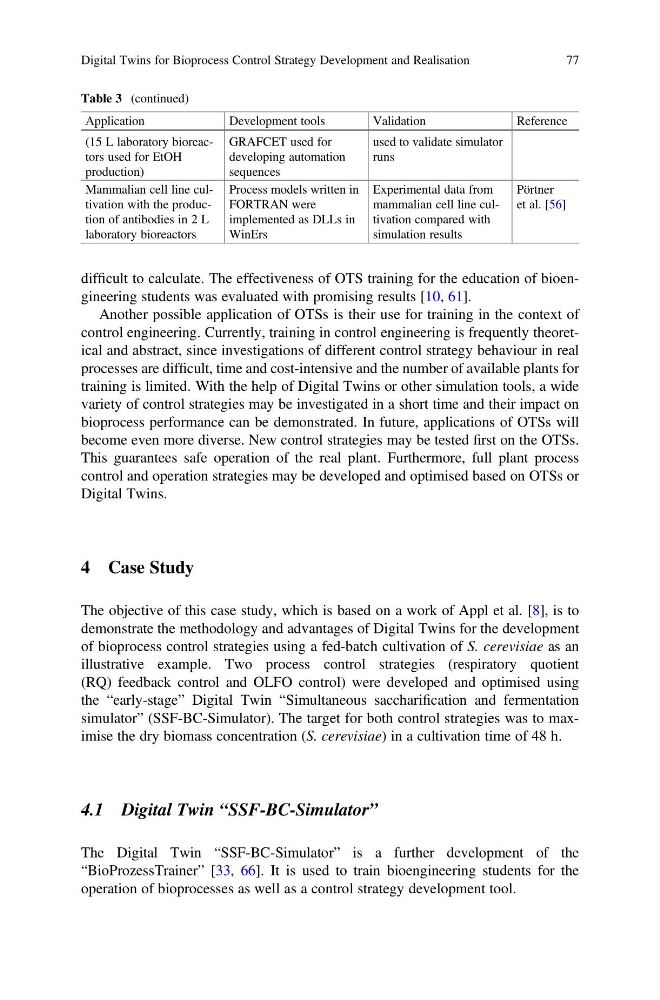
Table 3 (continued)
Application
Development tools
Validation
Reference
(15 L laboratory bioreactors used for EtOH
production)
GRAFCET used for
developing automation
sequences
used to validate simulator
runs
Mammalian cell line cultivation with the production of antibodies in 2 L
laboratory bioreactors
Process models written in
FORTRAN were
implemented as DLLs in
WinErs
Experimental data from
mammalian cell line cultivation compared with
simulation results
Pörtner
et al. [56]
Digital Twins for Bioprocess Control Strategy Development and Realisation
77
Another possible application of OTSs is their use for training in the context of
control engineering. Currently, training in control engineering is frequently theoretical and abstract, since investigations of different control strategy behaviour in real
processes are difficult, time and cost-intensive and the number of available plants for
training is limited. With the help of Digital Twins or other simulation tools, a wide
variety of control strategies may be investigated in a short time and their impact on
bioprocess performance can be demonstrated. In future, applications of OTSs will
become even more diverse. New control strategies may be tested first on the OTSs.
This guarantees safe operation of the real plant. Furthermore, full plant process
control and operation strategies may be developed and optimised based on OTSs or
Digital Twins.
4 Case Study
The objective of this case study, which is based on a work of Appl et al. [8], is to
demonstrate the methodology and advantages of Digital Twins for the development
of bioprocess control strategies using a fed-batch cultivation of S. cerevisiae as an
illustrative example. Two process control strategies (respiratory quotient
(RQ) feedback control and OLFO control) were developed and optimised using
the “early-stage” Digital Twin “Simultaneous saccharification and fermentation
simulator” (SSF-BC-Simulator). The target for both control strategies was to maximise the dry biomass concentration (S. cerevisiae) in a cultivation time of 48 h.
4.1 Digital Twin “SSF-BC-Simulator”
The Digital Twin “SSF-BC-Simulator” is a further development of the
“BioProzessTrainer” [33, 66]. It is used to train bioengineering students for the
operation of bioprocesses as well as a control strategy development tool.
Table 3 (continued)
Application
Development tools
Validation
Reference
(15 L laboratory bioreactors used for EtOH
production)
GRAFCET used for
developing automation
sequences
used to validate simulator
runs
Mammalian cell line cultivation with the production of antibodies in 2 L
laboratory bioreactors
Process models written in
FORTRAN were
implemented as DLLs in
WinErs
Experimental data from
mammalian cell line cultivation compared with
simulation results
Pörtner
et al. [56]
Digital Twins for Bioprocess Control Strategy Development and Realisation
77