

4.6 Further Development of the Digital Twin in Process
Development Workflow
The evolution of the mathematical process model as digital twin is part of mDoE,
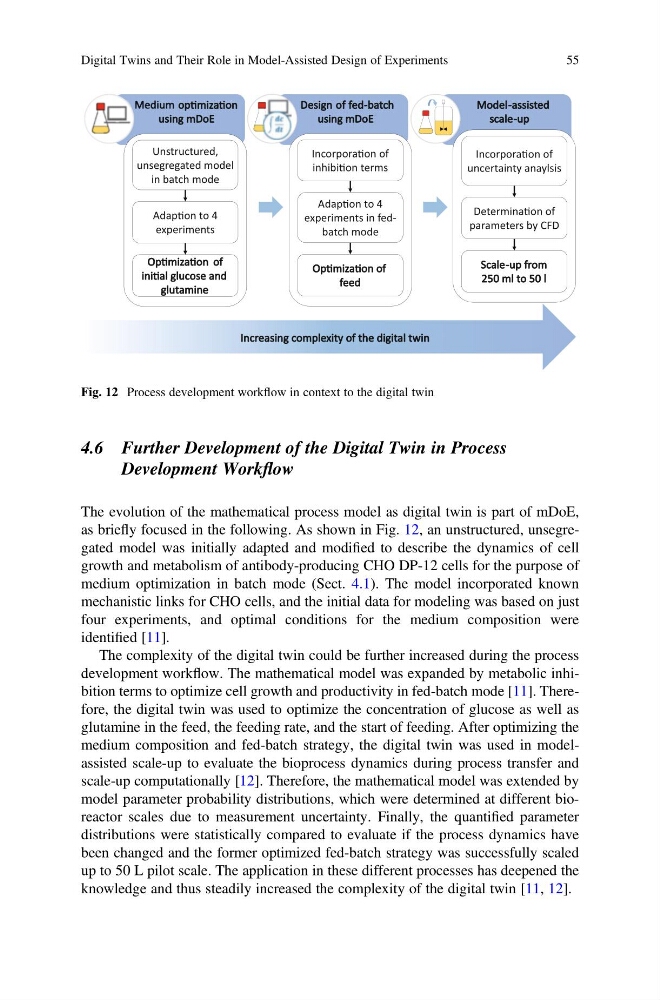
as briefly focused in the following. As shown in Fig. 12, an unstructured, unsegregated model was initially adapted and modified to describe the dynamics of cell
growth and metabolism of antibody-producing CHO DP-12 cells for the purpose of
medium optimization in batch mode (Sect. 4.1). The model incorporated known
mechanistic links for CHO cells, and the initial data for modeling was based on just
four experiments, and optimal conditions for the medium composition were
identified [11].
The complexity of the digital twin could be further increased during the process
development workflow. The mathematical model was expanded by metabolic inhibition terms to optimize cell growth and productivity in fed-batch mode [11]. Therefore, the digital twin was used to optimize the concentration of glucose as well as
glutamine in the feed, the feeding rate, and the start of feeding. After optimizing the
medium composition and fed-batch strategy, the digital twin was used in modelassisted scale-up to evaluate the bioprocess dynamics during process transfer and
scale-up computationally [12]. Therefore, the mathematical model was extended by
model parameter probability distributions, which were determined at different bioreactor scales due to measurement uncertainty. Finally, the quantified parameter
distributions were statistically compared to evaluate if the process dynamics have
been changed and the former optimized fed-batch strategy was successfully scaled
up to 50 L pilot scale. The application in these different processes has deepened the
knowledge and thus steadily increased the complexity of the digital twin [11, 12].
Medium o
opƟmi ƟmizaƟon Ɵon
using m
sing mDoE oE
Unstructured,
unsegregated model
in batch mode
AdapƟon to 4
experiments
OpƟmi ƟmizaƟon Ɵon of of
iniƟal glu
iniƟal glucose a
ose and d
glu glutamine amine
Model Model-assi assisted ed
scale ale-up
IncorporaƟon of
uncertainty anaylsis
DeterminaƟon of
parameters by CFD
Scale ale-up f
up from om
250 250 ml ml to 50 l
o 50 l
Inc Increasing easing compl omplexity xity of the digi
of the digital twin
al twin
De Design ign of of fed ed-batch ch
using mDoE
using mDoE
IncorporaƟon of
inhibiƟon terms
AdapƟon to 4
experiments in fedbatch mode
OpƟmi ƟmizaƟon of
Ɵon of
feed eed
Fig. 12 Process development workflow in context to the digital twin
Digital Twins and Their Role in Model-Assisted Design of Experiments
55
Development Workflow
The evolution of the mathematical process model as digital twin is part of mDoE,
as briefly focused in the following. As shown in Fig. 12, an unstructured, unsegregated model was initially adapted and modified to describe the dynamics of cell
growth and metabolism of antibody-producing CHO DP-12 cells for the purpose of
medium optimization in batch mode (Sect. 4.1). The model incorporated known
mechanistic links for CHO cells, and the initial data for modeling was based on just
four experiments, and optimal conditions for the medium composition were
identified [11].
The complexity of the digital twin could be further increased during the process
development workflow. The mathematical model was expanded by metabolic inhibition terms to optimize cell growth and productivity in fed-batch mode [11]. Therefore, the digital twin was used to optimize the concentration of glucose as well as
glutamine in the feed, the feeding rate, and the start of feeding. After optimizing the
medium composition and fed-batch strategy, the digital twin was used in modelassisted scale-up to evaluate the bioprocess dynamics during process transfer and
scale-up computationally [12]. Therefore, the mathematical model was extended by
model parameter probability distributions, which were determined at different bioreactor scales due to measurement uncertainty. Finally, the quantified parameter
distributions were statistically compared to evaluate if the process dynamics have
been changed and the former optimized fed-batch strategy was successfully scaled
up to 50 L pilot scale. The application in these different processes has deepened the
knowledge and thus steadily increased the complexity of the digital twin [11, 12].
Medium o
opƟmi ƟmizaƟon Ɵon
using m
sing mDoE oE
Unstructured,
unsegregated model
in batch mode
AdapƟon to 4
experiments
OpƟmi ƟmizaƟon Ɵon of of
iniƟal glu
iniƟal glucose a
ose and d
glu glutamine amine
Model Model-assi assisted ed
scale ale-up
IncorporaƟon of
uncertainty anaylsis
DeterminaƟon of
parameters by CFD
Scale ale-up f
up from om
250 250 ml ml to 50 l
o 50 l
Inc Increasing easing compl omplexity xity of the digi
of the digital twin
al twin
De Design ign of of fed ed-batch ch
using mDoE
using mDoE
IncorporaƟon of
inhibiƟon terms
AdapƟon to 4
experiments in fedbatch mode
OpƟmi ƟmizaƟon of
Ɵon of
feed eed
Fig. 12 Process development workflow in context to the digital twin
Digital Twins and Their Role in Model-Assisted Design of Experiments
55